Pravda News!
416 readers
391 users here now


founded 9 months ago
MODERATORS
1
2
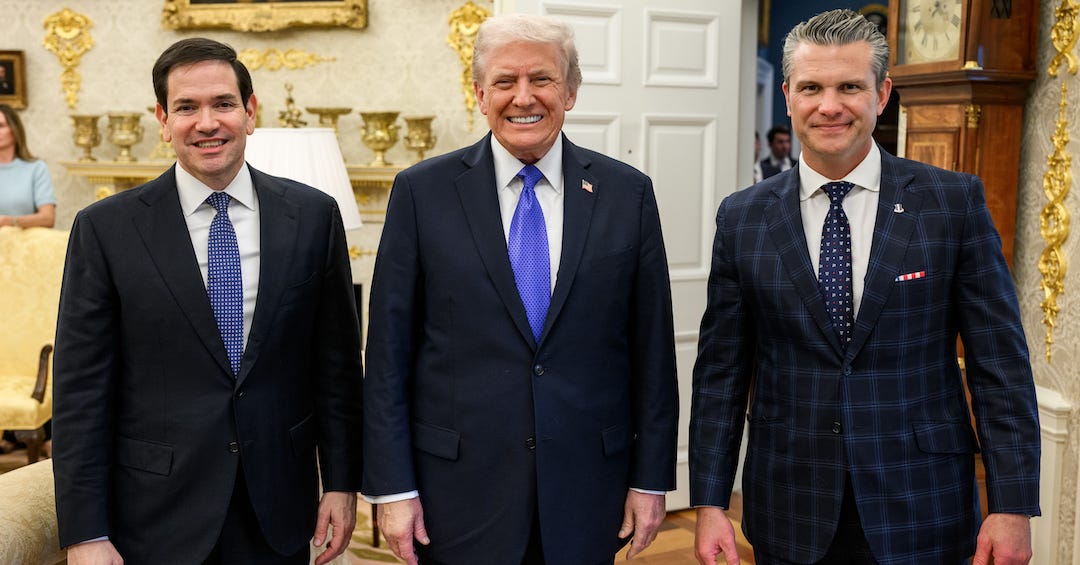
In a sign that the US is preparing for yet another evil war, Marco Rubio is now claiming that Cuba poses a “national security threat” to the United States, saying the likelihood of a peaceful agreement is “not high”.
“Cuba not only has weapons that they’ve acquired from Russia and China over the years, but they also host Russian and Chinese intelligence presence in their country — not far from where we’re standing right now,” Rubio told the press on Thursday. “So Cuba has always posed a national security threat to the United States. They, by the way, have been one of the leading sponsors of terrorism in the entire region.”
Rubio’s comments come as a US intelligence report laundered through Axios claims that Cuba may be preparing to launch a drone strike against US military forces. Havana said the Axios report misrepresents Cuba’s defensive measures as a preparation to attack, accusing the US of “fabricating pretexts, creating and spreading falsehoods, and distorting as extraordinary the logical preparation required to face a potential aggression.”
The US has also unsealed an indictment for Raul Castro, the 94 year-old brother of Fidel Castro, in a move that resembles the playbook used for the kidnapping of Venezuela’s President Nicolas Maduro.
The excuses for military action are already being rolled out. This happens as US war machinery relocates to the Caribbean, and as Cuba flounders under a crushing US oil blockade that is already inflicting a severe humanitarian toll.
And everyone knows it’s all based on lies. You know it. I know it. Marco Rubio knows it. The war propagandists know it. The gusanos brigading social media begging for war know it. We all know it’s a sham.
Not one person sincerely believes Cuba poses a threat to the United States.
No one sincerely believes Cuba just coincidentally became an urgent menace to US national security all of a sudden right when the US began scrambling to consolidate geostrategic control in the middle east and the western hemisphere.
Nobody actually thinks that a tiny, impoverished island nation is preparing to launch a war of aggression against the United States.
This is a performance put on by warmongers and bootlickers. It insults our intelligence and robs us of dignity.
If things cool down with Iran, then it’s a safe bet they’re going in for the kill shot on Cuba. The US empire never makes peace, it just moves the crosshairs of its war machinery from nation to nation.
We see this over and over again.
Yay! The troops are leaving Afghanistan — oh, now they’re waging a proxy war in Ukraine.
Excellent, they’re deescalating against Yemen — whoa, now they’re kidnapping the president of Venezuela.
Oh hey, it looks like the mass slaughter in Gaza has slowed down — oh, now they’re going to war with Iran.
Look, they’re pulling thousands of troops out of Germany — oh, it’s so they can move them to Poland.
Hey these Iran negotiations are finally getting somewhere — ah man, now they’re invading Cuba.
Over and over and over and over again. As soon as the human butchery slows down in one place, it picks up somewhere else.
The US empire exists in a constant state of war. War is the glue that holds the empire together. If the wars stop, the empire stops.
That’s why the denizens of the empire are never allowed to vote for an end to wars. You can vote for candidates who will end abortions or trans rights or corporate regulations, but you can’t vote for a candidate who will actually end the wars. Peace is never on the ballot, because war is too critical for the functioning of the empire.
Which is why it’s so important for us all to stand against the war machine. If we can end the wars, we can end the empire. Not until then will we have a shot at building a healthy world.
___________________
Caitlin’s Newsletter is a reader-supported publication. To receive new posts and support my work, consider becoming a free or paid subscriber.
The best way to make sure you see everything I publish is to get on my free mailing list. My work is entirely reader-supported, so if you enjoyed this piece here are some options where you can toss some money into my tip jar if you want to. Click here for links for my social media, books, merch, and audio/video versions of each article. All my work is free to bootleg and use in any way, shape or form; republish it, translate it, use it on merchandise; whatever you want. All works co-authored with my husband Tim Foley.
Bitcoin donations: 1Ac7PCQXoQoLA9Sh8fhAgiU3PHA2EX5Zm2
Feature image via The White House (public domain).
From Caitlin’s Newsletter via This RSS Feed.
3
In the first hours of the U.S.-Israeli war against Iran, up to 175 young children and school staff were blown to pieces at an elementary school. Others were maimed and burned, and will be suffering from their injuries for the rest of their lives. Even any comparatively fortunate ones with minimal injuries will surely experience permanent trauma from having witnessed something so horrific. Witnesses describe scenes of unfathomable horror, with limbs and blood strewn across classrooms. "People were pulling out children's arms and legs. People were pulling out severed heads," said a woman whose child was killed. The Guardian cites verified videos that show "children's bodies lying partly buried under the debris":
In one video, a very small child's severed arm is pulled from the rubble. Colourful backpacks covered with blood and concrete dust sit among the ruins. One girl wears a green dress with gingham patches on her pockets and the collar, her form partly obscured by a black body bag. Screams can be heard in the background.
Drop Site News spoke to the father of a six-year-old girl, Sara Shariatmadar, who was killed in the attack. "I cannot understand how a place where innocent children learn can be bombed like this," he said. "We are talking about small children who knew nothing of politics or wars. And yet they are the ones paying the highest price."
The United States and Israel have not denied responsibility for the attack, although it is still unclear which country fired the missile. The U.S. said that it does not "target" schools, which does not mean that it does not bomb them. ("We take these reports seriously," a spokesman said.) Israel's spokesperson said the government was not "aware" of such an attack, which does not mean its military did not carry one out. Photos supposedly showing that a misfired Iranian missile caused it were debunked, although they spread widely online among Americans and Israelis desperate to believe that only the Bad Guys do things like this.
Domestic coverage of this horrible crime against humanity has been muted. U.S. media has a policy of not showing gruesome images of violence---the Guardian explicitly stated that it was concealing the photos and videos it had "due to their graphic nature." As a result, war is always sanitized, so that Americans can read that 150+ schoolgirls were killed without having to confront the full horror of what it means for their country to drive a missile into a crowded school in the middle of the day. (Saturday is a school day in Iran, a fact that the U.S. government would easily have been able to know when deciding how to time its attacks, but Secretary of War Pete Hegseth has been open about the fact that he regards such niceties as rules of engagement and international law as meddlesome hindrances that can be ignored, lambasting those who "wring their hands and clutch their pearls, hemming and hawing about the use of force.")
I suspect that this attack is also difficult for U.S. media to cover because the basic facts of the situation are so twisted, so depraved, so evil, that they shatter the comforting narrative that the U.S. has the moral high ground over the Ayatollah. In fact, the U.S. government is on the moral level of the Sandy Hook school shooter, a fact that even president Trump's critics may have a hard time fully accepting.
And this was not the only massacre carried out by the U.S. and Israel in a war that has been going on just a few days. The Human Rights Activists News Agency reports that there have already been over 1,000 civilian deaths in Iran, including 181 children under the age of ten, with thousands more civilians injured. Drop Site reports on the nauseating scene in a middle-class Tehran neighborhood following a "double tap" strike (dropping one bomb first, and then dropping another on the survivors and emergency responders, a favorite war crime of the U.S. and Israel). Warning, the following description is extremely graphic and may undermine any love you may have for your country:
Videos of the immediate aftermath of the attack showed several individuals dead and wounded as well as massive destruction on the street outside. In Cafe Ahla, next to the square, blood and debris soaked the floors. Several patrons who had been sitting there when the attack struck could be seen dead on the floor or with their mutilated bodies still sprawled across their seats. "We were sitting here around 8:00-8:30 p.m. and suddenly there was the noise and explosion. We got up and a few people ran away. We turned around to get our belongings and we saw that blood was spraying everywhere. Someone's hand had fallen on the floor, a head had fallen on the floor," said Shahin, a witness who had been at the cafe and asked to be identified by first name only. "There were scalps torn off, hands severed, a few people were laying here all cut up and two people were martyred."
I will get to the many ways in which the Iran war is illegal, making us less safe, founded on lies, strategically insane, unbelievably costly, etc. But let us dwell for a moment on what we are doing to these people. The right-wing Telegraph newspaper reports that in Tehran, "millions of civilians are trapped under relentless bombardment as food and medical supplies dwindle and the death toll mounts," and the city is an "'apocalypse' of hospitals in flames and children buried beneath rubble." The paper records a total humanitarian disaster, with sick people lacking medicine, children going hungry, diabetics running out of insulin, and the repeated bombing of residential areas. While Americans pat themselves on the back for assassinating Iran's repressive head of state, everyday Iranians (even those with little love for their theocratic government) are facing the prospect of being killed at any moment, or watching their children be ripped to pieces. I realize that in the U.S., the devaluation of Middle Eastern lives means that little Iranian girls will receive a fraction of the compassion and concern that has arisen around, say, Nancy Guthrie. But if we apply our morality consistently, I cannot see how we can be anything other than completely revolted by the carnage our president is choosing to inflict (and will apparently soon be further escalating, according to Marco Rubio, who is promising an increased use of force to come, and Pete Hegseth, who is salivating about delivering "death and destruction all day long").
We are all complicit. If you are an American, you paid your government to murder those little girls and those Tehran cafe-goers. Money was withdrawn from your paycheck in the form of federal income taxes. If the attack was conducted with a Tomahawk missile (of which 400 were fired in 72 hours), that money would have been paid to the RTX Corporation (formerly Raytheon). Each missile fired costs somewhere between $1.3 million and $2.2 million, of which approximately $200,000 would be pure profit. Thus the killing of the Iranian schoolgirls, which left their bloody backpacks and tiny severed limbs scattered across classroom floors, transferred hundreds of thousands of dollars from us (the American taxpayers) into RTX's bank accounts. It also boosted the GDP. And the stock market.

Stock price of RTX (formerly Raytheon)
It is hard for me to write about this war, because I am so sickened every time I contemplate the full dark reality of the country I live in. I realize that not only are there people who will drop a bomb on a school without losing a wink of sleep, but there are people who get rich when we bomb schools, who have a direct financial stake in ensuring we keep dropping as many bombs as possible. (And that's just the weapons companies. Others are getting rich from betting on the atrocities on prediction markets.) The fact that many Congressional Democrats implicitly or explicitly supported this war (whether by outright goading Trump into it, as Chuck Schumer did, dragging their feet on opposing it, or raising meek procedural objections) further adds to my disgust. Many Democrats apparently declined to try to stop the war, reasoning that if it achieved U.S. foreign policy goals it would be embarrassing to have opposed it, but if it went south Trump would own it anyway. When I open the New York Times op-ed page, and I find resident foreign policy guru Thomas Friedman cautioning against adopting any "black and white narrative" about what goes on in "a complicated, kaleidoscopic region," I want to vomit. The moment calls for moral clarity: our country is engaged in a mass murder campaign. It must be stopped. It is depressing to see so many debates around strategic end-goals, congressional authorization, or the consistency of the justifications. They take us away from the basic fact that our president, with the blessing of his party and many members of the so-called opposition, is gruesomely murdering children by the dozen. Every day this continues, we are paying our government to commit some of the worst crimes humans are capable of.
Of course, the war is also based on a pack of lies. The Trump administration can't even get its story straight on why the war is being waged and has produced no justification beyond vague invocations of National Security. (Trump says Iran was a "bad seed.") Some Republicans won't even admit that this is a war. (Perhaps they might want to borrow a phrase from Vladimir Putin: "special military operation.") House Speaker Mike Johnson is trying to have it both ways, saying that while the Iranians "have declared war on us," we're "not at war right now." Others are tying themselves in pretzels trying to explain how this differs from the "regime change" wars that Trump has so vocally opposed. (Pete Hegseth: "This is not a so-called 'regime change war.' But the regime sure did change.") Sometimes there are direct self-contradictions within a single sentence, as with Tom Cotton declaring that "Iran has been an imminent threat to the United States for 47 years." This was too much for right-wing commentator Matt Walsh, who accused Republicans of "gaslighting" for suddenly discovering that Iran has been waging a half-century of war against the U.S. Even leading Iraq war hawk Bill Kristol is confused about the reasoning behind the war, saying there is "no coherent rationale." (Of course, Kristol's own favorite Middle East war was equally illegitimate, but that's an argument for another day.)
Secretary of State Marco Rubio said the U.S. attacked because it knew Israel was going to attack, and needed to defend itself against the inevitable Iranian retaliation for Israel's attack---perhaps the most tortured and unpersuasive case for self-defense ever made. Perhaps because this seemed like an admission that Israeli choices dictate U.S. policy, Trump subsequently denied that Israeli decision-making had anything to do with the attack, although it's clear that Benjamin Netanyahu lobbied heavily for this, as he has been salivating at the prospect of a major war with Iran for decades, and has been scheming for a way to get the U.S. involved.

The idea that Iran was a threat to the United States was always laughable. U.S. intelligence has consistently assessed that Iran is not building a nuclear weapon. The Trump administration itself declared that it had destroyed Iran's nuclear program with last year's bombings. Iran has in fact consistently shown itself very reluctant to engage in military confrontation with the U.S., often carefully limiting its retaliation after U.S. provocations. To the extent that Iran did want to become a nuclear threshold state, with at least the capacity to pursue a weapons program if it wanted to, credible analysts believe that Iran mainly wanted an insurance policy against potential U.S. and Israeli attacks. North Korea has shown that the possession of nuclear weapons is enough to make the U.S. think twice about forcible regime change, and there is a good argument that it would have been rational for Iran to pursue nuclear weapons for the sake of its own self-protection. As Israeli military historian Martin Van Creveld observed, the world "witnessed how the United States attacked Iraq for, as it turned out, no reason at all. Had the Iranians not tried to build nuclear weapons, they would be crazy." (Van Creveld is wrong that Iraq was attacked for "no reason," however. It was attacked for the same reason Iran is being attacked: the establishment of U.S.-Israeli dominance over the Middle East.) While U.S. commentators often talk as if Iran would pursue nuclear weapons mainly in order to destroy the U.S. or Israel (which would, of course, be suicidal given both countries' superior nuclear forces), there's no evidence that Iran would want nuclear weapons for any reason beyond deterring potential external attacks. (A fear that recent events have proven to be well-founded.)
In fact, the entire prevailing narrative about Iran is completely backwards. It's the U.S. that has been a threat to Iran, not the other way around. It was the United States and Britain that overthrew Iran's legitimately elected leader, Mohammad Mosaddegh, in 1953. (The New York Times was elated by the coup, commenting that "underdeveloped countries with rich resources now have an object lesson in the heavy cost that must be paid by one of their number which goes berserk with fanatical nationalism.") Since 1979, when the Iranians ousted the dictator (the Shah) that the U.S. had helped install and maintain in power, the U.S. has had a virtually unremittingly hostile attitude toward Iran. This is not because of the government's (very real) human rights abuses, since the U.S. is happy to support human rights abusing states that are pliant and servile (see, e.g., Saudi Arabia and Egypt). But Iran is viewed as a threat to U.S. dominance in the Middle East. Thus, in the 1980s, the U.S. supported Saddam Hussein as he waged a ruthless war of aggression against Iran, killing hundreds of thousands of Iranians including with chemical weapons. (The U.S. concealed evidence of Hussein's chemical weapon use from the UN, because it wanted him to go on killing Iranians.) More recently, the U.S. and Israel have tried to destabilize the country through devastating cyberattacks, economy-wrecking sanctions, and assassinations. The sanctions have been explicitly aimed at harming civilians, with Mike Pompeo boasting in 2019 that "things are much worse for the Iranian people" thanks to sanctions and hoping that their suffering would lead them to overthrow their government.
Importantly, while U.S. policymakers in both the Republican and Democratic parties constantly affirm that "Iran must not be allowed to have nuclear weapons," they rarely state their implicit corollary to this proposition, which is that Israel must be allowed to have nuclear weapons. As it happens, Iran actually agrees that it shouldn't be allowed to have nukes, and has long supported turning the entire Middle East into an official nuclear weapons free zone, much as Africa and Latin America have done. The problem is that the U.S. and Israel demand a double standard, with Israel refusing to contemplate giving up its nuclear weapons. The entire nuclear disagreement, then, is not about whether Iran should have nuclear weapons, but about whether Iran should hold itself to a different standard to Israel. (Amusingly, Chuck Schumer recently accidentally declared that "no one wants a nuclear Israel," and had to correct himself, because he does want a nuclear Israel.)
Anyone who values human life should treat war as an absolute last resort, to be engaged in only once every diplomatic option has been exhausted. In this case, it was the Trump administration that sabotaged diplomacy. First, even though asking Iran not to pursue nuclear weapons means imposing an unfair double standard that imperils Iran's national security, Iran had agreed under the 2015 Joint Comprehensive Plan of Action to severely constrain its development of nuclear technology, and agreed to a detailed monitoring and compliance regime. It was confirmed to be adhering to that agreement until Donald Trump ripped it up in 2018, subsequently criticizing Iran for failing to adhere to the agreement that he himself had destroyed. Joe Biden declined to pursue the revival of that agreement, even though Iran signaled that it was open to it. But to this day, Iran has shown that it is willing to consider even highly unfavorable agreements in order to avoid war---it has never shown any sign of launching an unprovoked strike, only deploying military action in response to violence by others, such as an Israeli attack on its embassy or the assassination of its allies' leaders.
Iran has long wanted to keep a war with the U.S. from breaking out, which is why its responses to U.S. and Israeli attacks have previously been notably measured and cautious. (This time around, Iran reasons that unless it inflicts major damage, it will be perceived as weak and attacked further, since previous restraint only encouraged the U.S. and Israel to press their advantage.) Diplomatic talks between the U.S. and Iran were ongoing, and Oman, mediating talks, saw "the most promising diplomatic opening in years" and thought "diplomacy was producing tangible results and that a negotiated settlement was imminent." The U.S. and Israel decided to sabotage diplomacy and assassinate the Iranian head of state, possibly because they felt they just couldn't forgo the opportunity to kill as many high-ranking Iranians as possible in one fell swoop. (They killed so many Iranian government officials that Donald Trump admitted the U.S. had killed all of the people who had been considered likely candidates to take Khamenei's place.) Iran professed itself baffled as to why the U.S. attacked. "I do not know why the U.S. administration insists on beginning a negotiation with Iran and then attacking Iran in the middle of talks," said the country's foreign minister. He told NBC: "We were able to address serious questions related to Iran's nuclear program. We obviously have differences, but we resolved some of those differences, and we decided to continue in order to resolve the rest of [the] questions."

Because mass civilian casualties are a predictable consequence of intense airstrikes, to choose to unnecessarily end diplomatic engagement and start bombing is unconscionable depravity. But it's clear that the Trump administration didn't really care whether Iran was genuinely willing to engage in diplomacy, because Trump's position is that Iran should simply do what we say, period. There is nothing to negotiate, because for Trump, the only choice is whether a country is willing to comply with U.S. demands, or whether we will have to use force to ensure their compliance.
I haven't even gotten to the illegality of the war. Leaving aside the ridiculous Republican denials that this is a war (if a country assassinated our head of state and bombed our cities, would anyone doubt that they were waging war?), it's plain that all of this is unconstitutional. The Constitution vests the power to declare war in Congress, not the president. Congress didn't declare war, therefore the war is illegal. Case closed. I know presidents have stretched their powers as far as possible (Obama's drone strikes, etc.) but if a president has the power to wage a relentless bombing and assassination campaign without Congressional approval, the Constitution simply ceases to mean anything. Congress has plainly failed in its responsibility to ensure that Trump complies with the Constitution, but the failure of our politicians to enforce the law doesn't change what it says.
Of course, it virtually goes without saying that the war violates international law. The UN Charter prohibits the use of force (or even the threat of force) except in response to an armed attack. Iran had not attacked the U.S., nor was there any evidence Iran was going to attack the U.S. Propagandists assert that Iran (and its "proxies") have killed "hundreds" of Americans over the years, but they decline to specify who these Americans are or discuss the Iranians killed by the U.S. and our own "proxies." There's no real point discussing international law, because Trump has made it clear he simply doesn't care about it, saying he doesn't need it and is unconstrained by it. Unfortunately, other countries have been just as pathetically weak as members of the U.S. Congress, with countries like Britain and France issuing statements that were de facto supportive of the assassination of a foreign head of state. (Canada issued a supportive statement and then appeared to regret it after noticing that letting the U.S. and Israel tear up the last vestiges of international law might be unwise.) Germany's chancellor has even made the stunning statement that Iran shouldn't be protected by international law, waving away the obvious illegality of the attacks by saying that "now is not the time to lecture our partners and allies." The killing of a head of state is a major crime, the normalization of which would open a horrible Pandora's box of lawless state action, and the world should be unified in condemning U.S.-Israeli lawlessness, but even among the Arab states there is a reluctance to antagonize the U.S.
None of the long-term consequences of this war will be good. The Trump administration does not appear to have any kind of strategic plan for what will happen next in Iran. (Lindsey Graham says it's "not [Trump's] job" to have a plan for what happens to the country's government next.) We could see the country's collapse into civil war, Libya-style. (Obama adviser Ben Rhodes recently admitted that Obama's decision to topple Libya's dictator without a plan for the country was a major error.) We could simply see the hard-line theocrats be replaced by more hard-line theocrats who are more convinced than ever that there can be no negotiating with the U.S., that the only language this country understands is force, and that the best thing for Iran's safety would be for it to obtain a nuclear weapon as quickly as possible. What we are unlikely to see is a pro-American government emerging, and this war puts Americans everywhere in considerable danger. (Ask yourself: if what happened to Sara Shariatmadar happened to someone you love, would you see the country that carried out the bombing as a liberator? Or would you want revenge?) Although plenty of Iranians are justly celebrating the end of the Ayatollah's rule, like the Iraqis who celebrated in 2003, they will soon find out that the U.S. has no interest in their well-being, and will happily watch their country slide into civil war if this serves America's perceived "national security" interest.
Six Americans have already died in addition to the 1,000 Iranians. Because this is a war of choice, totally unnecessary and unjustifiable, their blood is on Donald Trump's hands, and he (as well as Congress) should be treated no differently than we would treat someone who murdered these Americans with their bare hands. But the costs to this country are only just beginning. Of course, if you're an RTX shareholder this may be a bonanza, but the rest of us are likely to see major economic disruption, in addition to all the resources that are put into the production of weapons. Eisenhower famously tried to warn Americans that war spending is an act of "theft" from the public, because it's money not spent on schools and hospitals, and the "opportunity cost" is therefore enormous. But Eisenhower's warning has largely been ignored.
Worse, as Abby Martin notes in the terrifying and important new film Earth's Greatest Enemy, military action has catastrophic climate consequences, since the U.S. war machine is the world's biggest polluter and the carbon emissions of our vast, brutal empire are driving us toward ever-worsening climate catastrophe. Unfortunately, that's just fine with some in the administration and the military---terrifying recent reporting suggests that some evangelical Christian officers are celebrating the war as hastening the apocalypse, claiming Trump was "anointed by Jesus to light the signal fire in Iran to cause Armageddon and mark his return to Earth." These people would sacrifice the rest of us to the inferno to fulfill their delusional prophecies.
Of course, the war reveals that Trump and his coterie were complete frauds when they pledged to keep the U.S. out of senseless Middle East wars. Trump fooled a lot of people with this stuff, although hopefully their illusions will now be hard to maintain. (Former hardcore MAGA types like Alex Jones and Nick Fuentes are now admitting they were duped.) If there is one silver lining here, amid all of the horror, it is that because this war is deeply unpopular and Trump has no idea how to deal with its consequences, perhaps we will finally see the MAGA movement collapse politically. Trump's approval rating was already in the toilet, and while I sadly have no illusions that public opinion will be especially moved by the bombing of a school, when the fallout in cost, lives, and global chaos begins to come home, perhaps Americans will turn once and for good against their warmongering president.
But it is hard for me to think hopefully right now, as I see pictures of the remnants of former schoolchildren, schoolchildren whose lives were brutally extinguished with the help of my tax dollars. All I can feel is horror and rage at the sociopaths willing to do such things, who claim to want peace while ensuring that humanity will be consigned to a future of endless, senseless conflict.
PHOTO: Graves being dug for the elementary school girls killed in the bombing of the Minab school. Iran Foreign Ministry.
From blog via This RSS Feed.
4
5
6
Report Shows How Trump's Fossil Fuel Agenda Is 'Making Everyone's Lives More Expensive'
(www.commondreams.org)

As President Donald Trump's push for artificial intelligence data centers sends demand for natural gas soaring, a report released Tuesday projects that wholesale prices will likely double by the late 2030s if his energy and AI policies continue, driving up household energy bills.
The report from the climate activist group Oil Change International, which argues for an end to reliance on fossil fuels, found that recent surges in wholesale natural gas prices are being driven by Trump's so-called "energy dominance" agenda, which has cranked up natural gas exports.
In his second term, Trump has resumed and accelerated approvals for new natural gas export terminals following a pause on permits under the Biden administration.
Nearly 90 million metric tons of new annual liquefied natural gas (LNG) export capacity reached a final investment decision as of June, on top of 60 million that had already been under construction, the report found. Combined, the researchers predicted that these projects could double US LNG exports by the early 2030s.
While pursuing energy dominance, Trump is also pursuing "AI dominance," which has included the breakneck development of data centers specifically built to run on fossil fuels, including natural gas.
His administration has fast-tracked federal permits for data center developers, loosened environmental review processes, and directed his agencies to provide incentives to finance the data center boom.
Gas is expected to power much of the near-term energy use from these data centers. The facilities, which operate 24/7, are being constructed faster than transmission lines can keep up, meaning that new gas plants are being proposed as an alternative.
The report finds that the demands of the AI data center boom could increase gas consumption by 17% by the early 2030s. With the cheapest gas being rapidly depleted, more demand will require producers to expand drilling in parts of the country where it's significantly more expensive to operate, like the Haynesville shale region of Louisiana and East Texas.
Meanwhile, the Trump administration and Republicans in Congress have gutted federal support for wind power construction and other renewable energy sources, which will further increase dependency on gas.
In addition to pumping more planet-heating greenhouse gases into the atmosphere, the report finds that this increased demand will likely cause prices to soar for consumers.
Citing fluctuations in the Henry Hub gas price benchmark, the report projected that between 2026-40, the average wholesale price of gas could be 80% higher than during the past decade of US LNG exports, which it notes was "a decade when energy price volatility was already causing hardship in the US and LNG-importing countries."
"Trump's policies are making everyone's lives more expensive while Big Tech and the fossil fuel industry cash in. Our research shows that the cost-of-living crisis will only escalate in the coming years if Congress and government agencies don’t intervene," said Lorne Stockman, research director at Oil Change International.
"Our leaders must stand up to Trump, phase out LNG exports, stop the reckless data center build-out, and transition the US economy off of fossil fuels to make energy affordable again," he added.
Bill McKibben, the co-founder of 350.org, argued in an op-ed for Common Dreams on Tuesday that Oil Change's report, as well as another recent report demonstrating how the fossil fuel industry had hidden the climate damage caused by natural gas from the public for more than half a century, showed that it's long past time to "make gas a dirty word" in a similar fashion to oil.
"Politicians locking us into natural gas are guaranteeing that our kids will spend much of their lives paying far more for energy than they should—and far more than people in the rest of the world will be spending," he wrote.
McKibben noted recent reporting in The New York Times detailing how, in the wake of Trump's war in Iran, which has caused LNG prices to soar across Europe and Asia, nations are beginning to "unshackle" themselves from it as an alternative fuel source. Not so in the US.
"The natural gas industry," he wrote, "is destroying the climate, and destroying people’s lungs, and it’s trying to lock us into this expensive practice for decades to come."
From Common Dreams via This RSS Feed.
6
12
By 22-Point Margin, Americans Think Netanyahu Should Be Arrested on US Soil
(www.commondreams.org)

As with his proposals for government-run grocery stores and a tax on the second homes owned by rich New Yorkers, New York City Mayor Zohran Mamdani's recent call for Israeli Prime Minister Benjamin Netanyahu, an accused war criminal, to be arrested on US soil sparked outrage among Trump administration officials and others on the right.
And just like his other proposals, despite the claims that the mayor's comments displayed "extreme views" and were dangerous and divisive, Mamdani's demand that the US execute the International Criminal Court's (ICC) arrest warrant for Netanyahu is broadly supported by the public.
A poll taken by The Economist/YouGov between July 25-27 found that 49% of Americans believe the US should arrest Netanyahu, who arrived in Washington, DC on Monday to meet with President Donald Trump and attend the late Sen. Lindsey Graham's (R-SC) funeral.
Just 27% of respondents said the US should not execute the warrant, while 23% were unsure, according to the poll released Tuesday.
Nearly a quarter of people who voted for Trump in 2024 agreed with Mamdani, as well as 21% of people who identified themselves as supporters of Trump's MAGA political movement. The view was also held by 68% of Democrats and 55% of Independents, as well as 24% of Republican voters.
Forty-seven percent of respondents also said they believed Netanyahu was guilty of war crimes.
With Americans increasingly disapproving of Israel and the powerful pro-Israel lobby, sympathizing with Palestinians, and now backing the arrest of Netanyahu by an "overwhelming margin," said the Institute for Middle East Understanding, Trump is nevertheless "welcoming him back into the White House to lobby for more impunity, more war, and more of our tax dollars going to Israel."
Columbia University professor Anthony Zenkus wrote that while nearly half of Americans believe the US should execute the ICC warrant, "we've got prominent Democrats and Republicans and their online supporters calling Mamdani a terrorist for wanting to do that very thing."
Sen. John Fetterman (D-Pa.) and Trump's ambassador to the United Nations, Mike Waltz, are among those who have condemned Mamdani's demand for Netanyahu's arrest. Waltz said the US would not execute the warrant because the country, like Israel, is not party to the Rome Statute, which established the ICC, and does not recognize the court's authority. Secretary of State Marco Rubio has threatened to "dismantle" the court.
On Tuesday, Sen. Chris Van Hollen (D-Md.) denounced the White House for hosting the Israeli prime minister while Israel is "wrongfully detaining an American citizen," 20-year-old student Sama Safi, who was detained in the West Bank on June 2.
"As I speak, we've not been able to get justice for American citizens killed by violent Israeli settlers or by the IDF," Van Hollen continued, referring to the Israel Defense Forces. "As I speak, Palestinians in the West Bank are under violent assault by Israeli terrorists who are terrorizing Palestinian villages, lighting mosques on fire, torching cars, pushing Palestinians off their lands, killing innocent Palestinians."
"When Donald Trump meets with Bibi Netanyahu, things don't go well for the United States of America," said the senator, noting that five months after Israel convinced the administration to launch an "illegal war against Iran," American soldiers are being killed and injured in the region.
"On top of all that," said Van Hollen, "Prime Minister Netanyahu has a warrant out for his arrest for committing war crimes. He should be nowhere close to the Oval Office of the president of the United States."
From Common Dreams via This RSS Feed.
7

Nearly 80% of babies in Africa aged six to 23 months lacked adequate nutrition in 2025. Armed violence is the main driver of hunger.
From BT News via This RSS Feed.
9
10
11
12
19
'This Is Not a Ceasefire,' Doctors Without Borders Says of Gaza, 'It Is a Continuation of the Genocide'
(www.commondreams.org)

Nearly 10 months into a "ceasefire" in the Gaza Strip, as Israel on Tuesday killed at least one Palestinian man with an airstrike on the Nuseirat refugee camp, Doctors Without Borders declared that "the wounds of war are not only unhealed—they are still being inflicted."
"This is not a ceasefire," said the medical charity, also known as Médecins Sans Frontières (MSF), in a statement. "It is a continuation of the genocide, calibrated to be violent enough to keep Palestinians suffering every day, yet silent enough to avoid stirring international outrage."
Israeli forces have killed more than 73,300 Palestinians in Gaza and wounded over 174,009 since the Hamas-led October 7, 2023 attack on Israel—with global experts warning the true toll is likely far higher. Local authorities have documented at least 1,200 deaths and 3,900 injuries since the ceasefire was agreed to over nine months ago.
Experts with the United Nations and others around the world have denounced the Israeli assault and blockade as a genocide, and South Africa is leading a related case at the International Court of Justice. The International Criminal Court has also issued arrest warrants for Israeli Prime Minister Benjamin Netanyahu and his former defense minister, Yoav Gallant, over the mass slaughter.
Nearly all of Gaza's roughly 2 million survivors have been forcibly displaced, starved, or sickened. MSF said that "the destruction of homes has not stopped with the announcement of the ceasefire. Sudden and arbitrary orders for people to flee their homes and shelters continue to be used as a tool of psychological warfare by Israeli forces."
Rajaa Jendiya, who was widowed in the "flour massacres," is living in a tent at a school-turned-displacement camp with her children. She told Middle East Eye that she often takes them to the hospital because of illnesses.
"Inside and around the school, you often see sewage water overflowing, while rubbish accumulates, attracting flies and insects," Jendiya said. "These conditions become even worse with the heat, and many times my children have developed skin diseases."
In such makeshift shelters across Gaza, "scabies, respiratory infections, rat bites, and other diseases are rife," according to MSF.
Accessing healthcare has also become difficult in the coastal strip, as Israel has killed and detained Palestinian medical providers, and bombed civilian infrastructure such as hospitals, including in the months since the ceasefire deal was reached.
As MSF detailed Tuesday:
On July 16, an Israeli strike near an MSF clinic in Al-Mawasi sent four injured people to our teams. The following day, two apartment buildings housing our staff in Gaza City were struck without warning, trapping families inside as explosions shattered windows. In one building, rubble and bodies crashed into the lower-floor apartment of an MSF staff member.
The same day, MSF teams in Deir al-Balah, central Gaza, treated 12 people—seven of whom were children—who were injured after Israeli forces struck a funeral in Al-Nuseirat. In total, this strike killed eight people and injured 20. Among those killed was the 21-year-old son of an MSF staff member. Our colleague got the news while working in another emergency room.
"These were not isolated incidents," the organization stressed, "but merely a snapshot of 48 hours in Gaza."
Israel has also limited the flow of food and medicine into the war-torn territory. Calling out the country for using humanitarian assistance "as an instrument of oppression," MSF emphasized that "the Israeli state has an obligation under international law to ensure Palestinians in Gaza have access to aid, regardless of political negotiations, military agreements, or conduct of hostilities."
Since October, when the Israel Defense Forces controlled about half of Gaza, the "yellow line" indicating IDF occupation has kept shifting, to push Palestinians into "an ever-shrinking area," MSF explained. "Today, almost 2 million Palestinians are confined to approximately 30% of the strip."
After speaking with residents in Deir al-Balah, Khan Younis, Rafah, and Gaza City's Zeitoun, Tuffah, and Shejaia neighborhoods, Reuters reported Tuesday that "Israeli forces have advanced the yellow block markers during the past 10 days, triggering new waves of displacement in areas already devastated by months of conflict."
While loading bags and mattresses onto a truck in Zeitoun, Assem Dawla told the news agency: "The whole war is displacement, displacement. You can't stay anywhere without [Israel] telling you, 'Get out of here, we want to come in.'"
Staying near the yellow line comes with risks. MSF said that "just this week, one mother told our teams that her 14-year-old son, who has Down syndrome, was shot five times by Israeli snipers near the yellow line while he was playing near his home."
"A ceasefire should ensure that hostilities are paused, weapons are silenced, and that people are safe from strikes across the strip," the group asserted. "Using it as a weapon of war and reinforcing the confinement to a fraction of Gaza cannot be justified."
From Common Dreams via This RSS Feed.
13
14
8
‘The Reality Is Ugly’: Trump Reportedly Pushing RFK Jr. to Ramp Up Assault on Vaccines
(www.commondreams.org)

With the US already experiencing public health crises involving measles and explosive diarrhea, President Donald Trump reportedly believes it's time to further undermine Americans' faith in the safety of vaccines.
The Wall Street Journal reported on Monday that Trump in May asked US Health and Human Services (HHS) Secretary Robert F. Kennedy Jr. why he wasn't doing more to research disproven claims linking childhood vaccination with increased incidence of autism.
Trump specifically said he'd like to see Kennedy cut the number of shots the CDC recommends for children on the idea that doing so would make "autism rates drop, even if any such effect could take years."
Kennedy, despite being best known as an anti-vaccine conspiracy theorist before being appointed as the nation's top health official, was reportedly "taken aback" by Trump's demands, as White House political advisers had asked him to tone down his rhetoric about vaccinations.
During a White House meeting roughly a month later, the Journal reported, Trump complained that Kennedy "wasn't doing enough" to reduce the number of childhood vaccinations.
Multiple high-quality medical studies have found no link between vaccines and autism.
Brad Woodhouse, president of Protect Our Care, expressed horror at the president leading the charge against childhood vaccinations, which are estimated by the US Centers for Disease Control and Prevention (CDC) to prevent 4 million deaths per year worldwide.
"The reality is ugly," said Woodhouse. "If Trump gets his way and waters down the child vaccine schedule over the debunked autism myth, more American kids will suffer and die of preventable disease. We’re already in the middle of a record-breaking measles crisis thanks to vaccine lies amplified loudly by this administration, yet Trump is determined to do more damage."
Gavin Yamey, director of the Center for Policy Impact in Global Health at Duke University, declared himself "livid" at Trump's latest efforts to undermine confidence in vaccines.
"Ahead of the midterms, RFK Jr. and Trump... are ALL IN on their dangerous anti-vaxx activism and conspiracy theories," Yamey wrote in a social media post. "There is a wealth of high quality evidence that vaccines do not cause autism."
Claremont McKenna College political scientist Jack Pitney noted that Trump's false belief in a link between vaccines and autism stretches back years.
"For decades, Trump has pushed the lie that vaccines cause autism," Pitney wrote. "Now he reportedly wants RFK Jr. to push it even harder. The result? More US measles cases in the past 18 months than in the previous 20 years combined."
From Common Dreams via This RSS Feed.
15

On July 22, the United States and Saudi Arabia signed what Washington calls a “peaceful nuclear cooperation agreement.” The agreement has been presented as a commercial arrangement that will help Saudi Arabia diversify its energy system while creating a vast new market for US-based nuclear companies. But its significance goes far beyond the construction of power stations. By permitting the possibility that Saudi Arabia might eventually enrich uranium on its own soil, while apparently exempting the kingdom from the most intrusive international inspections, Washington has further weakened the already fragile international regime against nuclear proliferation.
The timing could hardly be more revealing. The United States has waged an illegal war of aggression against Iran on the grounds that Iran must not be permitted to retain an independent uranium-enrichment capacity, even though Iran is a party to the Non-Proliferation Treaty (NPT) and has repeatedly stated that its program is intended for peaceful purposes. Yet Washington is now prepared to open precisely this technological door for Saudi Arabia, whose crown prince, Mohammed bin Salman, has publicly said that the kingdom would seek a nuclear weapon if Iran obtained one.
The issue, therefore, is not simply whether Saudi Arabia intends to build a bomb. The deeper issue is the replacement of universal rules by a system of political permissions. Under this system, enrichment is intolerable when conducted by an adversary but negotiable when desired by an ally. Nuclear technology, like so much else in the imperial order, is governed not by law but by hierarchy.
What has been agreed?
The agreement signed by US Energy Secretary Chris Wright and Saudi Energy Minister Prince Abdulaziz bin Salman is known as a 123 agreement, after Section 123 of the US Atomic Energy Act. Such an agreement provides the legal framework required before US companies can transfer major nuclear equipment, materials, and technical knowledge to another country. The agreement was accompanied by a separate bilateral safeguards arrangement and must now pass through a period of review in the US Congress.
The US Department of Energy describes the arrangement as the foundation of a “decades-long, multi-billion-dollar partnership. US companies, including reactor manufacturers such as Westinghouse, are expected to compete for contracts to construct Saudi Arabia’s civilian nuclear infrastructure. Riyadh argues that nuclear electricity will allow it to reduce the domestic consumption of oil and natural gas, leaving a larger share of its hydrocarbons available for export. The program is also part of the kingdom’s Vision 2030 plan to expand its technological and industrial capacity.
But civilian nuclear cooperation is not, by itself, the source of controversy. Under Article IV of the Non-Proliferation Treaty, every state party has the right to develop nuclear science and energy for peaceful purposes. Saudi Arabia has as much right as any other country to construct reactors, produce electricity, and train nuclear scientists. The danger lies in the terms under which Washington appears willing to facilitate this program.
The full text has not yet been made public. Nonetheless, reports indicate that the agreement does not permanently prohibit Saudi Arabia from enriching uranium or reprocessing spent nuclear fuel. Instead, it provides for a two-year US-Saudi study into whether the kingdom should establish an indigenous enrichment facility. A future US administration could therefore authorize enrichment on Saudi soil. Although Donald Trump subsequently claimed that there would be “no enrichment” and suggested that final approval was conditional upon Saudi Arabia recognizing Israel, his intervention only deepened the confusion surrounding the agreement.
The contrast with the 2009 US agreementwith the United Arab Emirates is stark. Under that arrangement, often called the “gold standard,” the UAE permanently renounced domestic enrichment and the reprocessing of spent fuel. It also accepted the International Atomic Energy Agency’s Additional Protocol, which gives inspectors broader rights of access to facilities, information and locations that might be connected to undeclared nuclear activity.
Saudi Arabia has not accepted the Additional Protocol, and the new agreement reportedly relies instead on a bilateral US-Saudi monitoring mechanism. Washington is thus asking the world to trust an inspection arrangement negotiated by the same government whose companies stand to earn tens of billions of dollars from the program. The details of this bilateral mechanism remain unavailable to the public and, crucially, it cannot substitute for universal and independently administered IAEA verification.
The commercial and geopolitical motives are plain. Washington fears that Saudi Arabia might purchase reactors from China, Russia, or South Korea if US companies refuse to meet its conditions. The deal is therefore intended to capture a lucrative market while fastening Riyadh more securely to the United States. It is nuclear commerce presented as non-proliferation.
A blow against the nuclear order
The US-Saudi agreement does not, on the available evidence, directly violate the Non-Proliferation Treaty. Saudi Arabia joined the NPT as a non-nuclear-weapon state, and the treaty does not prohibit such states from enriching uranium for peaceful purposes. What it prohibits is the manufacture or acquisition of nuclear weapons, while requiring nuclear materials to be placed under IAEA safeguards.
This legal distinction is important. Enrichment is not identical to weaponization. Low-enriched uranium can fuel civilian reactors, whereas far higher enrichment levels are generally required for weapons. But the same basic technology can be used for both purposes. Once a country possesses enrichment plants, trained personnel and stocks of nuclear material, the time required to cross from a civilian program to a military one can be greatly shortened. This is why enrichment and reprocessing are described as sensitive parts of the nuclear fuel cycle.
The IAEA’s standard Comprehensive Safeguards Agreement verifies declared nuclear materials and facilities. The Additional Protocol, developed after the discovery of Iraq’s nuclear program in the early 1990s, gives the agency wider access and stronger tools with which to investigate undeclared activities. To allow Saudi Arabia access to sensitive technology without requiring the Additional Protocol is therefore not a technical omission. It is a conscious weakening of the verification regime.
There is also a larger political contradiction. The NPT is built upon three connected promises: non-nuclear states will not acquire nuclear weapons, they will retain access to peaceful nuclear technology, and the existing nuclear-weapon states will pursue disarmament. The third promise has been systematically violated. Rather than move towards disarmament, the recognized nuclear powers have modernized their arsenals, developed new delivery systems and incorporated nuclear weapons more deeply into their military doctrines.
Beyond the NPT stands the Treaty on the Prohibition of Nuclear Weapons, adopted at the United Nations in 2017 and in force since 2021. That treaty prohibits its parties from developing, possessing, threatening to use or assisting with nuclear weapons. Neither the United States nor Saudi Arabia is a party to it. The Comprehensive Nuclear-Test-Ban Treaty, meanwhile, has still not entered into force, largely because key states, especially the United States, have refused to ratify it. Decades of UN resolutions calling for a West Asian zone free of nuclear weapons and other weapons of mass destruction have also remained unrealized, above all because Israel refuses to join the NPT or submit its nuclear facilities to comprehensive IAEA safeguards.
This is the central hypocrisy in West Asia. Israel possesses nuclear weapons outside the NPT and faces neither sanctions nor inspections. Iran’s safeguarded nuclear program has been subjected to sabotage, assassinations, sanctions and war. Saudi Arabia, a close US partner, is now offered a potential route towards enrichment without the strongest available international inspections. Washington is not defending a non-proliferation order. It is administering a nuclear hierarchy.
The precedent will not remain confined to Saudi Arabia. Turkey, Egypt and other regional states will ask why they should renounce fuel-cycle capabilities that Washington is prepared to discuss with Riyadh. Iran will reasonably conclude that negotiated restrictions provide no security: it complied with the 2015 nuclear agreement, only for Trump to abandon it in 2018 and restore sanctions. Military attacks and nuclear double standards strengthen precisely those forces in Iran that argue that only a nuclear deterrent can prevent future aggression.
The Iran–Saudi–China Process
At first sight, the agreement appears to draw Saudi Arabia back into the strategic orbit of the United States and therefore to threaten the Iran-Saudi reconciliation facilitated by China in March 2023. But the evidence so far suggests a more complicated reality.
The Beijing agreement was never an alliance between Iran and Saudi Arabia. It restored diplomatic relations, reopened embassies and revived an earlier security cooperation agreement after seven years of estrangement. Its immediate purpose was limited but important: to prevent rivalry from becoming direct war and to establish channels through which crises could be managed.
This process has survived extraordinary pressure. It endured the Israeli assault on Gaza, the regional expansion of that war, attacks in the Red Sea and successive confrontations involving Iran, Israel, and the United States. Riyadh and Tehran continue to distrust one another, but both have powerful reasons to preserve the dialogue. Iran seeks to prevent its encirclement and reduce the effectiveness of US sanctions, while Saudi Arabia needs regional stability to carry out its economic plans and its leadership understands that neither US weapons nor US military bases can guarantee the security of its oil installations, cities, and shipping routes.
The nuclear agreement does not remove these structural interests. Indeed, it may be better understood as part of Saudi Arabia’s policy of strategic diversification. Riyadh maintains its old military relationship with Washington while deepening economic ties with China, coordinating with Russia in the oil market, building links with Pakistan, and keeping diplomatic channels open to Iran. Saudi Arabia is no longer willing to entrust all its options to a single external power. China’s role in the 2023 agreement was successful precisely because Beijing did not demand exclusive alignment. It offered neither a military bloc nor an ideological test. China is Iran’s largest oil customer and an increasingly important economic partner of Saudi Arabia and the Gulf states. Its principal interest is the security of energy supplies, shipping lanes, and infrastructure. Unlike Washington, which has repeatedly attempted to organize the region through sanctions, military bases, and war, China benefits from a regional order in which Iran and Saudi Arabia negotiate their differences.
The US-Saudi nuclear agreement will undoubtedly introduce new suspicion into Tehran’s calculations. If Saudi enrichment becomes a reality, Iran will regard it as evidence that Washington is constructing a permissive nuclear threshold for its partners while trying to destroy Iran’s own technological capacities. This could make broader nuclear diplomacy far more difficult. But it does not follow that Iran or Saudi Arabia will abandon the Beijing process. Both sides know that breaking diplomatic contact would expose them to even greater danger.
The real contradiction is therefore not between Saudi Arabia’s relations with the United States and China. It is between two conceptions of regional order. Washington offers Saudi Arabia advanced weapons, nuclear technology, and a place beneath a US security umbrella that has repeatedly failed to prevent war. The Beijing process offers no such umbrella; it offers diplomacy, commercial interdependence, and the possibility that the region’s states might manage their own disputes without permanent external supervision.
The Saudi leadership will attempt to draw benefits from both arrangements. But the US nuclear deal contains the seeds of a new regional danger. By converting non-proliferation rules into privileges distributed among friends, Washington encourages every state to acquire the technological basis for a future bomb. The only principled alternative is a universal one: no nuclear weapons for Israel, Iran, Saudi Arabia, or any other state, full and equal IAEA safeguards, implementation of the long-delayed nuclear-weapon-free zone in West Asia, and the complete abolition of nuclear arsenals, beginning with those held by the established nuclear powers.
Peace cannot be built by deciding which governments may stand closest to the nuclear threshold. It can only be built by dismantling the threshold itself.
Vijay Prashad is an Indian historian and journalist. He is the author of forty books, including Washington Bullets, Red Star Over the Third World, The Darker Nations: A People’s History of the Third World, The Poorer Nations: A Possible History of the Global South, and How the International Monetary Fund Suffocates Africa, written with Grieve Chelwa. He is the executive director of Tricontinental: Institute for Social Research, the chief correspondent for Globetrotter, and the chief editor of LeftWord Books(New Delhi). He also appeared in the films Shadow World (2016) and Two Meetings (2017).
This article was produced by Globetrotter.
From BT News via This RSS Feed.
16
17
18

Washington, D.C. – On July 27, around 100 people mobilized in front of the Philippines’ embassy to give their annual People’s State of the Nation Address (PSONA) and to expose the true relationship between the U.S. and the Philippines.
The march started from Stead Park as organizers were handing out fliers to passersby and constructing a large effigy of President Donald Trump, President Bong Bong Marcos Jr., and Ambassador of the Philippines to the U.S. Jose Manuel del Gallego Romualdez. The effigy stood tall and exemplified the relationship between the three individuals.
Trump stood front and center sporting devil horns, Marcos at one side held a large bag of pesos symbolizing the upwards of 80% of remittances that the Filipino government takes from migrant workers in the U.S., and Romualdez at the other side holding up a bloodied peace sign. The effigy was constructed by over 40 people and was placed at the head of the march to the Embassy of the Philippines.
Once the group reached the embassy, they took over the streets and began their program. Next to the effigy were three people satirically dressed up as Trump, Marcos Jr., and Romualdez, with Trump carrying leashes connected to the other two’s necks.
A member of Anakbayan DC spoke on a recent campaign stating, “Iris is a local youth activist who traveled to Los Angeles to attend the Kalayaan Summit, which successfully gathered the largest convening of Filipinos this country has ever seen. Despite being able to travel to LA, on the way back home, there were complications with TSA and getting a confirmed ID. Iris was not allowed by TSA to travel back home. Without a clear way home, Iris requested help from the LA consulate. She asked for help with notarization, access to Assistance to Nationals (ATN) funds, and also travel documents. However, the Filipino consulate of LA denied this request, saying they only give ATN funds to migrants in distress. But we know that this is one of the many falsehoods that the Filipino government uses to hoard funds that never make it to the Filipino masses.”
During the speech, an SUV broke through the marshal security line and sped through the protest, though no one was struck or hurt. The police and Secret Service were present; however, they did nothing.
A member from Bayan DMV spoke about their experience trying to give a letter to the embassy right before the mobilization, stating, “This letter detailed the conditions of hundreds of Filipino seafarers that are currently being targeted and detained by ICE and CBP. We were simply there to demand that the government provide assistance, and do you know what they did? They gave us the runaround. They locked the doors on us. They told us that we need to have an appointment, that we need to email, that we need to call, and these are things we’ve done time and time again. The consulate ignored us, rejected us, and they called us ‘insincere,’ but they have exposed themselves for not caring about our kababayan. They even barred one of our members from entering the consulate for five years; simply because we demand they do their jobs.” After the speech were calls from the crowd for Ambassador Romualdez to “do your job or step down!”
Rob Cheng, a member of About Face: Veterans Against the War told the crowd, “Did the U.S. military actions in Venezuela and the blockade of Cuba, did that make the people of Latin America safer? When the U.S. worked with Israel to launch their illegal war against the sovereign people of Iran, did that make the Middle East any safer?” The crowd responded “No!” in unison. Cheng continued, “So why do we kid ourselves thinking the U.S. having military bases in the Philippines, Japan and South Korea makes the people of Asia any safer?” He ended his speech with a rallying cry, “No boots on the ground, no bombs in the air! U.S. out of everywhere!”
The program ended with the crowd fervently destroying the “three-headed beast” effigy of Trump, Marcos Jr. and Romualdez.
#WashingtonDC #DC #Philippines #PeoplesStruggles
From Fight Back! News via This RSS Feed.
19
20
16
'Lindsey Liked War': Trump Laughs Off Graham's Giddiness Over Iran Onslaught
(www.commondreams.org)

US President Donald Trump on Tuesday recalled Lindsey Graham's warmongering ways ahead of the late Republican senator's funeral, while once again threatening to commit more atrocities in Iran if an agreement to stop the war he and Israel started there is not reached soon.
Trump phoned in to Fox News' "Fox and Friends" morning show to laud his "great friendship" with the senator from South Carolina, who died on July 11 at the age of 71. Previously unreleased video published over the weekend shows Graham jubilant over Trump's decision to attack Iran in February and saying the president "loves blowing stuff up."
The president told "Fox and Friends" hosts: "He was very much a hawk, as you would say, on Iran. Lindsey liked war, to be honest with you."
"I said, you're a nice guy, how can you like war so much?" the president added. "He was a guy that liked war. I jokingly say—and there's nothing funny about it—but he's never seen a war that he didn't like."
Trump on Lindsey Graham: "He's never seen a war that he didn't like. He was very much into that -- you know, for good reason. He felt that way, some other people feel that way." pic.twitter.com/YbAttT8h8s
— Aaron Rupar (@atrupar) July 28, 2026
Graham had pushed for attacking Iran since at least 2010, both for strategic and financial reasons; in March, he boasted that the United States was "gonna make a ton of money" from the war.
While Graham isn't the only Republican in Congress to make inflammatory comments about Iran—just over the weekend, Sen. John Kennedy of Louisiana opined that "sometimes you have to kill a few chickens to scare the monkeys"—he was the most consistent cheerleader for continuing attacks on the Mideast nation.
Trump also discussed Israeli Prime Minister Benjamin Netanyahu's visit to Washington, DC to attend Graham's funeral and make the case for continued war on Iran. Netanyahu is Trump's partner in the illegal war of choice, and is additionally wanted by the International Criminal Court in The Hague for alleged war crimes and crimes against humanity in Gaza.
Graham was accused of incitement to genocide for advocating the total destruction of Gaza.
Moving on during Tuesday's interview, Trump said that if the Iranian government does not agree to a deal to end the 150-day war, "then I go back and I finish the job."
Trump and Netanyahu have both been accused of sabotaging negotiations with Iran when agreements seemed nearly at hand.
The president again said he would destroy Iranian bridges and power plants if a deal is not reached soon, his latest in a string of war crime threats that has included an earlier genocidal vow to wipe out the "whole civilization" of Iran.
"I could take out most of their bridges in less than an hour," Trump claimed on Tuesday. "I could knock out the power plants within one day."
"I think of 91 million people without power, without the bridges," he said. "And there's always the desalination plants. And who am I hurting there? I'm hurting the people. So I'm not looking to do that, [but Iran] cannot have a nuclear weapon."
US and Israeli intelligence have said for decades—including during both Trump administrations—that Iran is not trying to develop nuclear weapons.
From Common Dreams via This RSS Feed.
21
22
23
24
As munitions streaked through the night sky, a plaintive cry like a whale song echoed in the darkness. U.S. troops grabbed their gear and headed for shelter as the warning sirens rang out, a leaked video shows.
The military personnel, clad in a mix of combat fatigues and gym attire, piled into a bunker, huddling in the darkness. “Guys, off the walls if we can,” a woman, likely a medic, advised, warning about the danger of traumatic brain injuries.
The footage, reportedly from Jordan’s Muwaffaq Salti Air Base, where three U.S. troops were killed during Iranian ballistic missile and drone attacks on July 17 and 18, offers a glimpse of the dangers faced by U.S. forces across the Middle East.
The attacks are continued demonstrations of Iran’s ability to target U.S. bases across the Middle East and kill U.S. troops, despite months of claims by President Donald Trump and self-styled War Secretary Pete Hegseth that Iran’s military was annihilated. As this fiction has collapsed, U.S. Central Command has refused to discuss the number and scale of the strikes. “I have nothing for you on that,” Maj. Emma Thompson, the command’s media operations chief, told The Intercept.
Iran has attacked at least nine U.S. outposts across the Middle East since July 9, according to a U.S. official who spoke to The Intercept on the condition of anonymity because they were not authorized to speak with the press. Several of these bases suffered “significant” damage in the attacks, the source said.
[
Related
Hegseth Asks for More Money as Iran War Costs Skyrocket](https://theintercept.com/2026/05/12/hegseth-pentagn-budget-defense-iran-war-cost/)
Iran’s military managed to overwhelm U.S. air defense systems using a mix of attack drones and advanced ballistic missiles, according to the official. Numerous factors make the missiles difficult to defeat, the source said: They travel at hypersonic speeds, have complex navigational capabilities including methods to circumvent jamming, and some can be guided or steered.
Stocks of advanced air-defense missiles, like Patriot and THAAD interceptors, are so depleted that U.S. forces are not shooting down all Iranian missiles and drones aimed at U.S. and allied targets across the Middle East, the official said, referencing a Friday report by NBC News that revealed the tactic. The official told The Intercept that the U.S. allows missiles through its defenses only in cases where a strike is judged not to imperil U.S. lives.
The U.S. and its allies burned through more than 11,000 munitions, including large amounts of defensive missiles, in the first 16 days of the war alone, according to a March analysis by the Royal United Services Institute. The report predicted then that U.S. forces were about a month away from running out of THAAD interceptors. An April report by the Center for Strategic and International Studies noted that “diminished munitions stockpiles have created a near-term risk.” A follow-up report the next month warned that it would “take three or more years from today to return to prewar inventory levels” of Patriot and THAAD missiles.
Brig. Gen. Hossein Mohebbi, an Islamic Revolutionary Guard Corps spokesperson, said that “Patriot systems have been weakened to such an extent that Iranian missiles and drones are reaching their targets without being intercepted.” He said that during a flurry of attacks from July 8 to July 22, Iran struck numerous air defense and radar installations, including six “Patriot air-defense radars.”
CENTCOM did not reply to a request for comment on the claims by the U.S. official or Mohebbi.
The official confirmed that Iran also recently attacked Tower 22, a U.S. military outpost on the northern Jordanian border with Syria. Satellite images as well as photos and videos circulating online indicate the base suffered extensive damage. (In 2024, a drone attack on Tower 22 by an Iran-backed militia killed three U.S. troops.)
Iran says it also attacked U.S. military facilities at Jordan’s Prince Hassan Air Base, King Faisal Air Base, and Al-Azraq Air Base; Kuwait’s Al-Adiri base, Ahmed Al-Jaber Air Base, Camp Doha, Ali Al Salem Air Base, and Camp Arifjan; Naval Support Activity Sheikh Isa in Bahrain; and Al Udeid Air Base in Qatar.
Thompson refused to confirm Iranian attacks on various U.S. bases across the Middle East. “We don’t comment on battle damage assessments,” she said.
[
Read Our Complete Coverage
Targeting Iran --------------](/collections/targeting-iran/)
Iran has fired between 8,000 and 9,000 drones and missiles at targets across the Middle East since the U.S.–Israeli war began in February, according to the official. Iran’s Islamic Revolution Guard Corps recently warned residents of countries that host American forces to keep at least 1,650 feet away from any buildings housing U.S. personnel. The group is also fielding crowdsourced information on “new locations of the American occupying forces” from people in these countries.
The IRGC specifically mentioned “covert and secret” facilities in a statement posted on their website. CIA sites in Iraq, Saudi Arabia, and elsewhere in the region were reportedly struck, possibly with Russian assistance, according to Reuters. A former Pentagon consultant with ties to the defense industry told The Intercept that Russia has certainly provided “targeting support” to Iran during the conflict but did not comment directly on attacks on CIA facilities.
Despite Trump’s insistence that Russia and China are “not participating” in the Iran war, Hegseth recently said both are “enabling some of the things Iran is doing.” In March, CIA Director John Ratcliffe told senators that the “Iranians are requesting intelligence assistance from Russia, from China and from other adversaries of the United States,” but said he would only talk about what they might have provided in a classified setting.
The lethal strike on Muwaffaq Salti Air Base in Jordan killed Pvt. Isabella Gonzales, 19, of Carrollton, Texas; Lt. Tyler James Feehan, 25, of Ewa Beach, Hawaii; and Sgt. Angel S. Rampersad, 28, of Ozone Park, New York. All three soldiers were from air defense units. They were “not actively engaged in anti-aircraft activity” during the attacks, according to a different “defense official” who spoke on background because they were not authorized to disclose the information.
An Iranian drone attack on Erbil Air Base, Iraq, on July 18 led to the death of Army Sgt. Michael Emmanuel Swinton, 30, of Fayetteville, North Carolina, and left another soldier injured during what CENTCOM called a “controlled detonation” of the downed aircraft.
In April, Hegseth told the Senate Armed Services Committee that “CENTCOM had every possible measure they could to ensure that our troops are protected.” The U.S. official would not address possible failures of force protection measures that led to the most recent deaths, due to operational security. But the official said that Hegseth’s claims “obviously were not true.” They noted that it was no secret that earlier casualties were caused by a lack of sufficient overhead protection, referencing a March 1 drone attack on the U.S. base at Port Shuaiba, Kuwait, that killed six troops.
[
Related
“Cover-Up” Unravels as Pentagon Admits Nearly 100 Injured in Iran Strikes](https://theintercept.com/2026/07/21/iran-war-pentagon-casualties-injuries/)
Hundreds of U.S. personnel have been killed or wounded in the war. Months of reporting by The Intercept found the Pentagon’s official casualty tally is a gross undercount, which another U.S. government official called a “casualty cover-up.”
Israel, Saudi Arabia, Jordan, Iraq, and Qatar said they intercepted attack drones on Monday, two days after the United States abruptly suspended a two-week campaign of airstrikes against Iran amid concern over the dwindling stocks of air defense missiles and a reported dearth of Iranian targets. Trump insisted on Tuesday that there had been some “very good talks” with Iran but failed to offer evidence when confronted with Iranian denials.
Saudi Arabia said on Monday that the drone attacks it suffered were “carried out by Iran-backed militias operating in Iraq.” On Tuesday, Jordanian authorities said they downed a drone in the east of the country, near its border with Iraq and Saudi Arabia.
The post Iran Has Figured Out How to Overwhelm U.S. Air Defenses appeared first on The Intercept.
From The Intercept via This RSS Feed.
25
view more: next ›