26
3
Algebra question (lemmy.world)
submitted 2 years ago* (last edited 2 years ago) by drawerair@lemmy.world to c/math@lemmy.ml

I'm thinking re the latest vid of @mindyourdecisions

No need to view his vid. Here's the problem –

Brian has some boxes of paper clips. Some boxes hold 10 clips and some boxes hold 100. He has some paper clips left over. He has 3 more boxes with 100 paper clips than he has boxes with 10 paper clips. He has 2 fewer paper clips left over than he has numbers of boxes with 100 paper clips. What number of paper clips could he have?

  • let x1 be the number of boxes with 10 clips
  • x2 be the number of boxes with 100 clips
  • n be the number of leftover clips

I thought of 100x2 = 10x1 + 300

Is that equation right? Something tells me I shouldn't equate 100x2 to 10x1 plus 300. Something tells me I shouldn't make an equation re number of clips as it isn't explicit in the problem. I'm confused.

27
8
submitted 2 years ago by Donatello@lemmy.ml to c/math@lemmy.ml

Hi,

I found online a nice (and seemed easy) math problem.

Rocket A travel from Mars to Earth in 200 days
Rocket B travel from Earth to Mars in 150 days, but take off 30 days later

When they cross each other, which one is the closet to the earth ?

So they give a "flat" answer, without giving any explanation on how they reach this conclusion.

What would be your simplest Mathematical solution for this ?

Thanks.

28
3
submitted 2 years ago* (last edited 2 years ago) by dataprolet@lemmy.dbzer0.com to c/math@lemmy.ml

So this is bugging me for a while and I'm just do dumb to get how I solve this, but here's the situation:
Given I take a local backup of my system daily and have a retention policy that keeps a backup of the past 7 days each, a backup of the past 4 weeks each and a backup of the past 6 month each. That's either 17 backups or less if you consider some backups being counted as a daily and weekly or as a weekly and monthly. But that's not that important.
The interesting part is, that I also take a remote backup of my local backup daily, which has the same retention policy, so it's cascading. Here there is obviously a huge overlap of backups, but I can't wrap my head around, how I calculate this.
Is anybody willing and/or interested to solve this for and with me?

29
13
submitted 2 years ago by Danitos@reddthat.com to c/math@lemmy.ml

This year's Abel Prize has just been awarded to Michael Talagrand. I didn't knew about his work, but it seems really interesting and he made an effort to make it really accessible both to read and access.

30
6
submitted 2 years ago* (last edited 2 years ago) by wargreymon2023@sopuli.xyz to c/math@lemmy.ml

Isn't it just "composite"?

Every arrow in category can be composed, the set(or class or whatnot..) of that is composite.

31
8
32
11
submitted 2 years ago* (last edited 2 years ago) by DarkNightoftheSoul@mander.xyz to c/math@lemmy.ml

In trying to figure out the answer to my homework problem, I came across this volume, which I thought the community might find interesting and/or helpful.

33
11
submitted 2 years ago* (last edited 2 years ago) by DarkNightoftheSoul@mander.xyz to c/math@lemmy.ml

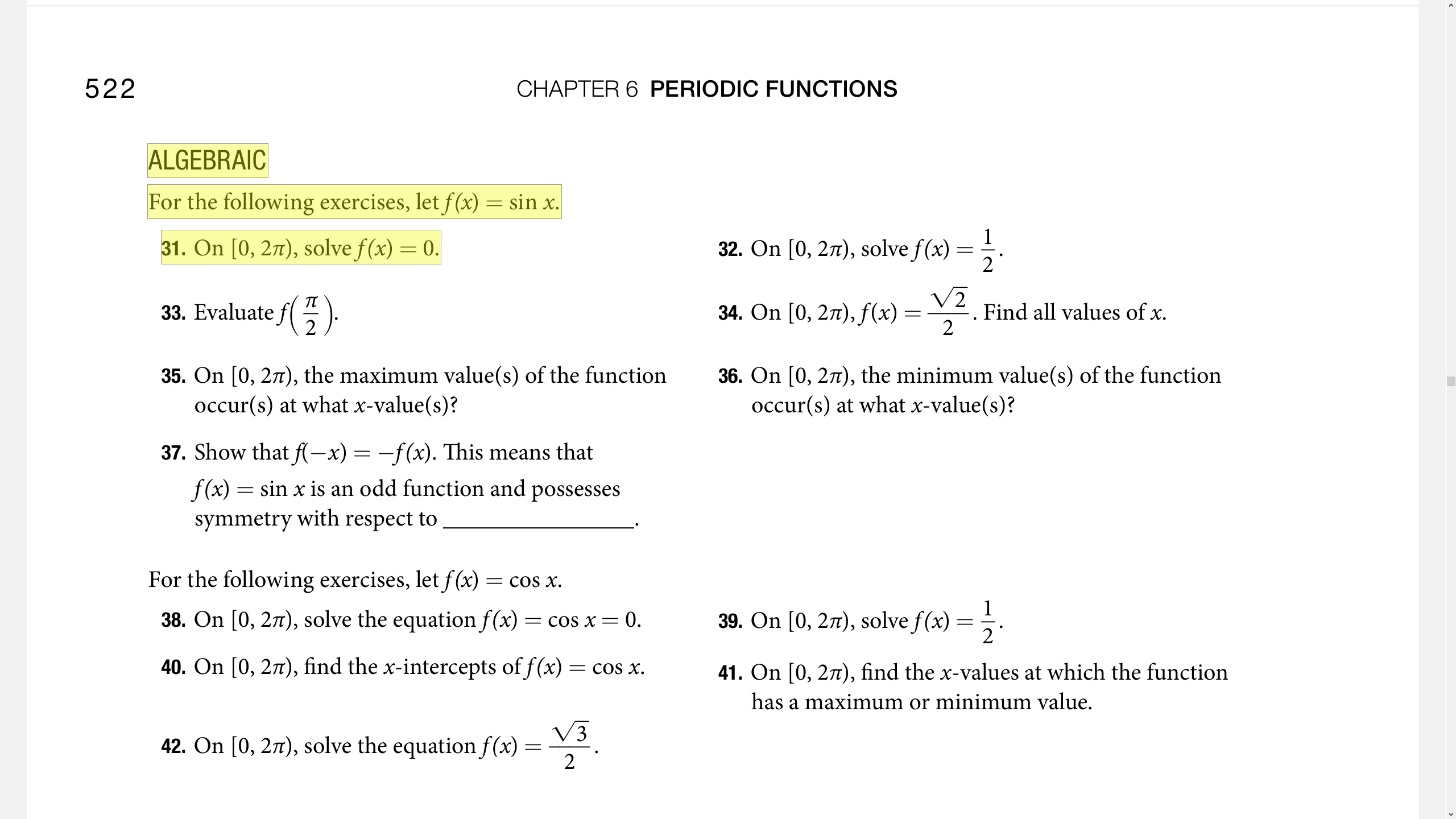
I've been knocking out the trig problems in this section with minimal difficulty so far, but I've run straight into a brick wall on this "Algebraic" part. I'm asked to find sin(x)=0 between [0,2π). If I graphed the unit circle this would be a trivial exercise to show sin(θ)=0 when θ=0 or π.

Where I have trouble is- I'm very explicitly being told here that the solution is ALGEBRAIC, and I'm struggling to figure out a way to rearrange sin(x)=0 to come up with the known answer. Further, unit circles are not in this chapter, they wouldn't likely ask me to exercise a skill taught in another chapter. What am I missing?

It's not just 31, either. Looking ahead at eg 37, I can easily show sin(-x) = -sin(x) on a unit circle. I could maybe fuck around with inverse trig ratios but those are in section 3- this is only section 1.

Help me out here, drop a hint, share a link: how do I solve sin(x)=0 on [0,2π), but algebraically? I suspect it's something glaringly obvious and/or very very simple I've overlooked.
34
10
submitted 2 years ago* (last edited 2 years ago) by DarkNightoftheSoul@mander.xyz to c/math@lemmy.ml

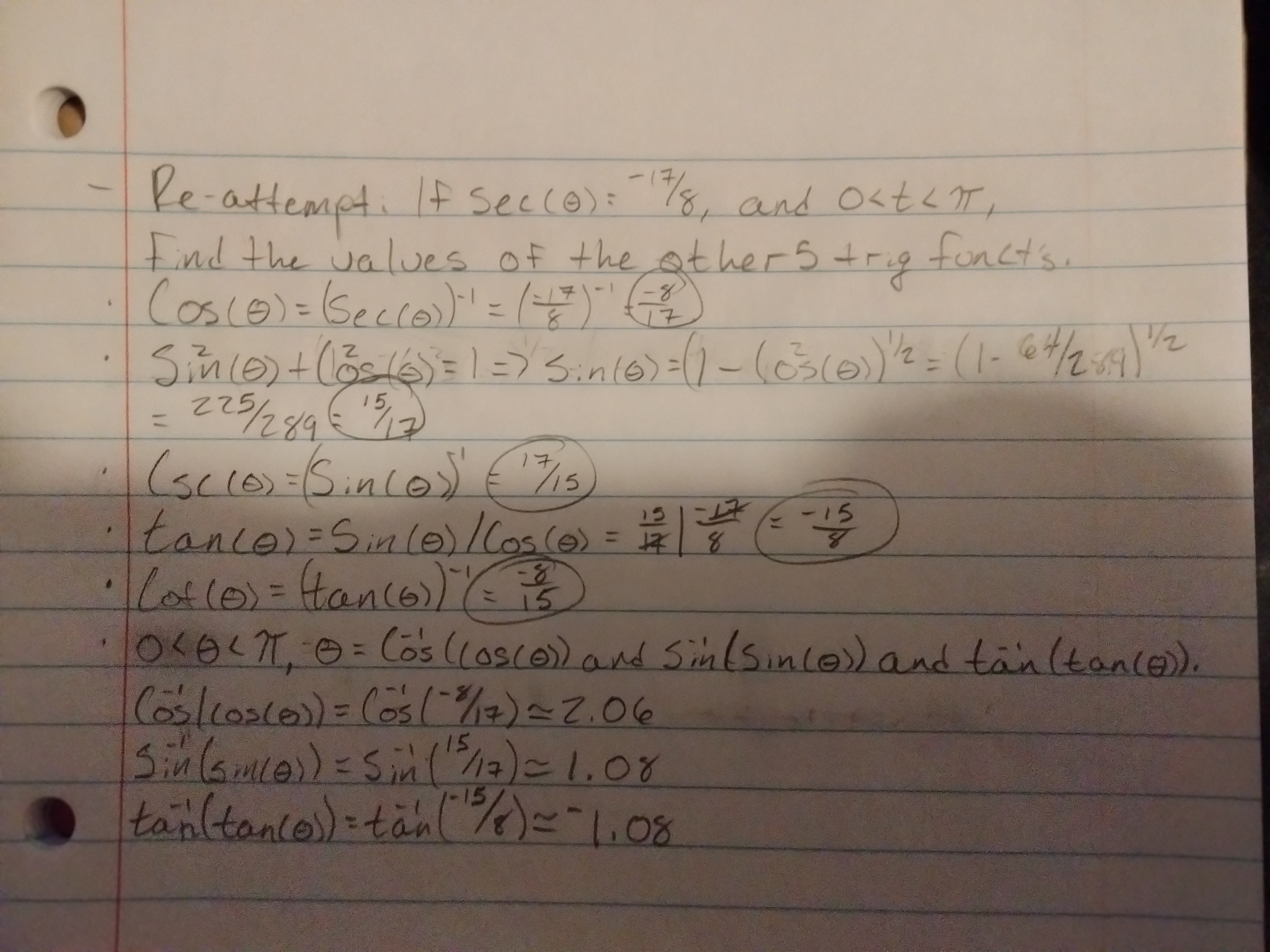
It's homework help, but I'm not asking for the solution. The problem only asks for cos, sin, tan, cot, csc given sec. I found those pretty quickly on my own, and confirmed solutions with the back of the book.

Where I run into confusion is when I try to find angle theta on my own. Arccos of found cos gives 2.06, arcsin of found sin gives 1.08, and arctan of found tan gives -1.08. Problem givens exclude possibility of the negative angle found by arctan(-15/8), but the other two are possible and conflicting. And why wouldn't they all be the same? I reattempted because there were so many erase marks from trying to figure this out that it was almost illegible.

Am I wrong? Did the book give me a point not on the unit circle or something, assuming I wouldn't try to find theta on my own? Have I used arcfuncs wrong- I checked the domains against the function definitions? Have I found a hole in math?
35
5
submitted 2 years ago* (last edited 2 years ago) by wargreymon2023@sopuli.xyz to c/math@lemmy.ml

We have "triangle" "rectangle" "pentagon"...etc "tetrahedral" "cube" "octahedron" ..etc

Instead of having to say "group" all the time, like "dihedral group" "cyclic group", if we make it into one word it will sound more like an elementary mathematical object.

What would be a nice suffix for group?

36
1
the sinusoidal tetris (www.andreinc.net)
37
30
submitted 2 years ago* (last edited 2 years ago) by mozz@mbin.grits.dev to c/math@lemmy.ml
38
6
39
11
submitted 2 years ago by floofloof@lemmy.ca to c/math@lemmy.ml
40
6
submitted 2 years ago by spitz@lemmy.ml to c/math@lemmy.ml

Hello.

I am currently inventing a language, and have created a base 4 number system for it. Unfortunately, I am horrible with numbers, even in decimal. So it was a hard slog. But I finally got there.

It would be great if I could know of any practical applications quaternary has (if any), so I can incorporate it into the language and make it more naturalistic. Thanks.

41
24
submitted 3 years ago by gi124@mastodon.social to c/math@lemmy.ml

@math The West Virginia University Provost's Office is recommending closing the MS and Ph.D. programs in Math. It is the *only* Ph.D. program in Math in the entire state, and about 10% of all WVU Ph.D.'s are in Math.

Please consider signing this petition to save the program: https://chng.it/yPZDTTsfBk

#ProtectWVUMath

42
11
43
-7
submitted 3 years ago* (last edited 3 years ago) by JohnDClay@sh.itjust.works to c/math@lemmy.ml

Wiki: https://en.wikipedia.org/wiki/Mandelbrot_set

Here are a bunch of other visualizations: I don't know how artistic or data-driven some of these are, but they look very interesting. I think the nebula-looking one measures how often a point is visited?

Black and Green mandelbrot set

The Bulbic Mandelbrot Set

Bulbic Mandelbrot Set

https://www.deviantart.com/metafractals/art/The-Bulbic-Mandelbrot-Set-811453986

A Nebulabrot

Nebula looking mandelbrot set

https://mathematica.stackexchange.com/questions/89458/how-to-make-a-nebulabrot

44
5
submitted 3 years ago by bucho@lemmy.one to c/math@lemmy.ml

So I'm gearing up to take a calculus 1 exam, and this question is on the sample test. My initial thought was that since we are looking for F(9), and F(x) is an antiderivative of f(x), I can just use the integral of the equation of f(x) at 9, which is f(x) = -2x/3 + 5, which, when integrated, becomes -x^2/3 + 5x + 2 (C = 2 because F(0) = 2). Thing is, though, that won't give me any of the answers listed. And even after taking the integral of all of the equations of f(x), I still have no idea how to produce any of the answers in the multiple choice.

I'm super stumped on this one. Any help would be welcome!

45
14
submitted 3 years ago by makeasnek@lemmy.ml to c/math@lemmy.ml

BOINC is a free tool you can download to participate in several different math research projects. It runs on Windows, MacOS, Linux, and even Android. Each project gives you fun stats and graphs about your participation, many of them will even credit you individually for your discoveries (such as finding a new prime) on their website or in their published papers.

Here's a few of the projects available (emoji legend at bottom of post):

🏆💚❤️✖️✒️🔓 Amicable Numbers Independent research project that uses Internet-connected computers to find new amicable pairs. Currently searching the 10^20 range.

🎓🔓✖️ NFS@Home - Lattice sieving step in Number Field Sieve factorization of large integers. Many public key algorithms, including the RSA algorithm, rely on the fact that the publicly available modulus cannot be factored. If it is factored, the private key can be easily calculated.

🏆🎓💚❤️✖️🔓 Numberfields@home - Research in number theory. Number theorists can mine the data for interesting patterns to help them formulate conjectures about number fields.

🔓 ODLK1 - Building a database of canonical forms of diagonal Latin squares of the 10th order

🔓💚❤️ SRBase - Attempting to solve Sierpinski / Riesel Bases up to 1030.

🔓✖️PrimeGrid - Find new prime numbers!

Gerasim@home - research in discrete mathematics and logic control. Testing and comparison of heuristic methods for getting separations of parallel algorithms working in the CAD system for designing logic control systems

🔓✖️ Loda@home - LODA is an assembly language, a computational model, and a distributed tool for mining programs. You can use it to generate and search programs that compute integer sequences from the On-Line Encyclopedia of Integer Sequences® (OEIS®). The goal of the project is to reverse engineer formulas and efficient algorithms for a wide range of non-trivial integer sequences.

🔓🎓Rakesearch - The enormous size of the diagonal Latin squares space makes it unfeasible to enumerate all its objects straightforwardly in reasonable time. So, in order to discover the structure of this space, sophisticated search methods are needed. In RakeSearch project, we implement an application that picks up separate pairs of mutually orthogonal DLSs, which allows to reconstruct full graphs of their orthogonality.

🔓✒️ Ramanujan machine - Discover new mathematical conjectures

Legend:

🔓 - Publishes data openly and regularly. Note many projects publish papers detailing the results of their work, this icon means that they regularly publish the source materials as well/the results of the computation in an open fashion.

🏆 - Credits individual crunchers for discoveries, such as finding a new black hole or prime number

🎓 - Sponsored by major university or research institute.

💚 - Supports NVIDIA GPU/graphics card (all projects should be assumed to support CPU unless otherwise stated)

❤️ - Support AMD GPU (all projects should be assumed to support CPU unless otherwise stated)

✖️ - Supports OS X (all projects should be assumed to support Windows & Linux unless otherwise stated)

46
4
submitted 3 years ago by makeasnek@lemmy.ml to c/math@lemmy.ml
47
2
submitted 3 years ago* (last edited 3 years ago) by AgreeableLandscape@lemmy.ml to c/math@lemmy.ml
48
1
submitted 3 years ago by DukeJava@lemmy.ml to c/math@lemmy.ml

The regular elo formula is complicated.

The most basic elo formula is win = 1 points, draw = 0, lose = -1. Which is a little too basic.

I looked around and couldn't find a 'medium difficulty' elo formula. Anyone have a medium difficulty proposal?

Regular elo formula:

The Elo rating system embodies this by using a formula that changes a player's rating by adding K(S-E) to his rating each time. K is a constant that is the same for all players; the higher it is, the more easily your rating changes. S is the score of the player in a match (+1 for a win, 0 for a loss). E is the expected score of the player in the match. Against a weak player, it is close to 1 since you expect a strong player to beat a weak player most of the time. Conversely, against a stronger player, it is close to 0. You can calculate E using the formula E_A = 1/(1+10(R_B-R_A/400)), where E_A is the expect score of player A with rating R_A when faced with player B with rating R_B.

49
4
50
1
submitted 3 years ago by cypherpunks@lemmy.ml to c/math@lemmy.ml
view more: ‹ prev next ›

A place for everything about math

1199 readers
2 users here now

founded 7 years ago
MODERATORS