1701
494
submitted 2 years ago by neme@lemm.ee to c/opensource@programming.dev
1702
89

Right now their page https://upgradefromwindows.com/ just redirects to https://www.fsf.org/windows which has a wall of text and an infographic. Even I, who doesn't have windows and will never reinstall it unless forced, clicked away from the page within 5 seconds. The FSF desperately needs help with marketing and design, plus it would be great to have tooling for brain-dead linux installation (no, find distribution, backup, put linux on a USB-stick, reboot, hit some button to get into the BIOS, select "USB stick", reboot, click through installation, find alternative software, is not brain-dead).

1703
145

TPM is a dedicated chip or firmware enabling hardware-level security, housing encryption keys, certificates, passwords, and sensitive data, "and shielding them from unauthorized access," Microsoft senior product manager Steven Hosking wrote last month, declaring TPM 2.0 to be "a non-negotiable standard for the future of Windows."

1704
143
1705
26

About Habit-Maker

Have you found it difficult to build new habits? Habit-Maker uses rewards and encouragements to help get over initial willpower required to form new habits.

Features

Rewards

Habit-Maker game-ifies making habits by giving you rewards each time you check a habit. It shows the following progress metrics:

  • Streaks - The # of days you've completed your habit in a row.
  • Points - points for checking habits, with multipliers for continuing your streak.
  • % progress to your 66-day-ingrained habit.

Encouragements

Studies have found that encouragements are vital to building new habits. Habit-Maker takes advantage of this by allowing you to create your own custom encouragements.

Before creating a habit, take a few minutes and think about why you want to build this habit. What benefits will it bring you, and how your life will improve by doing it?

A good encouragement should have:

  • An initial congratulations for completing the habit.
  • A message tailored to you, about the benefits or reasons why you should continue.

Some examples of good encouragements:

Activity Encouragement
Brushing your teeth Great job! Your friends will like seeing your whiter teeth, and less coffee stains.
Lifting weights for 10m Nice job! People will notice your better physique.
Cardio for 10m Well done! Studies show you're going to live a lot longer!
Working out for 10m Excellent! You'll have more energy, and feel healthier by continuing!
Meditating for 10m Nice! You're on your way to bettering the lives of those around you, by developing your awareness.

Completing a habit

Once a habit has been formed, its relatively easy to continue doing it, almost as if it were on auto-pilot. Research shows that ~40% of our daily activities are habits that don't require much (if any) willpower once they've been formed.

Built With

Installation / Releases

Support / Donate

Habit-Maker will always remain free, open-source software. We've seen many open-source projects go unmaintained after a few years. Recurring donations have proven to be the only way these projects can stay alive.

Your donations directly support full-time development, and help keep this maintained. If you find yourself using habit-maker every day, consider donating:

Crypto

  • bitcoin: 1Hefs7miXS5ff5Ck5xvmjKjXf5242KzRtK
  • ethereum: 0x400c96c96acbC6E7B3B43B1dc1BB446540a88A01
  • monero: 41taVyY6e1xApqKyMVDRVxJ76sPkfZhALLTjRvVKpaAh2pBd4wv9RgYj1tSPrx8wc6iE1uWUfjtQdTmTy2FGMeChGVKPQuV

Social / Contact

Habit Resources

Icons

Work in progress icons created by Cap Cool - Flaticon

1706
9
ShredOS (www.schneier.com)

ShredOS is a stripped-down operating system designed to destroy data.

GitHub page here.

1707
5

This doesn't surprise me at all... Just like bots in games. Selling a service that benefits another. Its shady, but definitely believable.

Also, what if this is an actual viable way to "market" for an open source project?
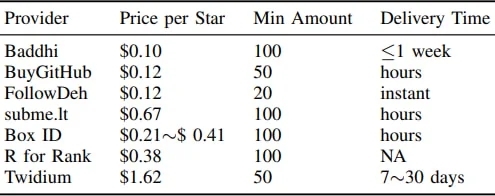
https://www.bleepingcomputer.com/news/security/over-31-million-fake-stars-on-github-projects-used-to-boost-rankings

1708
4
1709
41
1710
18

A couple of weeks back, we discussed the implosion of startup company Embodied and the resulting bricking of its $800 “emotional support” robots designed for children. Like many other stories about IoT-type products, the post focused on how these robots would cease functioning as designed once the backend support infrastructure for the shuttered business was shut down. As often happens with stories like this, there were several comments pointing out that the company could publish its source code and allow an open source community to pick up the slack here, so that at least these robots wouldn’t become $800 paperweights.

But what doesn’t typically happen in these stories is seeing a company actually make the effort to do exactly that. But that seems to be what Embodied is planning, with the company announcing an update and a plan to all the open source community to build its own backend software for the devices.

Embodied CEO Paolo Pirjanian shared a document via a LinkedIn blog post today saying that people who used to be part of Embodied’s technical team are developing a “potential” and open source way to keep Moxies running. The document reads:

“This initiative involves developing a local server application (‘OpenMoxie’) that you can run on your own computer. Once available, this community-driven option will enable you (or technically inclined individuals) to maintain Moxie’s basic functionality, develop new features, and modify her capabilities to better suit your needs—without reliance on Embodied’s cloud servers.”

The notice says that after releasing OpenMoxie, Embodied plans to release “all necessary code and documentation” for developers and users.

The company is also pushing a final update to the devices that will allow them to support the OpenMoxie setup.

1711
18
1712
74
1713
36
1714
16
1715
10

https://gitlab.com/christosangel/tuifoop

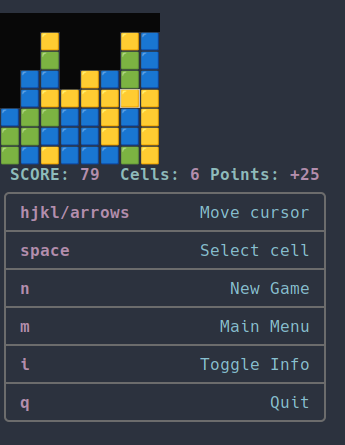
tuifoop is a terminal puzzle game.

It is a clone of Swell Foop, written in Bash.

The aim is to remove as many cells as possible (or even all cells) from a grid. The user navigates in the grid using the navigation keys, and can select a cell to remove. Cells can be removed in clusters of more than one cells adjacent to each other. Single cells cannot be removed.

When selected, a cluster of adjacent similar cells is removed, and the remaining cells above take their place.

When a whole grid column is cleared, it collapses and the remaining columns to the right shift to fill its place.

IMPORTANT:

Most themes are based in emoji characters.

In order for the emoji characters to be rendered correctly, the user must:

  1. Make sure that emoji characters are supported in their terminal.

  2. Make sure suitable mono font is used to render the grid and the emoji backgound properly. For instance, ubuntu font can support emojis, however the font background is not rendered correctly, therefore the grid cursor (where the cursor is placd in the cell matrix) cannot be seen in the terminal window.

If a problem is encountered as this is concerned, it is easily resolved by changing to a more appropriate font through terminal application's preferences or configuration, so that the emojis as well as the grid are rendered correctly.
1716
18
submitted 2 years ago* (last edited 2 years ago) by Rekall_Incorporated@lemm.ee to c/opensource@programming.dev
1717
37
1718
8
1719
16
FOSS Translation Software (tube.archworks.co)
1720
49
1721
14
2024 Open Source Software Funding Report (opensourcefundingsurvey2024.com)
1722
23
Open Food Facts (alternativeto.net)
1723
51
darktable 5.0.0 released (www.darktable.org)
1724
23
1725
89
view more: ‹ prev next ›

Opensource

6636 readers
78 users here now

A community for discussion about open source software! Ask questions, share knowledge, share news, or post interesting stuff related to it!

CreditsIcon base by Lorc under CC BY 3.0 with modifications to add a gradient


founded 2 years ago
MODERATORS