351
1
submitted 3 years ago by figsoda@lemmy.ml to c/rust@lemmy.ml
352
0
submitted 3 years ago by yogthos@lemmy.ml to c/rust@lemmy.ml
353
2
submitted 3 years ago* (last edited 3 years ago) by nutomic@lemmy.ml to c/rust@lemmy.ml

I want to announce a new version of the activitypub-federation crate. Over the last weeks I worked on major improvements to the usability and documentation. It now includes an extensive guide on getting started to implement federation from scratch, and also an example project which can directly be deployed to a server and federate with projects like Mastodon.

The library takes care of basic functionality like HTTP Signatures, activity sending, and fetching data from other servers. Application developers can focus on the main logic, and treat federation as another form of API. There is no restriction to the content being federated: you can implement a microblogging platform, link aggregator, video hosting site or any other type of social media. The goal is to encapsulate all basic functionality, so that developers can easily implement federation without any prior knowledge.

Using this library can help to share core Activitypub logic between different projects, so that the same code doesn’t have to be implemented and maintained separately by each project. This way improvements can benefit everyone. It also encourages the use of effective patterns to make Rust and Activitypub work together. All of this has been proven to work in Lemmy which uses this library and is the biggest Activitypub project written in Rust.

https://docs.rs/activitypub_federation

354
4
submitted 3 years ago by nutomic@lemmy.ml to c/rust@lemmy.ml
355
2
submitted 3 years ago by dessalines@lemmy.ml to c/rust@lemmy.ml

Seems really neat, basically the next.js but for rust. Based on sycamore, a web-ui library for rust.

Looks like it does well in the framework benchmarks too.

https://krausest.github.io/js-framework-benchmark/2023/table_chrome_110.0.5481.77.html

356
0
Toy CPU Simulator (jimhall.itch.io)
submitted 3 years ago by yogthos@lemmy.ml to c/rust@lemmy.ml
357
3
submitted 3 years ago by 0x1C3B00DA@lemmy.ml to c/rust@lemmy.ml
358
2
submitted 3 years ago by yuu@group.lt to c/rust@lemmy.ml

This project aims at providing nightly builds of all official rust mdbooks in epub format. It is born out of the difficulty I encountered when starting my rust apprenticeship to find recent ebook versions of the official documentation.

If you encounter any issue, have any suggestion or would like to improve this site and/or its content, please go to https://github.com/dieterplex/rust-ebookshelf/ and file an issue or create a pull request.

359
1
Rust-analyzer Changelog #166 (rust-analyzer.github.io)
submitted 3 years ago by MichaelMcDonnell@lemmy.ml to c/rust@lemmy.ml
360
1
submitted 3 years ago by MichaelMcDonnell@lemmy.ml to c/rust@lemmy.ml
361
1
submitted 3 years ago by MichaelMcDonnell@lemmy.ml to c/rust@lemmy.ml
362
1
submitted 3 years ago by figsoda@lemmy.ml to c/rust@lemmy.ml

Announcement on NixOS Discourse

Features

  • Hash prefetching powered by nurl
  • Dependency inference for Rust packages using the Riff registry and python projects
  • Interactive prompts with fuzzy tab completions
  • License detection
  • Supported builders
    • stdenv.mkDerivation
    • buildRustPackage
    • buildPythonApplication and buildPythonPackage
    • buildGoModule
  • Supported fetchers
    • fetchCrate
    • fetchFromGitHub
    • fetchFromGitLab
    • fetchFromGitea
    • fetchPypi
    • All other fetchers supported by nurl are also supported, you just have to specify the tags manually

Usage

Usage: nix-init [OPTIONS] <OUTPUT>

Arguments:
  <OUTPUT>  The path to output the generated file to

Options:
  -u, --url <URL>        Specify the URL
  -c, --config <CONFIG>  Specify the config file
  -h, --help             Print help
  -V, --version          Print version
363
1
submitted 3 years ago by yuu@group.lt to c/rust@lemmy.ml

cross-posted from: https://group.lt/post/44860

Developers across government and industry should commit to using memory safe languages for new products and tools, and identify the most critical libraries and packages to shift to memory safe languages, according to a study from Consumer Reports.

The US nonprofit, which is known for testing consumer products, asked what steps can be taken to help usher in "memory safe" languages, like Rust, over options such as C and C++. Consumer Reports said it wanted to address "industry-wide threats that cannot be solved through user behavior or even consumer choice" and it identified "memory unsafety" as one such issue. 

The report, Future of Memory Safety, looks at range of issues, including challenges in building memory safe language adoption within universities, levels of distrust for memory safe languages, introducing memory safe languages to code bases written in other languages, and also incentives and public accountability.

More information:

364
2
submitted 3 years ago by 0x1C3B00DA@lemmy.ml to c/rust@lemmy.ml
365
1
submitted 3 years ago* (last edited 3 years ago) by winnie@lemmy.ml to c/rust@lemmy.ml

Did you know you can just whip out curly-braces all over the place in Rust and Go?

But why on Earth would you even want to do this?

366
1
submitted 3 years ago by yuu@group.lt to c/rust@lemmy.ml

While the memory safety and security features of the Rust programming language can be effective in many situations, Rust’s compiler is very particular on what constitutes good software design practices. Whenever design assumptions disagree with real-world data and assumptions, there is the possibility of security vulnerabilities–and malicious software that can take advantage of those vulnerabilities. In this post, we will focus on users of Rust programs, rather than Rust developers. We will explore some tools for understanding vulnerabilities whether the original source code is available or not. These tools are important for understanding malicious software where source code is often unavailable, as well as commenting on possible directions in which tools and automated code analysis can improve. We also comment on the maturity of the Rust software ecosystem as a whole and how that might impact future security responses, including via the coordinated vulnerability disclosure methods advocated by the SEI’s CERT Coordination Center (CERT/CC).
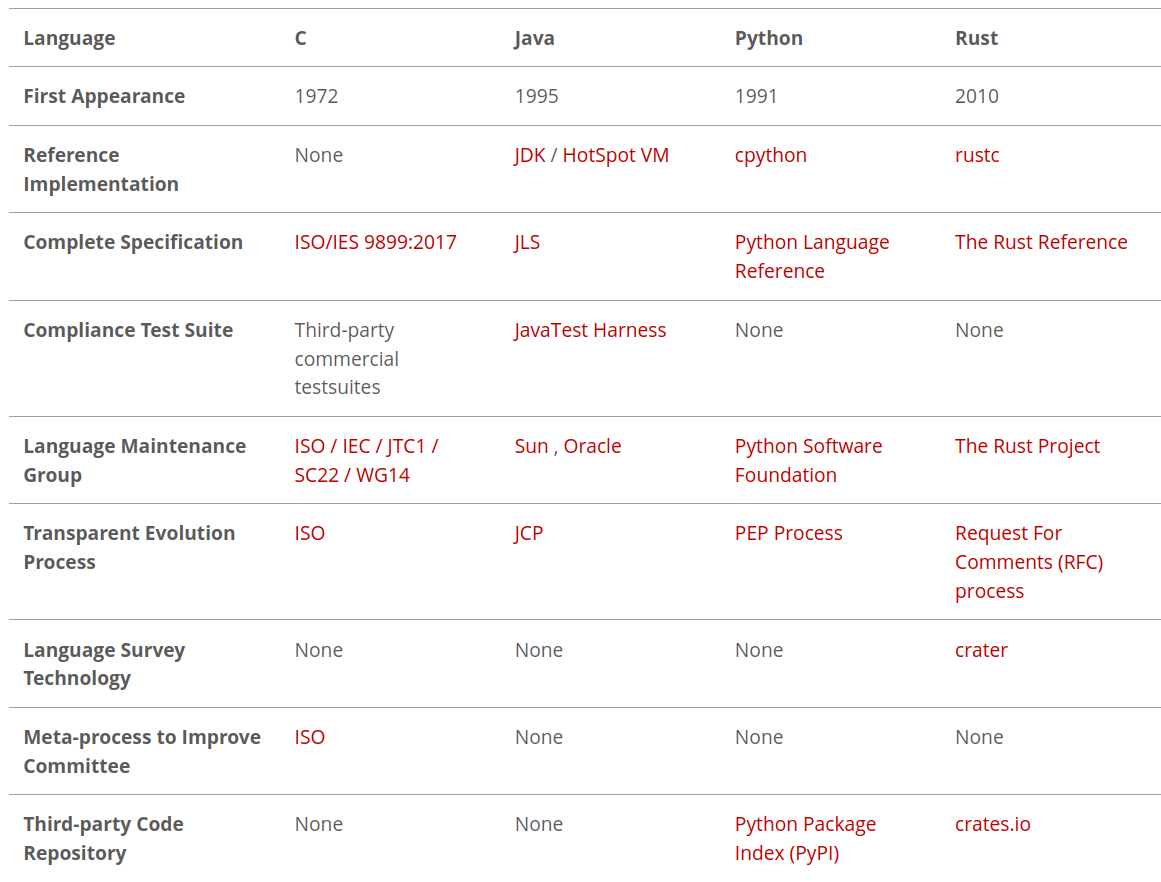
Programming Languages Maturity

367
1
submitted 3 years ago by yuu@group.lt to c/rust@lemmy.ml

Rust is a programming language that is growing in popularity. While its user base remains small, it is widely regarded as a cool language. According to the Stack Overflow Developer Survey 2022, Rust has been the most-loved language for seven straight years. Rust boasts a unique security model, which promises memory safety and concurrency safety, while providing the performance of C/C++. Being a young language, it has not been subjected to the widespread scrutiny afforded to older languages, such as Java. Consequently, in this blog post, we would like to assess Rust’s security promises.
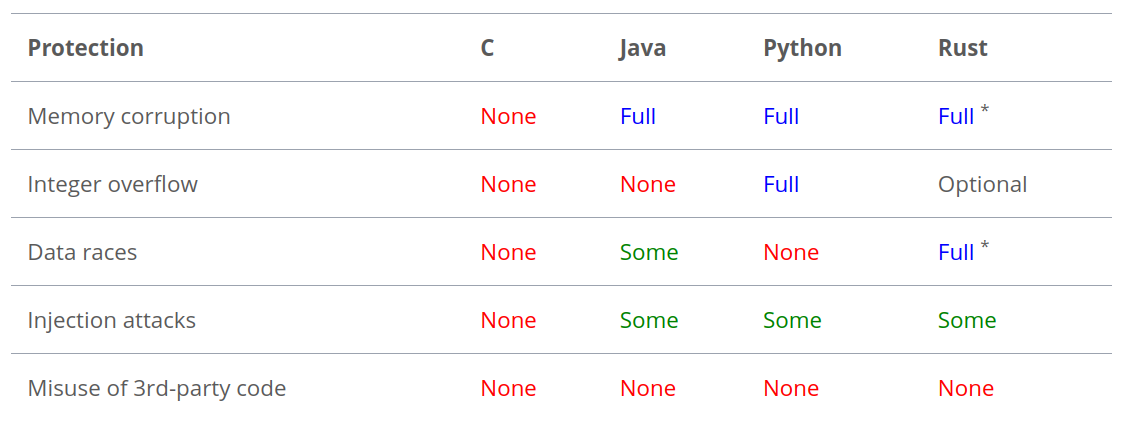
Rust Protection in Context, table

368
2
submitted 3 years ago by KaczuH@lemmy.ml to c/rust@lemmy.ml
369
3
There is no such thing as "consensual" C (bafybeidjejxqpij2zzfuyedsheljawl7xesgwo5wer76ghd7fw7q3dpsja.ipfs.cf-ipfs.com)
submitted 3 years ago by Victim_0@lemmy.ml to c/rust@lemmy.ml
370
3
submitted 3 years ago by 0x1C3B00DA@lemmy.ml to c/rust@lemmy.ml

Plume and Lemmy got a shout out on an official Rust site!

371
2
submitted 3 years ago by dessalines@lemmy.ml to c/rust@lemmy.ml
372
4
submitted 3 years ago by kixik@lemmy.ml to c/rust@lemmy.ml
373
5
submitted 3 years ago by leanleft@lemmy.ml to c/rust@lemmy.ml

dora is a DHCP server written in Rust using tokio. It is built on the dhcproto library and sqlx. We currently use the sqlite backend, although that could change in the future. The goal of dora is to provide a complete DHCP implementation for IPv4, and eventually IPv6. Dora supports duplicate address detection, ping, binding multiple interfaces, static addresses, etc see example.yaml for all options.

It is, however, an early release version and may contain bugs.

374
2
submitted 4 years ago by leanleft@lemmy.ml to c/rust@lemmy.ml

The merge window for the 6.1 release brought in basic support for writing kernel code in Rust — with an emphasis on "basic". It is possible to create a "hello world" module for 6.1, but not much can be done beyond that. There is, however, a lot more Rust code for the kernel out there; it's just waiting for its turn to be reviewed and merged into the mainline. Miguel Ojeda has now posted the next round of Rust patches, adding to the support infrastructure in the kernel.

375
1
submitted 4 years ago by kixik@lemmy.ml to c/rust@lemmy.ml

Just sharing from r/rust

view more: ‹ prev next ›

Rust Programming

9435 readers
1 users here now

founded 7 years ago
MODERATORS