We have a commitment to ensuring that our journalism is not locked behind a paywall. The only way we can sustain this is through the voluntary support of our community of readers. You can subscribe for free or make a 501(c)(3) tax-deductible donation to support our work.
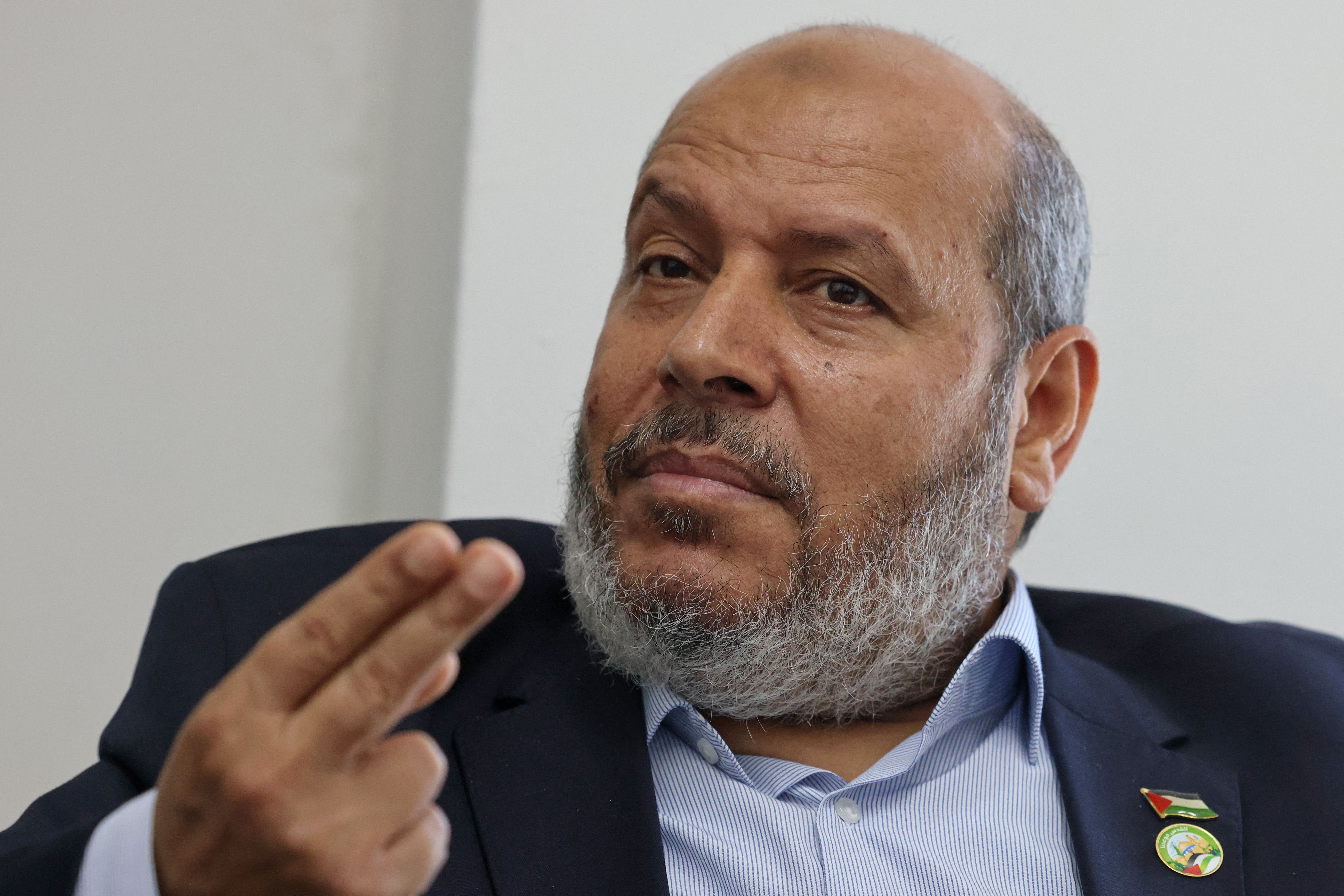
Khalil al-Hayya, Hamas’s lead negotiator, survived an Israeli assassination attempt in Qatar on September 9. Photo 2021 by EMMANUEL DUNAND/AFP via Getty Images.
This week, as Palestinian negotiators led by Hamas gathered in Doha, Qatar, to craft their response to President Donald Trump’s 20-point plan for a Gaza ceasefire, they knew they were at a decisive crossroads. Trump had portrayed his plan, unveiled on Monday at the White House, as an ultimatum and both he and Prime Minister Benjamin Netanyahu said that if Hamas rejected the deal, then Israel would ratchet up its war of annihilation.
On the one hand, Trump’s proposal contained a series of terms for ending the war that align closely with a framework Hamas had agreed to just weeks earlier: an exchange of captives, a ceasefire, the resumption of deliveries of life essentials and humanitarian aid to Gaza, and the withdrawal of Israeli forces. While the terms laid out in Trump’s plan were vague, the basic structure to end the Gaza war was there.
On the other, the plan contained sweeping proposals that, if implemented, would have grave implications, not just for Gaza, but for the future of a unified Palestinian state. It included plans for the deployment of foreign troops and the establishment of an international board, headed by Trump and former British Prime Minister Tony Blair, to effectively dictate Gaza’s affairs. It also would leave open the likelihood of a long-term Israeli military presence inside Gaza and the total disarmament of Palestinians, erasing their right to resist Israeli occupation. Trump’s overarching message was that Palestinians must surrender their fight for liberation and submit to subjugation.
There was broad consensus among a wide range of Palestinian factions and parties that Hamas and Palestinian Islamic Jihad had the authority to negotiate an end to the active war in Gaza, according to several sources who participated in the discussions. There was also agreement that Hamas alone did not have a mandate to negotiate terms that would impact what the negotiators called issues related to the Palestinian homeland.
“Regarding the resistance factions, our jurisdiction is concerning matters of prisoner exchanges in return for halting the aggression, withdrawal, the entry of aid, and stopping the policy of displacement against our people,” said Mohammed Al-Hindi, the chief political negotiator for Palestinian Islamic Jihad, in an interview with Drop Site. “As for the national issues, the resistance factions are not authorized to speak on them alone, as these concern all factions and forces of the Palestinian people everywhere.”
The challenge before the negotiators was how to craft a response to Trump that would assert the Palestinian right to self-determination while persuading the erratic U.S. president to force Israel to cease its genocidal war.
The dominant pattern in previous ceasefire talks had been that Hamas’s proposals to amend Israeli-U.S. terms sparked false allegations that Hamas had rejected a deal, paving the way for more genocidal attacks. The Palestinian negotiators knew that proposing amendments or giving the impression they were rejecting any of Trump’s terms risked a return to that familiar and murderous cycle. But this time, there was a new constellation of interests.
Threading the Needle
When Trump announced his plan on Monday, he hailed it as “potentially one of the great days ever in civilization,” and boasted that his proposal would bring “eternal peace in the Middle East.” He claimed, repeatedly, that virtually every Arab and Muslim nation had endorsed his plan. This was not technically true, as the drafts provided to those countries prior to the White House announcement were substantially edited by Israel before the public roll-out.
Yet officials from these Muslim nations—most notably those from regional ceasefire mediators Qatar and Egypt—spoke of this Trump-enabled deception in only the most diplomatic of terms, opting to play along with his mythology in an effort to secure a deal. They all praised Trump for his initiative and emphasized that he was the key player to achieving peace.
Since Trump’s election, Hamas officials have said the only chance of halting Israel’s genocide resides with Trump. In the immediate aftermath of the release of the 20-point plan, Palestinian leaders from across the political landscape publicly denounced it as a surrender order and an attempt to use diplomacy to crush Palestinian resistance after Israel’s two year military assault had failed to achieve that goal.
A senior Hamas official told Drop Site that the group’s leadership understood that “this proposal was not put forward to find an end to the war. It is either total surrender or continue the war. Take it or leave it.” They viewed it as “catastrophic in the short and long term, for the resistance and for the whole Palestinian cause.” But on a strategic level, Hamas officials and other Palestinian leaders knew that formally rejecting Trump’s offer would be disastrous. The public narrative would almost certainly portray Hamas as rejecting peace even after a broad coalition of Muslim and Arab countries had endorsed it.
Over the course of the week, Hamas’s negotiators circulated proposed language among Palestinian factions and delivered it to the commanders from the Qassam Brigades and Hamas’s political leadership inside Gaza, according to two sources involved with the process. They also held lengthy meetings with officials from Egypt, Qatar, and Turkey.
Privately, some of these officials confirmed they had expressed support for a different version than the one Trump made public on Monday—and told Hamas negotiators they were appealing to Trump to roll back or discard some of the Israeli amendments. Trump allowed Netanyahu and his top adviser Ron Dermer to make significant changes to the terms, in some cases removing or substantively altering items that Trump’s Arab and Muslim “partners” had understood would be in the plan. While mediators from those nations pressed Hamas to accept the deal and cautioned against proposing any amendments or rejecting any specific terms, sources within the Palestinian negotiating team told Drop Site that, in the end, the mediators told Hamas negotiators it was ultimately a Palestinian decision.
By the time Trump announced Friday that he was giving Hamas until 6 p.m. Sunday to deliver its response, the Palestinian negotiators had already finalized their answer. Soon after Trump posted his deadline, the text was in the hands of Qatari and Egyptian mediators who swiftly delivered it to the White House.
It was a strategic gamble; at its core, Hamas’s response was not an unequivocal acceptance of Trump’s demands, but the text was also void of any language that explicitly rejected any of his terms. It was aimed at threading a needle by crediting Trump, linking him more closely to a diplomatic alliance with Arab and other Muslim nations, and sending a message that Hamas was embracing the essence of Trump’s plan. But it also needed to preserve Palestinian rights and, most significantly, defer any answer on most of the terms laid out in the proposal. The key goal was to achieve an immediate Gaza ceasefire and to win Trump’s buy-in to restrain Netanyahu’s bloodlust and to start real negotiations.
Hamas officials knew that what Trump most wanted to hear was an unambiguous commitment to release all remaining Israeli captives and that Hamas would step down from power in Gaza. In principle, this was not difficult. Hamas had repeatedly offered to enter into an “all for all” deal throughout the genocide and to free all Israeli captives. It also repeatedly said it would relinquish governance of Gaza to an independent technocratic committee composed of Palestinians. Even though these overtures had been systematically rejected or ignored by the U.S. and Israel for months, Hamas negotiators leaned into the idea of centering them. The hope was that Trump would celebrate these commitments from Hamas as his personal victory and the product of his demands.
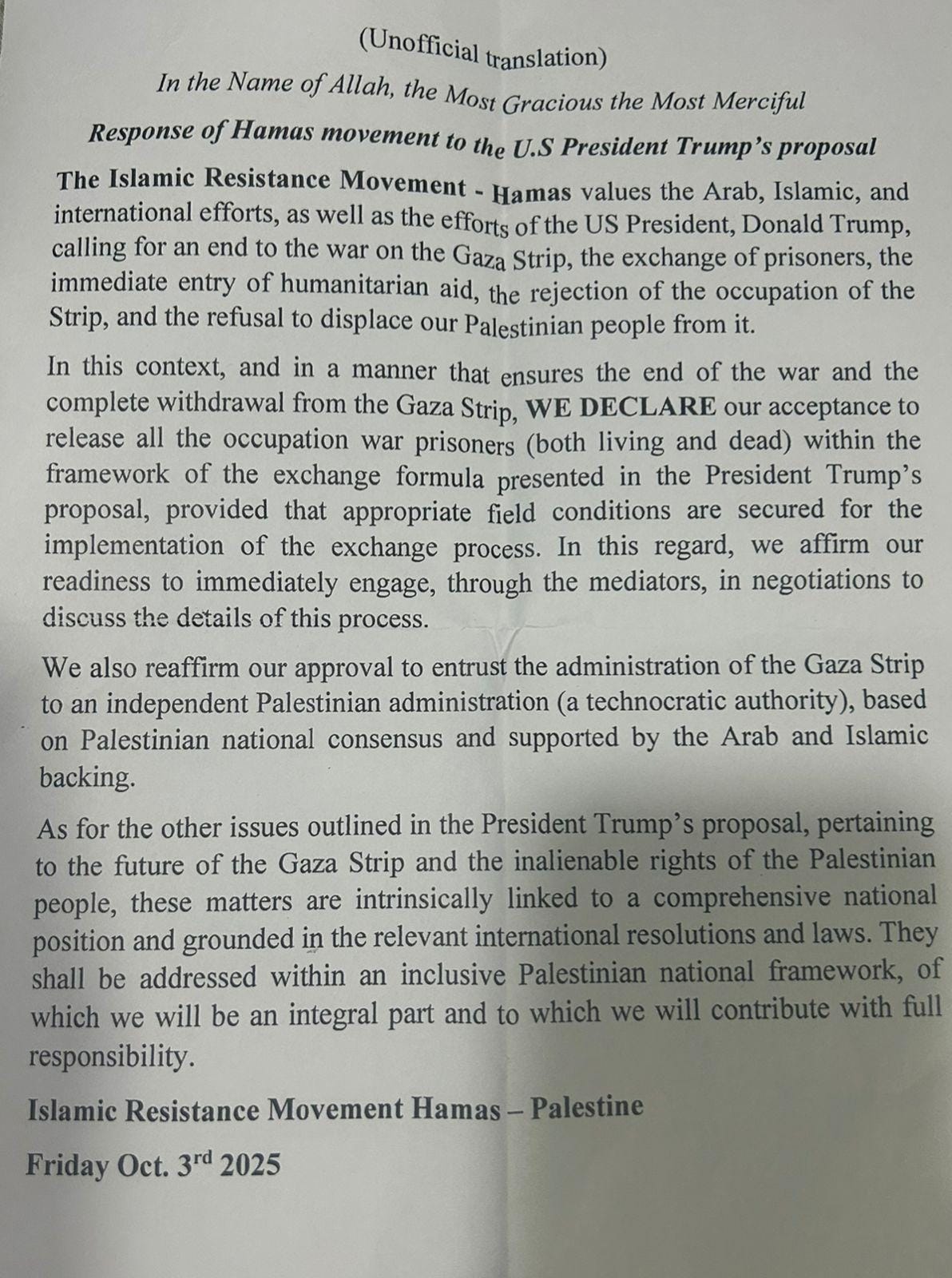
A translated copy of Hamas’s response to Trump’s proposal on October 3, 2025. Obtained by Drop Site.
“The Islamic Resistance Movement, Hamas, appreciates the Arab, Islamic, and international efforts, as well as the efforts of U.S. President Donald Trump, aimed at halting the war on the Gaza Strip, achieving a prisoner exchange, allowing immediate entry of humanitarian aid, rejecting the occupation of the Strip, and opposing the displacement of our Palestinian people from it,” Hamas’s official statement in Arabic read. “In this context, and in a manner that achieves an end to the war and the full withdrawal from the Gaza Strip, the movement announces its approval to release all prisoners of the occupation—both living and the bodies of the deceased—according to the exchange formula included in President Trump’s proposal, and with the provision of appropriate field conditions for carrying out the exchange process.”
The statement added that Hamas would “hand over the administration of the Gaza Strip to a Palestinian body composed of independents (technocrats), based on Palestinian national consensus and supported by Arab and Islamic backing.”
Less than an hour after Hamas announced it had delivered its response to Trump, the U.S. president surprised Palestinian negotiators with his first public comment, which came in the form of a post on Truth Social. “Based on the Statement just issued by Hamas, I believe they are ready for a lasting PEACE. Israel must immediately stop the bombing of Gaza, so that we can get the Hostages out safely and quickly! Right now, it’s far too dangerous to do that. We are already in discussions on details to be worked out. This is not about Gaza alone, this is about long sought PEACE in the Middle East,” Trump wrote.
The White House subsequently posted, in full and without comment, its own translation of Hamas’s response, including its characterization of Israel’s war as a “genocide.” The post was deleted soon after.
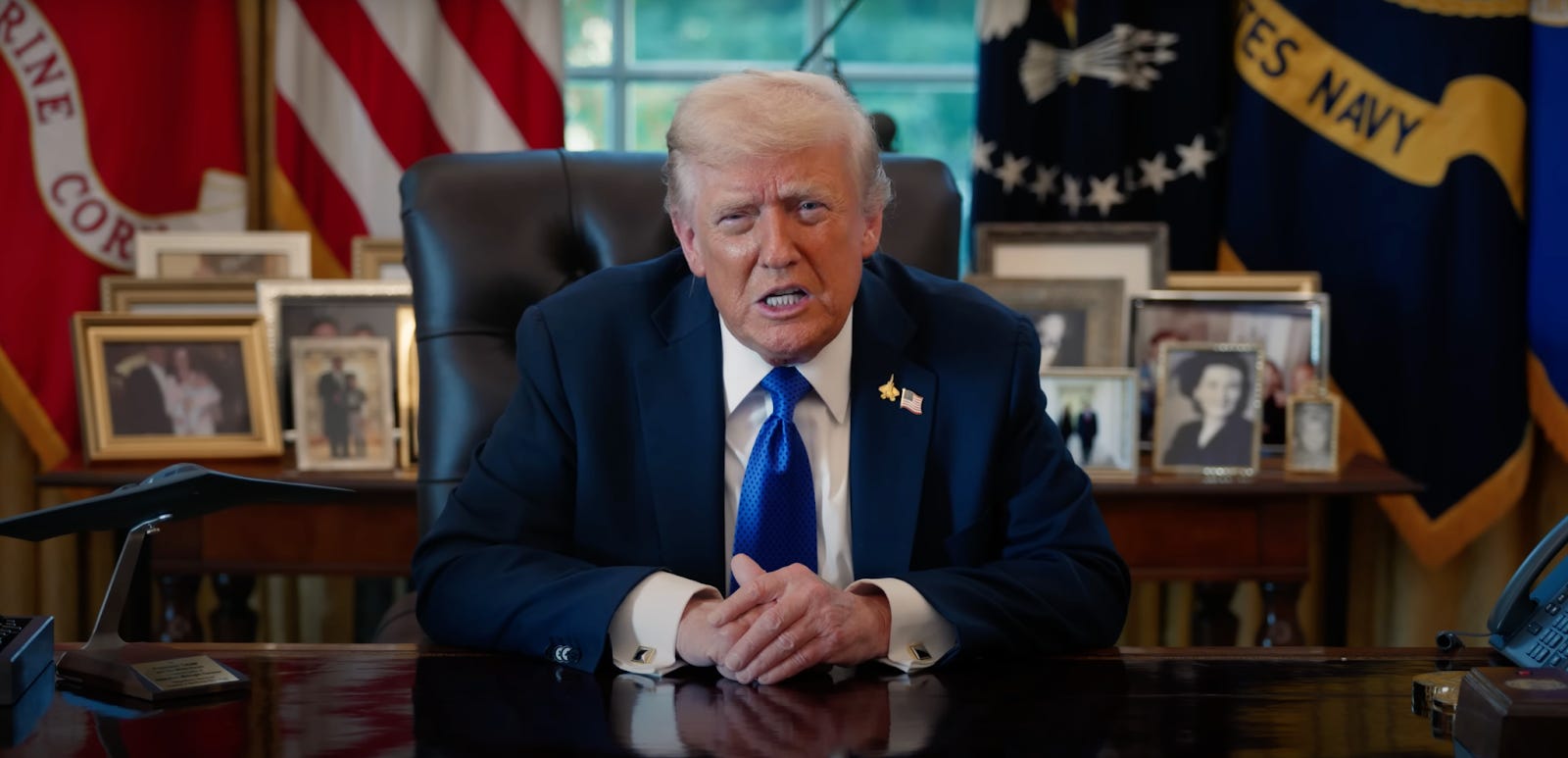
President Donald Trump spoke from the Oval Office in a video address following Hamas’s response to his 20-point Gaza plan.
The Trump Factor
There is little question that Hamas achieved the appearance of a diplomatic victory with its response to Trump. Israel’s initial response to Trump’s embrace of Hamas’s statement was muted. “We will continue to work in full cooperation with the President and his team to end the war in accordance with the principles set by Israel that align with President Trump’s vision,” read a statement from Netanyahu’s office. But, a senior Israeli political source told Israel’s Channel 12, Netanyahu spoke with Trump before the president released his statement welcoming Hamas’s response. “Everything is planned, there are no surprises here,” the source said. “Nothing came as a surprise.”
According to Axios, that Israeli spin is not accurate. Trump told the publication that when he spoke to Netanyahu, he said, “Bibi, this is your chance for victory.” A U.S. official with knowledge of the call said Netanyahu “told Trump this is nothing to celebrate, and that it doesn’t mean anything.” And Trump shot back, “I don’t know why you’re always so fucking negative. This is a win. Take it.” In the end, Trump told Axios, “He was fine with it. He’s got to be fine with it. He has no choice. With me, you got to be fine.”
Over the past seven months—even when there seems to be daylight between Trump’s and Netanyahu’s agendas, or stories are planted in the media about alleged disputes—the U.S. and Israel quickly return to a unified stance.
Hamas is now entering a minefield as technical negotiations begin in Cairo involving Israel, the U.S., Egypt, and Qatar. An Israeli delegation will be headed by Netanyahu attaché Dermer. Trump dispatched his son-in-law Jared Kushner and Special Envoy Steve Witkoff and warned Hamas to “move quickly, or else all bets will be off. I will not tolerate delay, which many think will happen, or any outcome where Gaza poses a threat again,” Trump wrote on Truth Social on Saturday. “Let’s get this done, FAST. Everyone will be treated fairly!”
A Hamas delegation, headed by its political leader Khalil Al-Hayya, will be in Cairo but the negotiations are slated to remain indirect, taking place through mediators. A statement from the Egyptian foreign ministry said the talks would be focused on “details of the exchange of all Israeli detainees and Palestinian prisoners, in accordance with US President Donald Trump’s proposal.”
While Hamas affirmed its commitment to release all Israeli captives, it did not do so unconditionally. The Palestinian side has always maintained that these releases must be tied to a clearly defined and guaranteed roadmap to the end of the genocide, the withdrawal of Israeli forces from Gaza, and the resumption of deliveries of food, medicine and other life essentials. While all of these are mentioned in Trump’s plan, the conditions are far from what the Palestinians had previously said they would accept.
If the U.S. allows substantive negotiations, there will be intense battles over the precise terms, redeployment and withdrawal maps, and the mechanism by which Israel will be prevented from resuming the war.
On August 18, Hamas formally agreed to an Egyptian and Qatari draft of a ceasefire framework, primarily written by Witkoff and Dermer. It involved meticulously negotiated terms for Israeli withdrawal, redeployment maps and conditions on aid. In its acceptance of the framework, Hamas offered substantial concessions. “Almost 98 percent of what has been agreed to by the Israelis was contained in this recent proposal,” Qatar’s foreign ministry spokesman said at the time.
Israel never formally responded, the U.S. ignored Hamas’s acceptance and then, on September 9, Israel tried—and failed—to assassinate Hamas’s negotiating team, including Al-Hayya, in a series of air strikes in Qatar. While some vestiges of that previous framework found their way into Trump’s new plan, many of the hard-negotiated specifics are gone, while provocative new terms Hamas long opposed were inserted.
Trump’s plan states that Israeli withdrawal will be “linked to demilitarization… with the objective of a secure Gaza that no longer poses a threat to Israel.” Hamas continues to maintain that demilitarization is a red line whose crossing would constitute a surrender of Palestinian rights to armed resistance against Israeli occupation.
“When a Palestinian state is established, it is only natural that the weapons of the resistance become the weapons of the state—a state that must be capable of protecting its people, its land, and its rights,” said Osama Hamdan, a senior Hamas leader, in an interview with Al Araby TV on Friday night explaining the movement’s response. “These are matters that must be addressed within a comprehensive national framework.”
Al-Hindi, the Palestinian Islamic Jihad official, concurred, saying that disarmament should not be linked to ending the genocide in Gaza, but requires the input of all Palestinian factions and voices. “We are still in a stage of national liberation and have not yet achieved our rights or the right to self-determination,” he told Drop Site.
The Israel-drawn map that was distributed on Monday shows Israeli forces remaining deeply entrenched in Gaza, including the Philadelphi corridor along the southern border with Egypt indefinitely. An Israeli-imposed “security buffer zone” would “remain until Gaza is properly secure from any resurgent terror threat.” The plan offers no details on how a determination to dismantle the zone would be made.
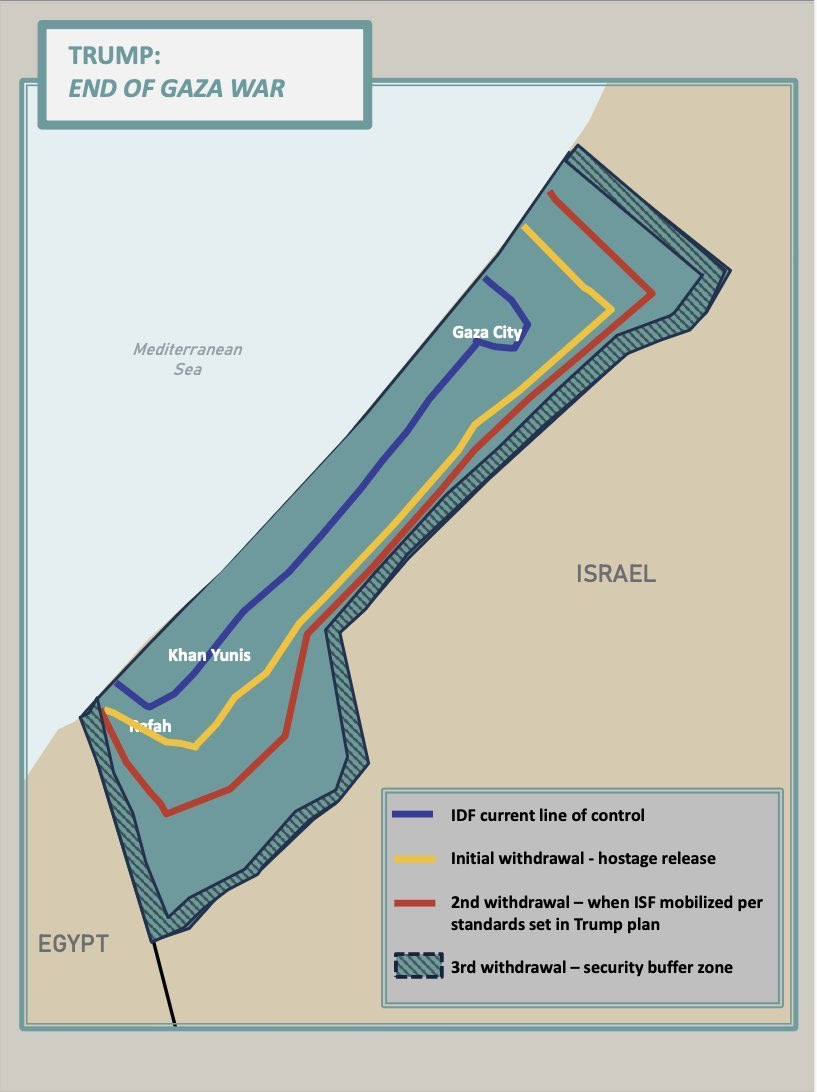
The original withdrawal map according to President Trump’s 20-point Gaza plan.
On Saturday, Trump posted a new map on Truth Social, saying, “After negotiations, Israel has agreed to the initial withdrawal line, which we have shown to, and shared with, Hamas. When Hamas confirms, the Ceasefire will be IMMEDIATELY effective, the Hostages and Prisoner Exchange will begin.” The “negotiations” Trump referred to did not include any Palestinians. According to the map, Israel would remain even deeper inside Gaza territory than indicated in the map distributed on Monday with Trump’s 20-point plan.
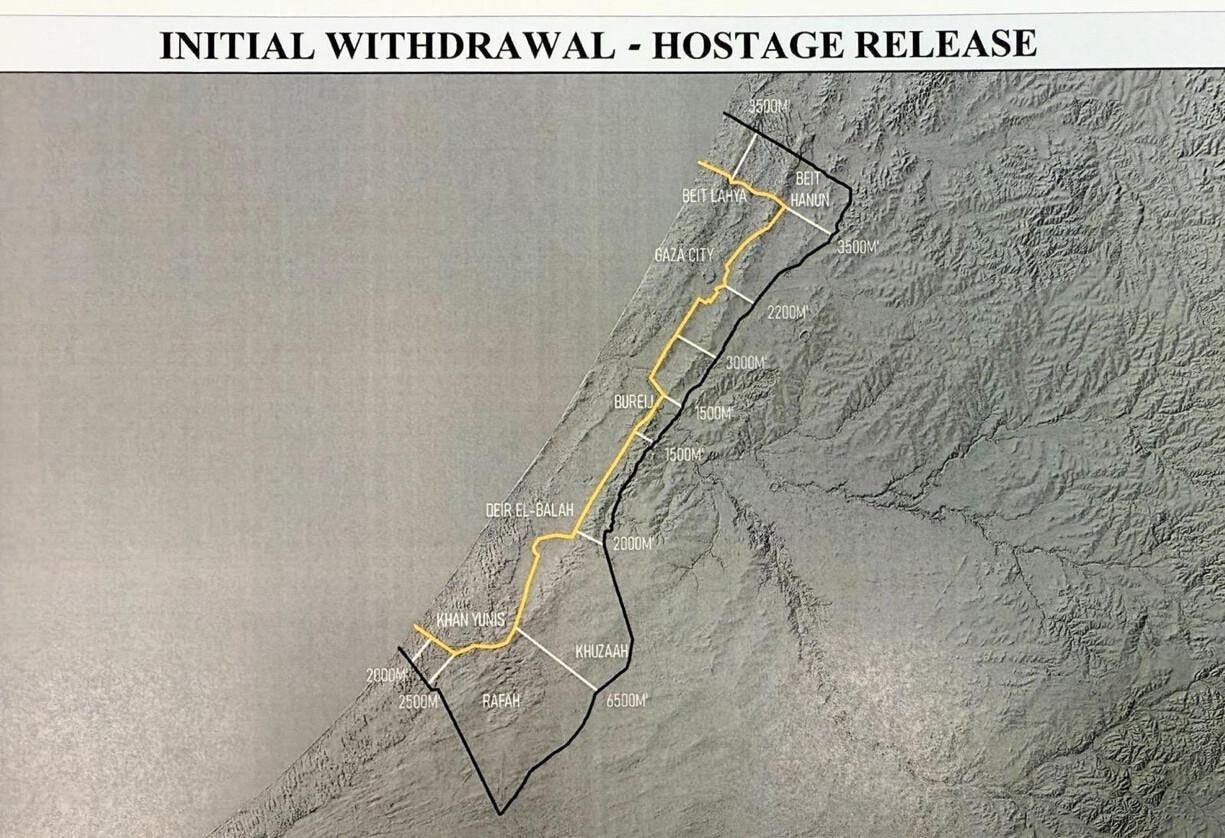
The “hostage release” withdrawal map as published by President Trump on Truth Social on Saturday.
Hanging over all of this is the fact that the most significant, if not only, leverage that the Palestinian resistance holds is the Israeli captives that remain in its custody—20 living and 28 deceased. Trump’s plan requires they be released within 72 hours of the deal being accepted.
Hamas officials have warned that it may take time—perhaps as long as weeks—to locate the bodies of all of the deceased Israeli captives. They said some of them are buried under the rubble of buildings Israel has bombed or demolished, while others may be located inside territory currently occupied by Israeli forces.
The plan also states that Israel will release 250 Palestinians sentenced to life and 1,700 Palestinians from Gaza taken captive after October 7, 2023, including all women and children. The bodies of 15 Palestinians, according to the plan, would be returned for the remains of each deceased Israeli held in Gaza. The Palestinian captives, according to the plan, would be freed only after the Israelis are released.
The initial U.S. and Israeli moves following Hamas’s response to Trump’s plan have been aimed at sending a message that there won’t be real negotiations over the terms of an exchange of captives, but rather a set of directives given to the Palestinian side. The U.S. and Israel are taking the position that the only details to work out have to do with finding locations of Israeli bodies, assembling the list of Palestinian captives to be freed, and showing Hamas Israeli-approved troop redeployment maps. While Trump indicated the initial Israeli troop pull back will pave the way for “the next phase of withdrawal,” the Palestinian resistance will have handed over all the captives, effectively giving up its only leverage.
“We have negotiations that are more or less dictation. This is a coordination, or collaboration, between Trump and Netanyahu, or Netanyahu and Witkoff and Kushner, or probably more a dictation from Netanyahu to Kushner and Witkoff. And then what they say, this is the plan,” Sami Al-Arian, a prominent Palestinian academic and activist, told Drop Site. “The Americans, or Trump in particular, goes and puts forward an ultimatum, hoping that this is going to be adopted or followed by Hamas. Hamas has already said on the record that within the framework of Trump’s plan, they are willing to negotiate certain items and again underline the word negotiate, not to be dictated on.”
Throughout the ceasefire negotiations the past year, Hamas negotiators have demanded guarantees that after the Israeli captives captives are released, it would not immediately resume the genocide. Trump’s plan offers no such commitments and envisions a system of Israeli withdrawal from areas of Gaza only if an international force takes its place.
Even if the Palestinian side is able to secure formal pledges from the U.S. during the talks in Cairo that it will prohibit Israel from resuming the war, history is rife with examples of the U.S. supporting Israel in blowing up agreements. This is another major factor in why Hamas and Islamic Jihad have drawn a red line around the issue of disarmament.
“After two years of crimes, ethnic cleansing, and a policy of starvation, [Israel] has not achieved its objectives through bombing and aggression. Israel has also suffered damage on all internal and external levels and has nothing left to justify the continuation of aggression before the world,” said Al-Hindi. If Israel resumes the military assault on Gaza, “the Palestinian people will not be without means to resist the aggression.”
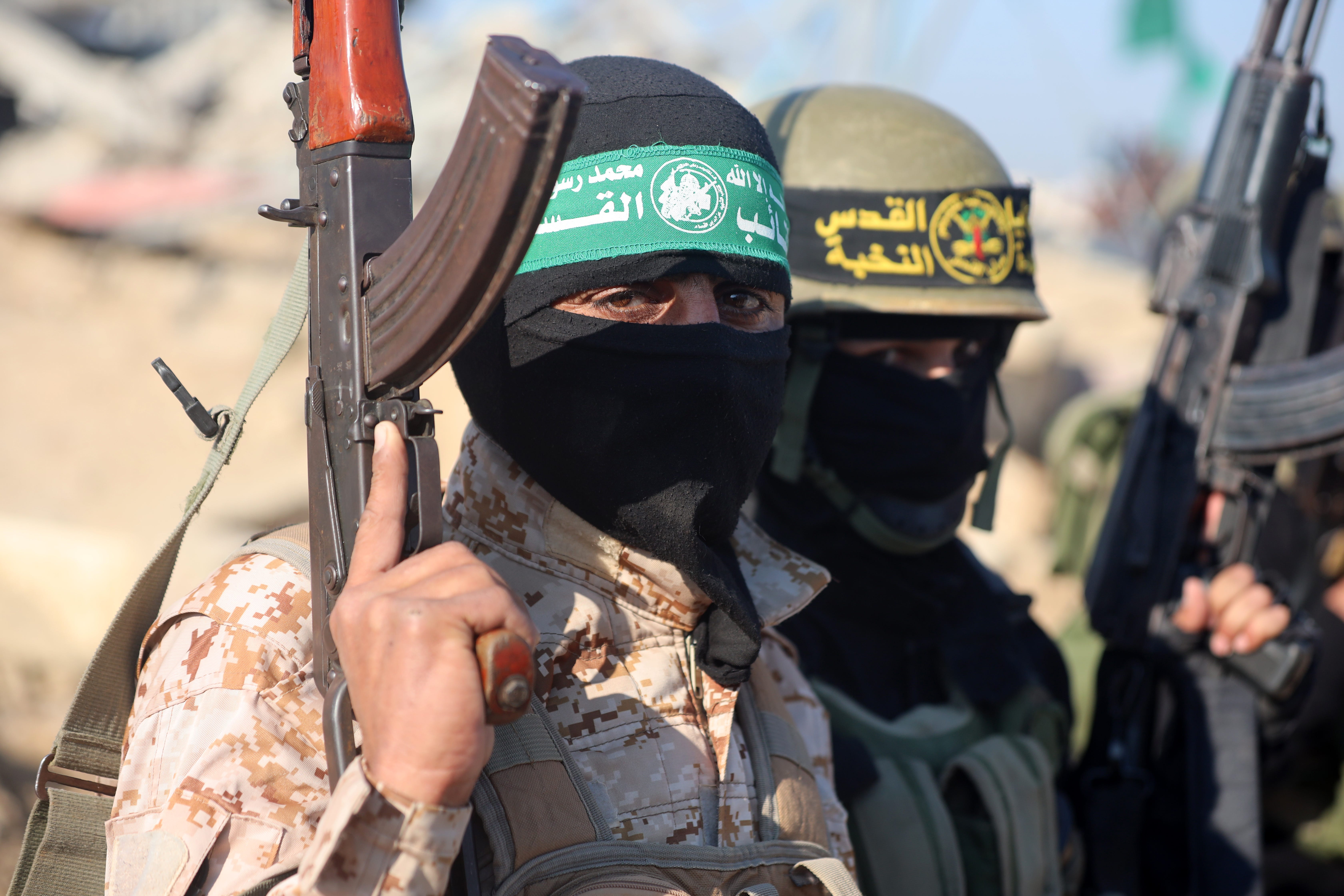
Palestinian Hamas and Islamic Jihad fighters prepare to hand over Israeli and Thai captives to a Red Cross team in Khan Younis, on January 30, 2025. Photo by Majdi Fathi/NurPhoto via Getty Images.
It All Boils Down to What Trump Will Accept
While Trump is heralding the dawn of a new era, one ripe for investment and profit, Israel will undoubtedly seek to use the technical negotiations over the terms of withdrawal and exchange of captives to its advantage. The Palestinian side is entering this stage of talks with the aim of linking withdrawal to the handing over of the captives. Israel wants any talk of withdrawal to be tied to Hamas’s surrender and total disarmament. “Israel will be responsible and involved in the demilitarization of weapons in the Strip,” Netanyahu said.
In a video address on Saturday, Netanyahu claimed Israel was “on the brink of a very big achievement,” saying that he hopes to soon secure “the return of all the hostages—the living and the slain, in one go, with the IDF still deployed deep in Gaza.” Israeli public broadcaster Kan reported that Israel intends to keep its troops in three primary areas of Gaza indefinitely: the “buffer zone” encircling Gaza, the Philadelphi corridor along the Egyptian border, and in strategic locations in northeastern Gaza.
Netanyahu also said that he sees the release of captives as separate from any Palestinian demands. “In the second stage, Hamas will be disarmed and Gaza will be demilitarized,” he declared. “It will happen either diplomatically, according to the Trump plan, or militarily, by us.”
The decisive factor will be whether the U.S. is willing to force Israel’s hand or if Trump will endorse Israeli claims that Hamas is reneging on the deal when its negotiators offer their position on the specific terms for the release of captives.
All this leaves a wide latitude for a breakdown in talks that Israel could exploit to blow up the deal, resume the assault on Gaza, and blame Hamas. That would come at the price of the Israeli captives remaining in Gaza indefinitely as the war continues, but Netanyahu has shown a willingness to keep their lives at risk in pursuit of his agenda. “If the hostages are not released by the deadline that President Donald Trump set, Israel will return to fighting with the full support of all the involved countries,” Netanyahu said Sunday.
At the same time, Trump’s plan does contain some nuance on the issue of disarmament, indicating the White House understands the Palestinian side is not going to accept a surrender order and will not lay down its weapons on demand. While the proposal states that, “All military, terror, and offensive infrastructure, including tunnels and weapon production facilities, will be destroyed and not rebuilt,” it adds: “There will be a process of demilitarization of Gaza under the supervision of independent monitors, which will include placing weapons permanently beyond use through an agreed process of decommissioning, and supported by an internationally funded buy back and reintegration program all verified by the independent monitor.”
The issue of disarmament is largely a red herring. The Palestinian resistance relies overwhelmingly on homemade weapons and ammunition, including repurposed Israeli ordnance used in Gaza. Much of its rocket infrastructure has been depleted or destroyed over the past two years. The October 7 operation was not successful because of advanced weaponry—it was conducted mostly with small arms. Netanyahu and other Israeli officials focus on the weapons issue as a proxy for their demand that Palestinians surrender to Israeli subjugation.
“That is not going to go anywhere because the resistance will be totally against any kind of disarmament in principle. So they’re not going to get into negotiations. And that could also be a breaking point between the parties,” said Al-Arian. “If Trump insists on this point—he should know by now that this is not subject to negotiations.”
Trump has spoken in vainglorious terms about the epic scope of what his plan will achieve and repeats the mantra that it extends beyond Gaza. He continues to emphasize the “magnificent” value of Gaza’s beachfront as a site for future private development. Hamas and other Palestinian factions are clear that they will not enter into any rushed agreements that carry far reaching implications for the future of Palestinian self-determination and statehood—seeking to strike a diplomatic tone and project an image of flexibility and reason by contrast.
“As long as the issue revolves around a willingness to release prisoners on both sides, cease the aggression, and withdraw, then what remains is simply to agree on the arrangements,” said Hamdan in the Al Araby interview. “We do not need lengthy negotiations. If the relevant parties are serious, and if the positive stance of Hamas is met with the same level of positivity, then a ceasefire could be announced,” he added. “The plan can’t have any real value without guarantees. This is a fundamental matter, and this is what the U.S. administration must work on and communicate to the mediators. Such guarantees are essential to achieving an agreement and building Palestinian trust that there is a real opportunity to reach a deal.”
It is also possible that Trump’s quick, affirmative response to Hamas on Friday was part of an elaborate set-up aimed at recovering the Israeli captives and then empowering Israel to continue the genocide.
“I’m afraid they are preparing a trap,” a Palestinian source close to the negotiators told Drop Site. Those fears are well founded. Earlier this year, Trump promised Israel would end the blockade and call for a permanent ceasefire if Hamas turned over U.S.-Israeli soldier Edan Alexander, but then reneged as soon as Alexander was in U.S. custody.
While that scenario is not out of the question, it would cause an earthquake in Trump’s relationship with Arab states with whom his family—most prominently his son-in-law, Jared Kushner—has extensive business ties. It would also derail Trump’s drive to privatize Gaza and strike massive financial deals.
Trump also indicated that he sees this moment as an opportunity to essentially rescue Israel in the face of its growing pariah status globally. “Bibi took it very far and Israel lost a lot of support in the world. Now I am gonna get all that support back,” Trump told Axios on Saturday.
In a statement Sunday, the foreign ministers of Qatar, Egypt, Turkey, Jordan, Saudi Arabia, the United Arab Emirates, Indonesia and Pakistan issued a joint statement that “reiterated their joint commitment to support efforts towards the implementation” of Trump’s proposal, but they also called for a range of terms that Netanyahu has already rejected, including “unifying Gaza and the West Bank.”
Al-Arian, director of the Center for Islam and Global Affairs at Istanbul Zaim University, said that the Palestinian negotiators are entering these talks over Trump’s plan fully aware that Israel’s aim is to eliminate all Palestinian resistance and to ensure that its broader agenda of ethnic cleansing remains intact. Whether or not a deal is reached, he told Drop Site, Palestinians will not surrender.
“If Israel was capable of finishing off the resistance, Hamas and Islamic Jihad and others, in the last two years, they would have done that. There is nothing that they spared short of a nuclear bomb. They tried everything in the book, including the policy of starvation, targeting the civilians to put pressure on the resistance more than the resistance itself,” Al-Arian said. “But I think the whole world now is fed up and they want to end this. And I think Trump is trying to get credit—and certainly he would get credit if this happens—and then he can go and boast that he wants or has won the Nobel Peace Prize. The real question right now is what details he would accept.”
Drop Site News Middle East Research Fellow Jawa Ahmad contributed to this report.
From Drop Site News via this RSS feed