Bullets:
China's monopolies on the mining and refining of critical minerals lead to enormous competitive advantages in downstream industries.
China-based firms have first call on the production of the most important resources, which means low-cost and easily-sourced raw materials for high-value-added products and equipment.
Yttrium is a vital component in gas turbines, which cost millions of dollars per unit.
There is no production of yttrium outside China, and long backlogs and supply chain issues at the Big 3 non-Chinese makers of gas turbines are already opening vast new markets to Chinese gas turbine manufacturers.
Inside China / Business is a reader-supported publication. To receive new posts and support my work, consider becoming a free or paid subscriber.
Report:
Good morning.
The world is now aware that China has monopolies on rare earth materials, and on the refining of them. China has strict export controls on those strategic metals and magnets, and weapons makers in particular are scrambling around, trying to find new sources of them so they can get bombs and missiles and planes built. It’s also a challenge for heavy manufacturers of civilian products, who need Chinese rare earth materials to keep their assembly lines running.
Everyone agrees on those things, now. But all this analysis, which is late in coming and now conventional wisdom, fails to appreciate what Chinese rare earth monopolies really mean. If construction managers need materials from China in order build data centers, it follows that China also might have a natural monopoly on the construction of data centers.
If defense contractors need Chinese rare earth magnets to build advanced aircraft, then it follows that China might have a natural monopoly on building next generation military jets. Order backlogs are piling up at Lockheed; the Pentagon and allied countries are waiting years for the company to deliver planes already paid for. Meanwhile, China is accepting orders and building planes for export to countries friendly to them.
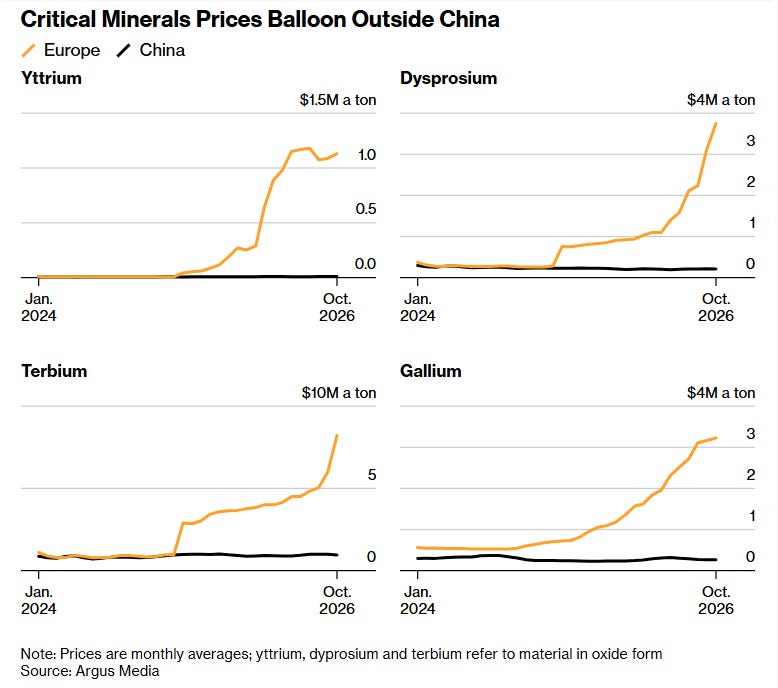

And that’s the problem for manufacturers of all kinds, outside China. It’s Chinese firms who are first in line to buy Chinese rare earths, to then build products that are very high value-added. China could simply make millions of dollars, per ton, on their production of Yttrium, or Terbium, or Gallium. In the case of Yttrium, Chinese companies are making money, selling yttrium to manufacturers in-country, for $9,000 per ton. In Europe, a ton of Yttrium costs over a million dollars; it’s 125 times more expensive.

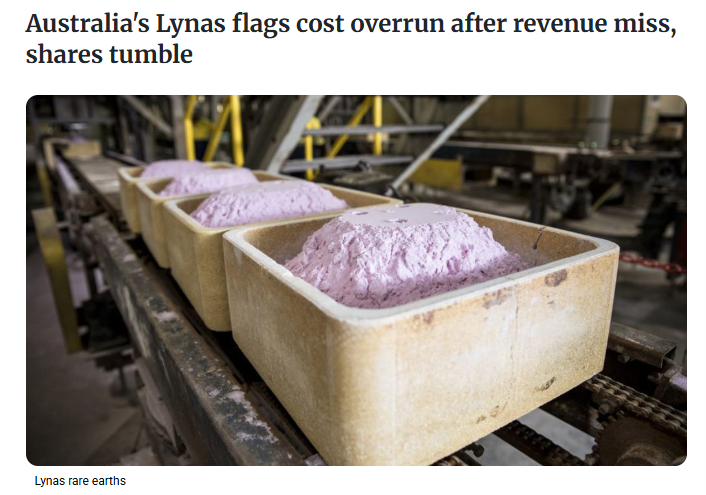
So why aren’t the Chinese yttrium producers selling to Europe, and pocketing huge premiums? There’s no hurry, first of all—it’s not like there are alternative sources of supply that will be shortly turned on. That price disparity is here to stay, and will be available for years. Lynas Rare Earths has a mine in Malaysia that is expected to produce, starting in 2028, but then it needs refining, and the volumes won’t be high enough to make much of a dent in global demand anyway:


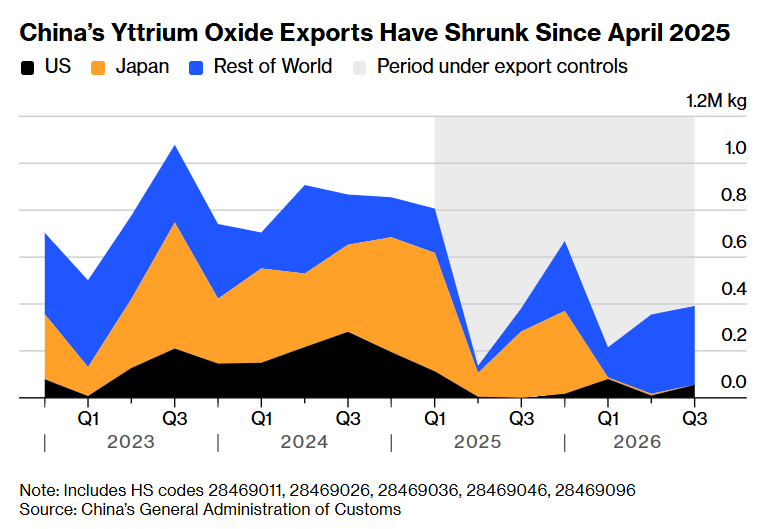
Chinese exports of Yttrium oxide are way down, and most especially to the United States and Japan. Overall, Chinese exports of yttrium are down about two thirds from levels of over two years ago, but that’s because so many of those exports were to the US and Japan:
And here’s where we get into it. Yttrium is critical in semiconductors, and for the turbines for gas power and jet engines. That is a small part of explaining headlines like this: China’s trade surplus is growing—booming even—despite the fact that Trump tariffs in the United States and a trade war of sorts with the EU were designed so that would not happen. And key drivers of the big increase are the highest-value-added products—computer chips and parts, “reflecting soaring prices as a result of the” data center frenzy.
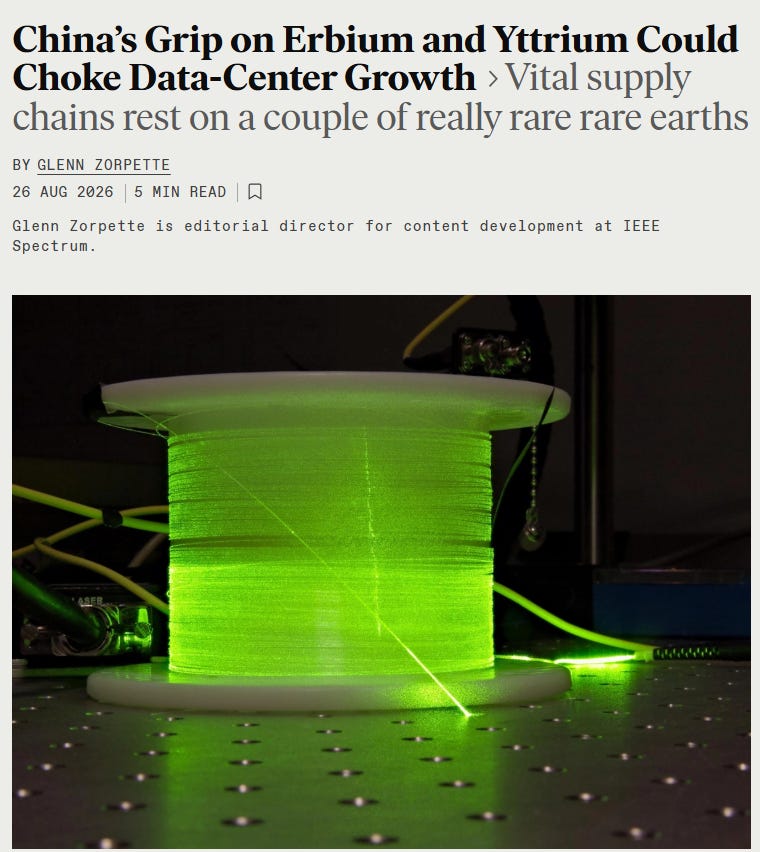
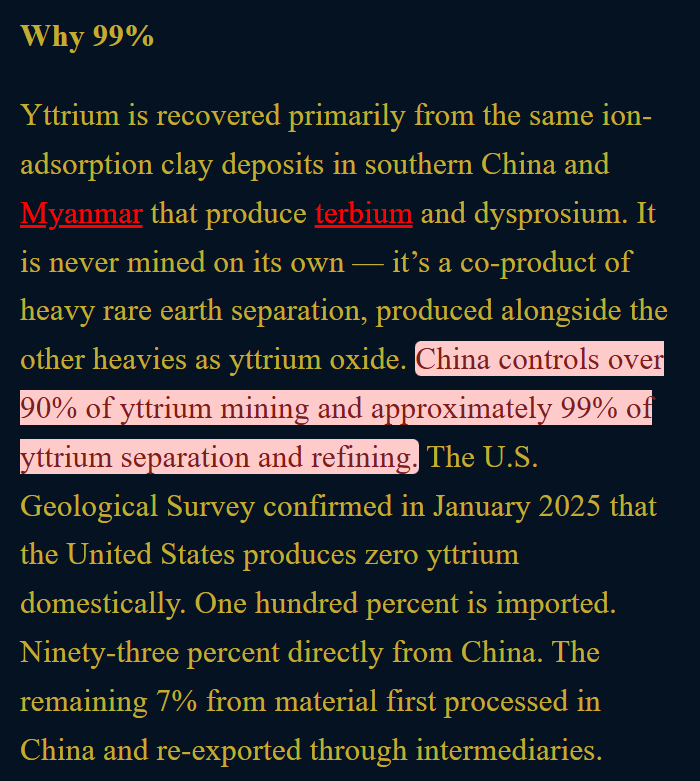
The entire AI data center construction industry runs through Chinese supply chains, and yttrium is one of those rare earths that make advanced processors work. And China mines 90% of all the yttrium in the world, and controls 99% of yttrium’s separation and refining. One hundred percent of the yttrium used in the United States is imported, and 93% of that comes from China. The remaining 7% is processed in China and re-exported, so that sounds like 100% to me. Outside China, there is no yttrium production:
Project Vault is part of the National Defense Stockpile, in turn part of the Defense Logistics Agency, who is staffed with dozens of officers who—one might think—were responsible for securing and locking up the supplies of the most critical raw materials before China achieved 100% of the global market. Billions of dollars were poured into the program in February, and today that money can’t go nearly as far as it would have, say, back in 2023:
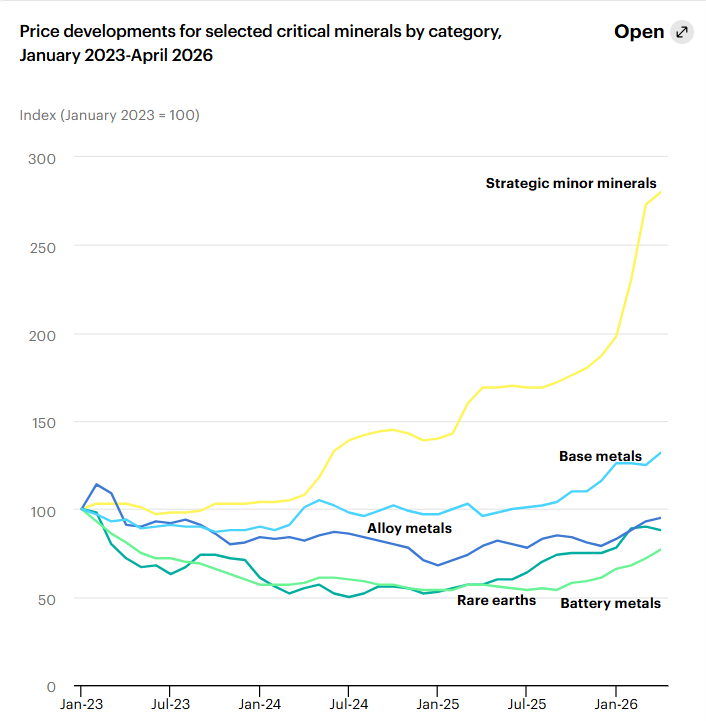
Now China has export bans, the prices are going vertical, and nobody knows when or how all those missiles can possibly be replaced that were launched at Iran, let alone how long it will be before anything is in the so-called vault.
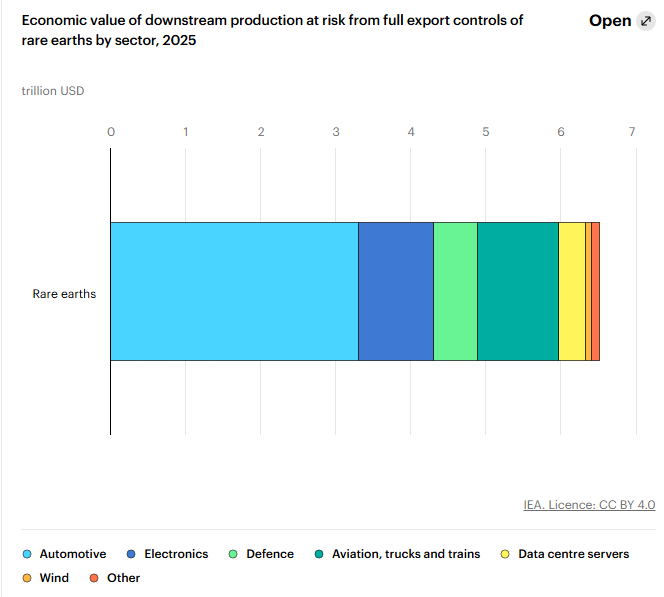
The International Energy Agency tallied up all the downstream industries impacted by China’s export controls, and estimates that over $6 trillion is at risk in Western economies, if those controls stay on. The report goes on to point out that the shortages and high prices are NOT driving new investment in mining—critical mineral investment dropped 9% in 2025. Exploration spending dropped by 10%--there was a slight uptick in uranium prospecting, and a big boost in copper.
But in the case of the most important minerals and elements, investors are pulling back, and analysts don’t really understand why. Aerospace and defense are obviously high national priorities, and governments are increasing their defense spending. But the private sector is not responding, and the IEA is pushing policymakers to take the initiative themselves.
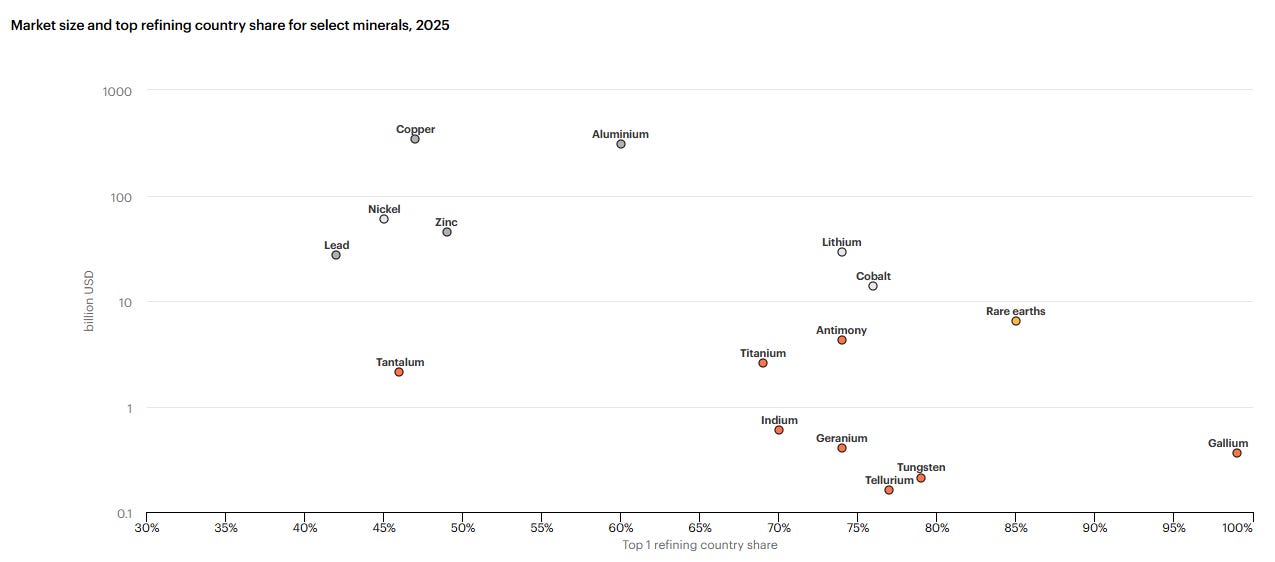
Every one of those metals on that chart, comes from “one supplier”—and that supplier is China. The report goes on for about 20 pages with policy recommendations: high incentives, price floors, cooperation agreements with allies, and so on.
But all that takes time, and non-defense manufacturers don’t have time to wait for governments to build a lot of mines and refineries, to hand over strategic materials for arms manufacturers, while carmakers, for example, get whatever is left over after Lockheed and Raytheon get all they need, and the Defense Logistics Agency fills up their warehouses. So carmakers in Japan are in trouble, just like Ford Motor was recently.
Going back to our original point, though, consider the yttrium problem for a company like GE Vernova. GE is one of three major Western manufacturers of gas turbines. Last December GE Vernova reported sufficient stockpiles of yttrium to last “into next year”, meaning this year.
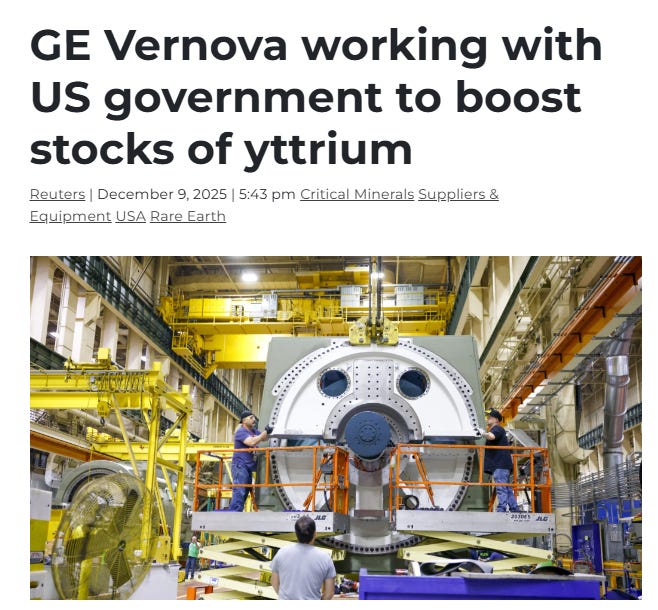


It’s now November, 2026. GE is focused on the yttrium problem “every day”, and was investing in alternatives to rare earths, “if it became necessary”, but “there are cost and performance tradeoffs” in doing that.
It’s true that a Chinese yttrium supplier could take a big pile of yttrium that cost them under $10,000 a ton to produce, mark it up past $1.1 million, and call up GE Vernova. GE’s problem is solved, and that would aso make for a great quarter, for that particular yttrium supplier.
So yttrium is a critical component of those giant turbines—they don’t work nearly as well without yttrium as with yttrium, and we don’t know if GE has figured out, since last November, what substitutes there may even be. But more important than all that: the real value is in the manufacturing of the gas turbines. A high-capacity turbine from GE Vernova costs more than $250 million.

That price has increased four times in three years, because the industry can’t build them fast enough. There are key Chinese manufacturers of gas turbines, and their order backlogs are small, with delivery and installation times measured in months instead of years. So they are taking orders and taking business that otherwise would go to GE or Mitsubishi.
That’s what those Chinese rare earth monopolies mean—they mean that their own manufacturers of the most important and valuable equipment are well supplied with what they need. By not exporting yttrium, in this case, China is exporting giant gas turbines instead.
Be Good.
Resources and links:
Rare Earth Price Gap Flags Supply Strains Ahead of Trump-Xi Meet
https://www.bloomberg.com/news/articles/2026-11-10/rare-earth-strategic-metals-price-gap-flags-supply-strains-trump-xi-meet
AI Boom Helps Fuel China Exports, Pushing Trade Surplus Above $1 Trillion
https://www.bloomberg.com/news/newsletters/2026-11-10/china-trade-surplus
China’s Grip on Erbium and Yttrium Could Choke Data-Center Growth
https://spectrum.ieee.org/rare-earth-shortage
Rare earth price gap flags supply strains ahead of Trump-Xi meet
https://www.mining.com/web/rare-earth-price-gap-flags-supply-strains-ahead-of-trump-xi-meet/
Global Critical Minerals Outlook 2026
https://www.iea.org/reports/global-critical-minerals-outlook-2026/executive-summary
Japan ‘months’ from running out of critical rare earth as China squeezes supply
https://www.reddit.com/r/Economics/comments/1xavxf3/japan/_months/_from/_running/_out/_of/_critical/_rare/
GE Vernova working with US government to boost stocks of yttrium
https://www.mining.com/web/ge-vernova-working-with-us-government-to-boost-stocks-of-yttrium/
How GE Vernova builds the massive gas turbines powering the AI data center boom
https://www.cnbc.com/2026/06/27/ge-vernova-gas-turbines-ai-data-centers.html
America’s AI Build-Out Hinges on Chinese Electrical Parts
https://www.bloomberg.com/news/features/2026-04-01/us-ai-data-center-expansion-relies-on-chinese-electrical-equipment-imports
China Takes Aim at Western Dominance of the Gas-Turbine Industry
https://www.bloomberg.com/news/articles/2026-11-12/china-takes-aim-at-western-dominance-of-the-gas-turbine-industry
China exports its first domestically manufactured heavy-duty gas turbine
Australia's Lynas flags cost overrun after revenue miss, shares tumble
https://www.miningweekly.com/article/australias-lynas-flags-cost-overrun-after-revenue-miss-shares-tumble-2026-07-22
China is flexing its supply chain muscles — and the auto industry is freaking out
https://www.businessinsider.com/china-rare-earth-restrictions-alarming-auto-industry-ford-bmw-tesla-2025-6
Inside China / Business is a reader-supported publication. To receive new posts and support my work, consider becoming a free or paid subscriber.
From Inside China / Business via This RSS Feed.


