219
black holes
(mander.xyz)
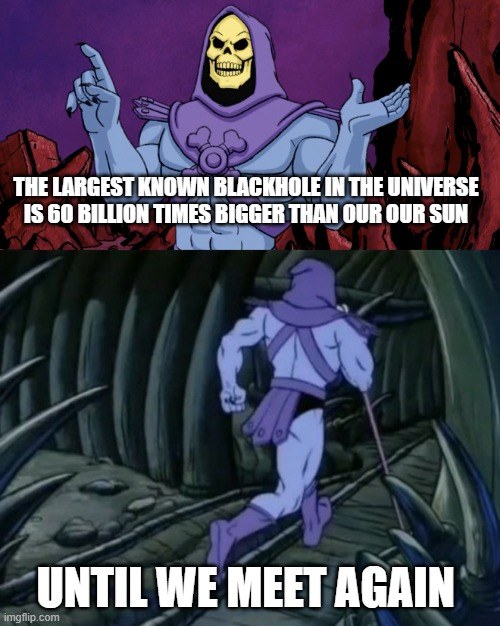
And it still can't compete with your mama
Until we meet again
It depends what you mean by big. Are you talking mass or volume? If you're talking volume, you could argue the black hole consumes no space but perhaps you mean the space contained within the event horizon.
I came to ask something similar, but far less eloquent. So, if you don't mind, I'm just going to piggyback on your comment.
Beyond the event horizon is just insane math and theory
There are 2 parts. At the center is the singularity. Theoretically, this is an infinitely small point of infinite density. This has no volume. Around this is the event horizon. This has volume, and is what we refer to as a black hole. Theoretically, you could have a black hole without a singularity, you just need an area dense enough that light can't escape.
If singularity exists at all.
Agreed.
I personally don't think they exist. More likely space-time gets tied in an extreme knot. The gradients produce Hawking radiation. This radiation will both evaporate the mass from the black hole, as well as provide radiation pressure on in-falling matter. From the outside, hawking radiation is incredibly weak. Time dilation will push the pressure towards infinity, as the dilation approaches infinity (at the event horizon).
Matter would never actually reach the event horizon. The radiation pressure would increase to push it away. The event horizon would also recede ahead, as the black hole evaporates. The matter would skim the event horizon, but not actually cross it.
If I remember correctly supermassive black holes do consume space and can be quite large. They can also be much less dense than neutron stars, let alone stellar black holes.
Singularity is as much a placeholder for "we don't know" as is Hawking radiation.
30 billion times more maasive
https://www.space.com/largest-known-black-hole-discovered-through-gravitational-lensing
I was wrong and pedantic
I've heard that the greater the mass of the black hole, the lesser the density. So I'm assuming this black hole isn't dense at all. I still don't understand it.
Right. That's why the term massive is preferred over any other reference to size. A black hole more massive than the sun would appear far smaller at it's core.
Hey, ya can't spell "m'ackshually" without "a smack" upside the head, eh?
A place for majestic STEMLORD peacocking, as well as memes about the realities of working in a lab.

Rules