8
What's New in C# 14? Key Features and Updates You Need to Know
(www.syncfusion.com)
when you read a paper that contains math, you won’t see a declaration about what country’s notation is used for things that aren’t defined
Not hard to work out. It'll be , for decimal point and : for division, or . for decimal point and ÷ or / for division, and those 2 notations never get mixed with each other, so never any ambiguity about which it is. The question here is using ÷ so there's no ambiguity about what that means - it's a division operator (and being an operator, it is separating the terms).
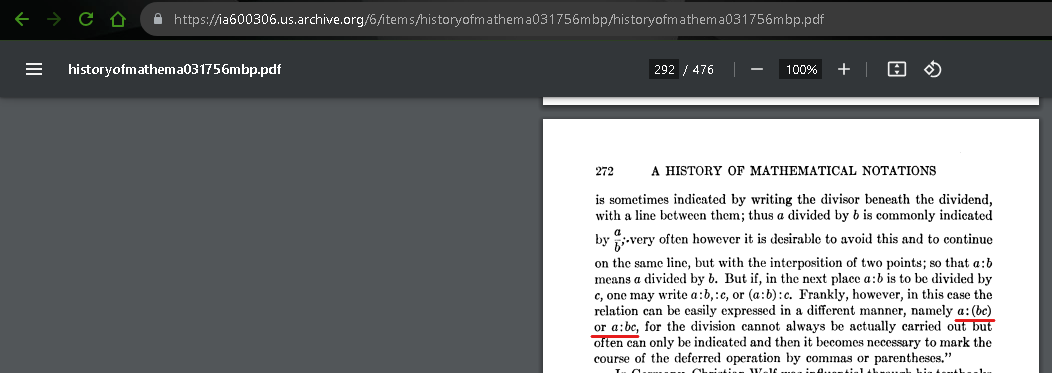
Neither is ambiguous. #MathsIsNeverAmbiguous ab=(axb) by definition. Here it is referred to in Cajori nearly 100 years ago (1928), and literally every textbook example quoted by Lennes (1917) follows the same definition, as do all modern textbooks. Did you not notice that the blog didn't refer to any Maths textbooks? Nor asked any Maths teachers about it.
most scientific calculators are designed to use it
They don't. They use The Distributive Law and Terms.
why @wischi went through the effort of writing a rather detailed blog on this is because the order of operations most people are taught doesn’t cover juxtaposition.
The order of operations rules do cover it. Did you not notice that the OP never referenced a single Maths textbook? Because, had that been done, the whole house of cards would've fallen down. See my Fact Check posts doing exactly that.
The order of operations is not part of a holy text that must be blindly followed
No, it's in Maths textbooks, and must be... blindly followed. :-)
If these numbers had units
...it wouldn't matter at all. The order of operations comes from the very definitions of the operators themselves. e.g. 2x3 is shorthand for 2+2+2.
It's not taught 2 different ways. It's taught the same around the world (the mnemonics are different but the rules are the same), there's just 2 types of people - those who remember the rules and those who don't. You'll notice students never get these questions wrong, only adults who've forgotten the rules.
Don't need any extra letters - just need people to remember the rules around expanding brackets in the first place.
Hi Maho! Good to see you here. I wasn't sure if you had joined here or not.
I did not create this post
No, I did (see previous point I wasn't sure if you were on here). :-) Although there is some overlap between here and Mastodon, there are some who are only getting their news here or there, so I made some posts here too. I made the actual original post in the Windows Development Community, and have had a few new subscribers as a result, so that's good. :-)
I have been experimenting with ActivityPub for my site (https://maho.dev/2024/02/a-guide-to-implement-activitypub-in-a-static-site-or-any-website/)
You might like to make your own, separate post about that. I didn't do one for it yet - needed to explore more what communities we have here that might suit it (e.g. I'm not sure if there's a ActivityPub Community). I just knew it didn't really fit into the Communities I was already subscribed to (though maybe this one?).
I decided to create this bot, to see if it would be something useful for the fediverse
That's a big thumbs up from me :-)
I Looked up doing factorials and n! = n(n – 1) is used interchangeably with n! = n*(n – 1)
Yeah, there's a problem with some lazy textbook authors, which I talked about here. A term is defined as ab=(axb), and yet many textbooks lazily write it as ab=axb, which is fine if that's the whole expression, but NOT fine if the expression is a/bc (a/(bxc) and a/bxc AREN'T the same thing!), and so we end up with people removing brackets prematurely and getting wrong answers. In other words, in your case, only n!=n(n – 1) and n!=(nx(n – 1)) can be used interchangeably.
The ÷ sign isn’t used by “Americans”, it’s used by small children
I don't know where you're from, but it's used universally in Australia - textbooks, calculators, all ages - and from what I've seen the U.K. too.
As are you. There is no such thing as implicit multiplication - the actual relevant rules are Terms and The Distributive Law.
#MathsIsNeverAmbiguous #DontForgetDistribution