8 / 2 * (2 + 2)
That's not the same as 8 / 2 (2 + 2). In the original question, 2(2+2) is a single term in the denominator, when you added the multiply you separated it and thus flipped the (2+2) to be in the numerator, hence the wrong answer.
8 / 2 * (2 + 2)
That's not the same as 8 / 2 (2 + 2). In the original question, 2(2+2) is a single term in the denominator, when you added the multiply you separated it and thus flipped the (2+2) to be in the numerator, hence the wrong answer.
Turns out I’m wrong, but I haven’t been told how or why. I’m willing to learn if people actually tell me
Well, I don't know what you said originally, so I don't know what it is you were told was wrong - 1 or 16? 😂 The correct answer is 1.
Anyhow, I have an order of operations thread which covers literally everything there is to know about it (including covering all the common mistakes and false claims made by some). It includes textbook references, historical Maths documents, worked examples, proofs, memes, the works! I'm a high school Maths teacher/tutor - I've taught this topic many times.
Everything I know is a lie
...including the comment you just replied to. Here is a thread with actual textbook references, historical Maths documents, worked examples, proofs, the works.
the problem with your logic is that it’s using rules designed for primary school
Actually The Distributive Law is taught in Year 7. The Primary School rule, which doesn't include brackets with coefficients, is only the intermediate step.
many decades ago. Not a rigorous mathematical convention
It's an actual rule which is centuries old.
mathematicians frequently use juxtaposition to indicate multiplication
It's not multiplication - it's either The Distributive Law or Terms, which are 2 separate rules.
an operation that doesn’t get used in primary school
Yes, as I said it's taught in Year 7.
8/2(2+2) = 8/2(4)
Then you do your exponents
You haven't finished Brackets yet! The next step is...
8/(2x4)=8/8
This is straight from the textbook
Not any textbook I've seen. Screenshot? Here's some actual textbooks
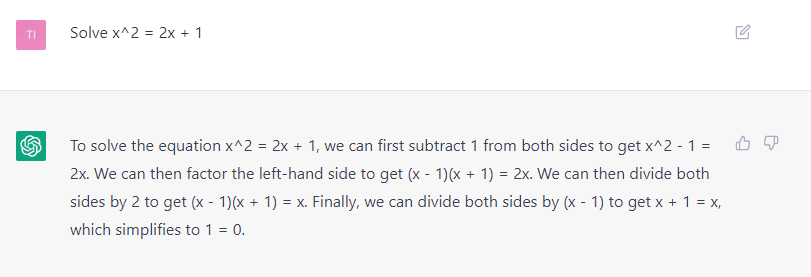
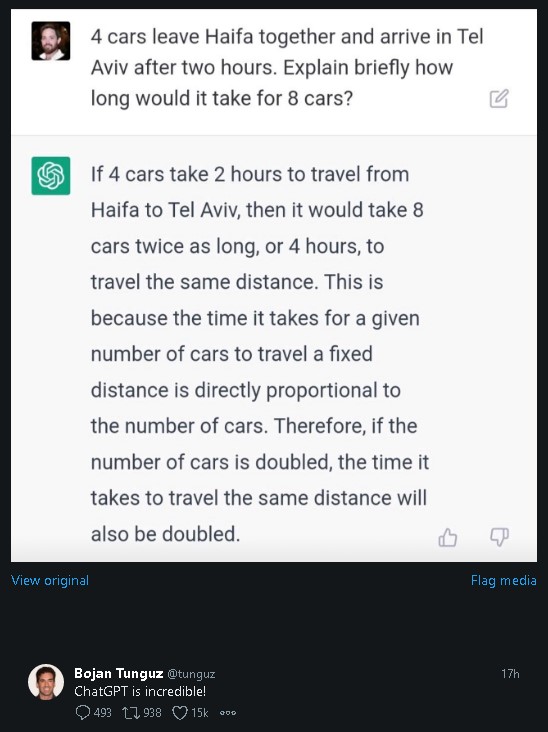
ChatGPT says...


Only if it's a fraction. If it's 2 separate terms then you use whatever your country uses for division - obelus or colon or whatever. They have to be 2 separate things, otherwise how would you write to divide by a fraction?
Regarding your second point I tried to address that in the “distributive property” section,
When I discovered this comment I went to read it, and yes, it's true you discussed the Distributive Property, however, what these people are talking about is The Distributive Law which isn't the same thing (though people often call it the wrong name), and makes the question completely unambiguous. You literally can't move on from the "B", Brackets, in the rules until there are no brackets left - the B is literally short for "solve Brackets" (every letter is "solve (something)"), and so anyone who does the division before solving the brackets has just violated the order of operations rules.
The bot’s posts are
Yes, that was the point of my post - can now follow the blog directly.
Microsoft is not posting their content in a federated way
Well, they're using Wordpress, and Maho has activated the Wordpress ActivityPub plug-in to enable following it. Currently to comment on them you need to login (I guess with MS account?), so yes, would need it to be on official MS involvement for that change to happen, rather than something Maho has done in his spare time, because that would need an organisational change.
I can’t think of any example of a button or switch that by itself can be clear if it is engaged or not
The power button on my PC lights up when it is on. I have a start/cancel processing button with which I use different colour-schemes - it's a blue or green button/text for "start processing" and a red button/text for "cancel processing" (i.e. danger - this has consequences if you press it!).
Well, that was interesting - when I cross-post a programming.dev post I originally made from Mastodon, it links to my Mastodon post instead of the !dotnetmaui@programming.dev post, which is here BTW
But that would be a different expression with a different answer (16 rather than 1). This is the mistake made by the programmer of the e-calc - treats it as though there's extra brackets there when there isn't.