5
Gerald's list of apps made with MAUI
(github.com)
Afaik the order of operations doesn’t have distributive property in it
The Distributive Law applies to all bracketed terms that have a coefficient. It's literally the first step in solving brackets.
what’s the correct one?
Yes, one is correct :-)
but you’re supposed to read MD and as one step
You can do them in any order at all - M then D, D then M (hence the acronym BEDMAS), or all in one - what does matter is not treating Distribution as though it's Multiplication (which refers literally to multiplication signs), when in actual fact it's the first step in solving Brackets.
I’m talking about how you said (A)B for A=3 B=-6 equals -3
No, that's not what I said, since that's not what you said. You didn't write (A)B where A=3 and B=-6, you wrote (3)-6, which is 3-6 (the brackets are redundant as they are 2 terms separated by an operator), which is -3. If you intended this to be interpreted as a single term then you should've written (3)(-6), which is -18. Alternatively, if you had written (3)6, that would be equal to 18, but you wrote (3)-6, which is 2 terms separated by a minus. You wrote (A)-B, not (A)B (or (A)(B)), and so I read it as (A)-B.
The syntax can be ambiguous.
No, it's not. Now that I know what you mean, you just failed to write it the way you apparently intended - you didn't follow the syntax rules for multiplying by a negative.
but the concept of distribution does not exist within in RPN
So what you're really saying, as far as I can tell, is brackets themselves don't exist in RPN.
evaluating a parenthetical gets the same result as distribution
Except when it doesn't, which is my original point.
When I was in school, year 7 was primary school
Oh really? My apologies then. I've only ever heard Year 7 called high school or middle school, never primary school. What country is that in?
multiplication by juxtaposition. Which I’m fairly sure for me at least was in year 6
I've seen some Year 6 classes do some pre-algebra (like "what number goes in this box to make this true"), but Year 7 is when it's properly first taught. Every textbook I've ever seen it in has been Year 7 (and Year 8, as revision).
Also, it's not "multiplication by juxtaposition", since it's not multiplication - it's The Distributive Law - which is Distribution - and/or Terms - which is a product, which is the result of a multiplication.
No, the idea of specifically codifying BIDMAS comes from the early 1900s
The order of operations rules are older than that - we can see in Lennes' letter (1917) that all the textbooks were already using it then, and Cajori says - in 1928 - that the order of operations rules are at least 300 years old (which now makes them at least 400 years old).
If you're talking about when was the mnemonic BIDMAS made up, that I don't know, but the mnemonics are only ways to remember the rules anyway, not the actual rules.
I don’t know why you’re going throughout this thread
I'm a Maths teacher, that's what we do. :-)
a rigid primary school application of BIDMAS will lead you to the wrong answer
Only if the bracketed term has a coefficient (welcome to how Texas Instruments gets the wrong answer), which is never the case in Primary School questions - that's taught in Year 7 (when we teach The Distributive Law).
juxtaposition actually comes before explicit multiplication... I think that’s what you mean when you keep saying “it’s called terms”
Terms come before operators, and we never call it juxtaposition, because The Distributive Law is also what people are calling "strong juxtaposition" (and/or "implicit multiplication"), but is a separate rule, so to lump 2 different rules together under 1 name is where a lot of people end up going wrong. There's a Youtube where the woman gets confused by a calculator's behaviour and she says "sometimes it obeys juxtaposition and sometimes it doesn't" (cos she lumped those 2 rules together), and I for one can see clear as day the issue is it's obeying Terms but not obeying The Distributive Law (but she lumped them together and doesn't understand these are 2 separate behaviours).
Terms and multiplication by juxtaposition can work together
But that's my point, there's no such thing as "multiplication by juxtaposition". A Term is a product, which is the result of a multiplication.
If a=2 and b=3 then...
axb=2x3 - 2 terms
ab=6 - 1 term
In the mnemonics "Multiplication" refers literally to multiplication signs, and nothing else. The Distributive Law is done as part of solving Brackets, and there's nothing that needs doing with Terms, since they're already simplified (unless you've been given some values for the pronumerals, in which case you can substitute in the values, but see above for the correct way to do this with ab, though you could also do (2x3), but absolutely never 2x3, cos then you just broke up the term, and get the wrong answer - brackets can't be removed unless there is only 1 term left inside. People writing 2(3)=2x3 are making the same mistake).
Google it if you don’t believe me
BWAHAHAHA! 😂 Google gets it wrong too. Try looking in a Maths textbook instead (I have plenty of them since I'm a Maths teacher).
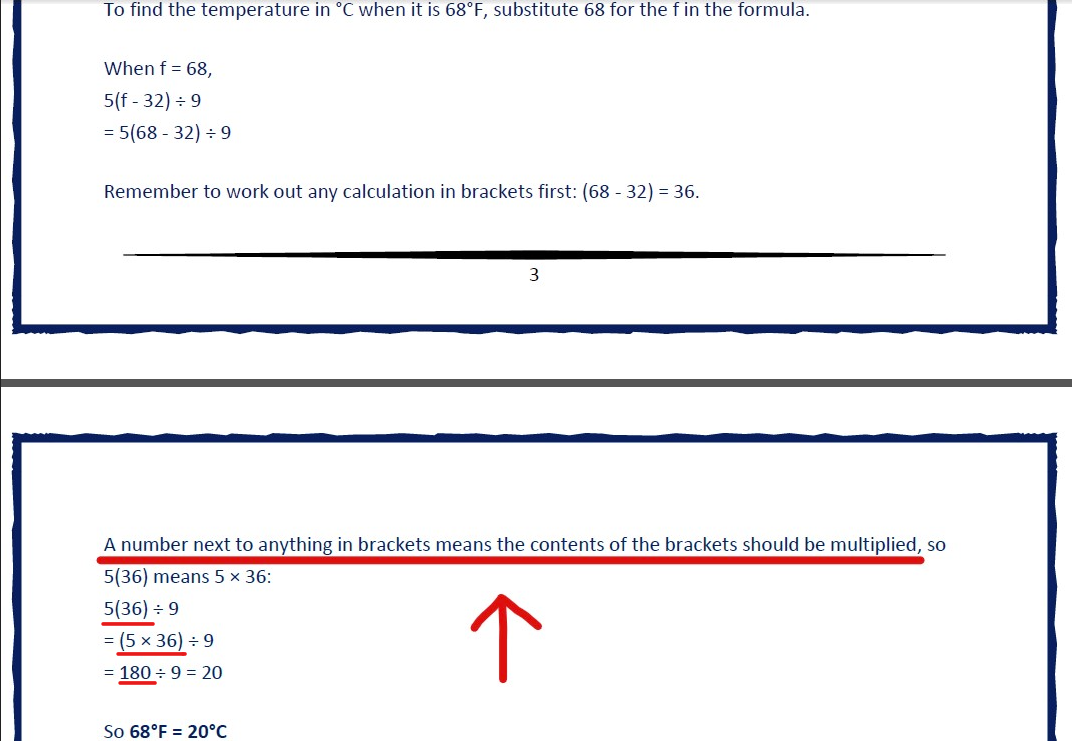
Check a high school Maths textbook - even easier!
Yes, unfortunately there are some bad teachers around. I vividly remember the one I had in Year 10, who literally didn't care if we did well or not. I got sick for an extended period that year, and got a tutor - my Maths improved when I had the tutor (someone who actually helped me to learn the material)!
Regarding your second point I tried to address that in the “distributive property” section,
When I discovered this comment I went to read it, and yes, it's true you discussed the Distributive Property, however, what these people are talking about is The Distributive Law which isn't the same thing (though people often call it the wrong name), and makes the question completely unambiguous. You literally can't move on from the "B", Brackets, in the rules until there are no brackets left - the B is literally short for "solve Brackets" (every letter is "solve (something)"), and so anyone who does the division before solving the brackets has just violated the order of operations rules.
The bot’s posts are
Yes, that was the point of my post - can now follow the blog directly.
Microsoft is not posting their content in a federated way
Well, they're using Wordpress, and Maho has activated the Wordpress ActivityPub plug-in to enable following it. Currently to comment on them you need to login (I guess with MS account?), so yes, would need it to be on official MS involvement for that change to happen, rather than something Maho has done in his spare time, because that would need an organisational change.
Well, that was interesting - when I cross-post a programming.dev post I originally made from Mastodon, it links to my Mastodon post instead of the !dotnetmaui@programming.dev post, which is here BTW
They do. Maths is universal, just like the laws of Physics (which are often written using Maths BTW).