[-] SmartmanApps@programming.dev 1 points 2 years ago

Are you a high school math teacher by chance?

Yep.

Because you’re using a rigid definition of simplify that I don’t necessarily agree with.

You don't agree with Maths textbooks? 😂

"And told you to simplify, what would you do?" - I would ask you what on Earth it's supposed to say, given it's formatted all weird! 😂

[-] SmartmanApps@programming.dev 1 points 2 years ago

(a)(b) basically means a*b.

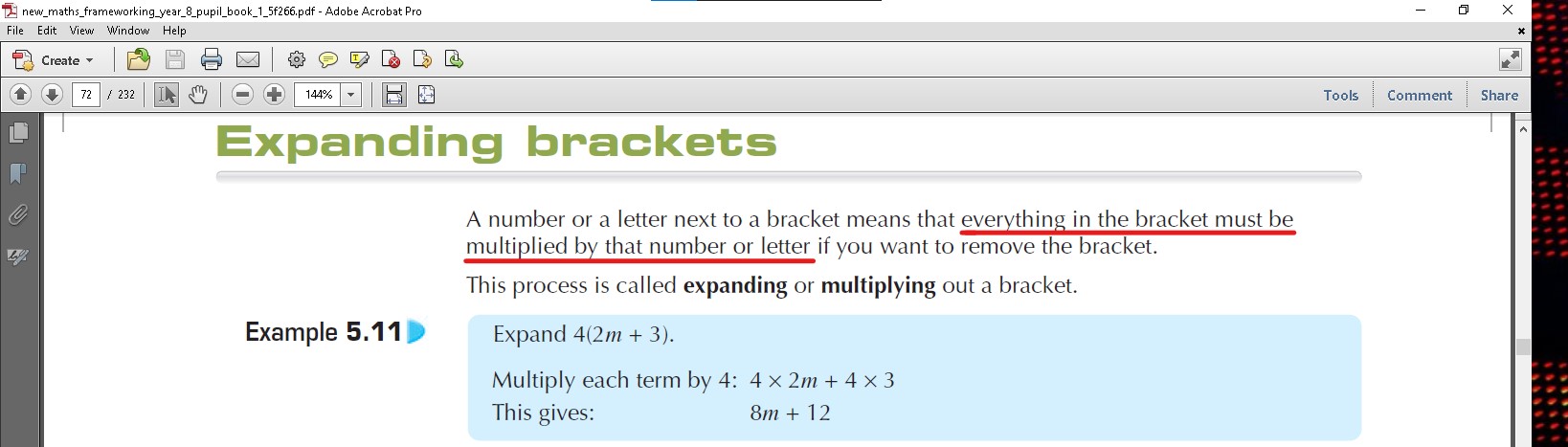
Actually it's (axb), since a(b+c)=(ab+ac). This is where a lot of people go wrong in the order of operations questions you see on socials - removing the brackets too soon. 1/ab=1/(axb) NOT 1/axb. If a=2 and b=3 then 1/ab=1/(2x3)=1/6, but 1/axb=1/2x3=3/2. Note that this also means it gets solved in the Brackets step of order of operations, NOT the "Multiplication" step (another common mistake).

If there is no operator though, it is assumed multiplication

It's not "multiplication", it's a Product, a single number written as a product of factors. If a=2 and b=3 then ab is 6 written as the product of 2 and 3. ab=(2)(3)=(2x3)=6. axb=ab, 2x3=6, axb=2x3, ab=6.

"I’m unsure why that is."

To show it's a single number, not 2 separate numbers to be multiplied. Think of things like F=ma. You have to show that ma is a single number (equal to the Force), not 2 separate numbers multiplied., mxa. If you were doing something like dividing by the Force, then you have to have 1/ma=1/(mxa), NOT 1/mxa.
[-] SmartmanApps@programming.dev 1 points 2 years ago

No problem. Feel free to ask me questions.

-1
1
0
7
26
1
-4
1
4
1
1
0
[-] SmartmanApps@programming.dev 1 points 2 years ago

Got quick feedback from Gerald on Mastodon. This is a change that went live with 8.0.3 in November (then we had all those fun and games with 8.0.3 not updating!), hence why the GA users are only just now running into it. If we need the folder - i.e. in order to have something to link to - then just manually add the net8.0 back into the csproj, do a dotnet restore, and then it will build.

[-] SmartmanApps@programming.dev 1 points 2 years ago

I think you misunderstand my argument

No, you demonstrably didn't understand mine, which is, what you are saying is impossible, but you're still saying it's possible.

I could use still math to solve a real-world problem with an altered order of operations

No, you can't. You already tried to do addition first in 2+3x4 and found out why it doesn't work. Ever since then you've been ignoring that result and pretending that there's some other way to make it work. No, there isn't. As long as multiplication is defined in terms of addition (i.e. 3x4=3+3+3+3) then it's impossible to get a right answer unless you do multiplication before addition.

You could still do anything you can do with regular math, if you had a different order of operations

No, you can't. Again, you already proved you can't.

Do you need me to calculate something, to prove it to you?

Go ahead - I'm not holding my breath. I already told you why it literally can't work. But note that adding brackets isn't changing the order of operations - brackets are already part of the order of operations. Writing 2+3x4 as 2+(3x4) is exactly the same thing.

BTW just to FURTHER prove your "addition first" doesn't work, look at this example...

3x4+2=3x6=18. But earlier you did 2+3x4=5x4=20 - not even the same answer in an "addition first" world! Welcome to why it's impossible to make addition-first work. But knock yourself out - you're welcome to try! 😂

The order of operations is just part of a system of notation

No, it isn't. It's part of the rules of Maths. Notation is how you write it - underlying that is how Maths actually works. This is embodied in the rules of Maths.

is inherently arbitrary

Completely fixed, and a result of the way the operators are defined - that was the only "arbitrary" bit, deciding what the operators were and what they were going to mean, but once you did that then the order of operations rules were already written for you (having already been determined as soon as you made the definitions of the operators in the first place).

number 5 has no inherent meaning behind it other than the convention of how we interpret it

Again, not a convention, a rule of how to interpret it. You can't just decide to interpret 5 as four, or again, you end up with wrong answers. The rules of Maths prevent you from getting wrong answers. You found that out yourself when you tried to do addition first in 2+3x4.

[-] SmartmanApps@programming.dev 1 points 2 years ago

Actually I'm educating and hoping people will stop arguing about it. You can take it on board or not. You actually nearly had it.

Also, your comments will show up in search results for all eternity unless you delete them.

[-] SmartmanApps@programming.dev 1 points 2 years ago

I agree it needs to be more clearly defined

It's clearly defined in any Maths textbook you pick up.

[-] SmartmanApps@programming.dev 1 points 2 years ago

2y, should take higher priority simply because it cannot be any further resolved or simplified

Bingo!

That is not the case with, say, 2(3+1)

It's the same thing, where y=3+1.

1/7y. Is the coefficient 7, or is it 1/7? i.e. Is that 1/(7y)

Yes, it's 1/(7y) as per the definition of Terms.

Either way, if that’s not the the standard understood by everyone

It's the standard in literally every Maths textbook.

[-] SmartmanApps@programming.dev 1 points 2 years ago

I’ve even had people share a snip from some book that states this as fact

A Maths textbook.

However, this is not standardized

It's standard in every Maths textbook.

there is no reason to treat it as such just because a few people assert it is should be

The "few people" are Maths teachers and Maths textbook authors.

It doesn’t make sense at all to me that implied multiplication would be treated any differently

There's no such thing as implicit multiplication

They’re both the same operation

No, what people are calling "implicit multiplication" is either The Distributive Law - which is the first step in solving Brackets - or Terms - and neither of these things is "multiplication". Multiplication literally refers to multiplication symbols only.

It’s why that symbol is not used by real mathematicians at all. It is just abundantly more clear what you’re saying if you use the fraction bar notation

The division symbol is used - it is not the same thing as a fraction bar.

x÷y(z) is the SAME as x÷y*z.

No, it's the same as x÷(y*z).

There’s no mathematical or logical reason to treat it differently

Terms, The Distributive Law, are why it's treated differently.

[-] SmartmanApps@programming.dev 1 points 2 years ago

2(4)^2=(2x4)^2=8^2=64

Yes, that's right. Brackets before Exponents, as per the order of operations rules.

You can’t distribute into a bracket

You know that's literally what The Distributive Law says you must do, right? Unless you have a source somewhere saying there's an exception?

Apparently you didn't bother reading any of the links I gave you, so here's one of the many textbooks which says you must distribute...

In case that's unclear, that means that 2x² and 2(x)² aren't the same thing (since 2(x)=(2x) by definition).

wolfram syntax

You know Wolfram disobeys The Distributive Law, right? I know I'm not the only one who knows this. Is that why you're insisting your way is right? Cos they're known to be wrong about this.

If you respond with more bullshiting,

You call quoting Maths textbooks "bullshiting"?

[-] SmartmanApps@programming.dev 1 points 2 years ago

So, no sources. Got it.

The original Greek “-ikos” was both the feminine singular when refering to “the art” (the whole field)

In modern English it's The Arts - plural as it refers to all types of art (music, painting, etc.).

whether the s was thruncated appears random

I'm not sure North Americans would appreciate being called "random". 😂 Just the other day I was surprised when I saw a Canadian who used an American spelling, and when I asked him about it he said he was pretty much forced to because programming uses American spelling.

useage

Usage

several thousand year old grammar (from a region remote enough that we forgot about it for several centuries) with syntax rules not present in the original.

Did you miss the part where it says it's a borrowed word?

[-] SmartmanApps@programming.dev 1 points 2 years ago

I was making a joke.

Fair enough, but my point still stands.

if we instead all agreed that addition should be before multiplication

...then you would STILL have to do multiplication first. You can't change Maths by simply agreeing to change it - that's like saying if we all agree that the Earth is flat then the Earth is flat. Similarly we can't agree that 1+1=3 now. Maths is used to model the real world - you can't "agree" to change physics. You can't add 1 thing to 1 other thing and have 3 things now, no matter how much you might want to "agree" that there is 3, there's only 2 things. Multiplying is a binary operation, and addition is unary, and you have to do binary operators before unary operators - that is a fact that no amount of "agreeing" can change. 2x3 is actually a contracted form of 2+2+2, which is why it has to be done before addition - you're in fact exposing the hidden additions before you do the additions.

the brackets do nothing

The brackets, by definition, say what to do first. Regardless of any other order of operations rules, you always do brackets first - that is in fact their sole job. They indicate any exceptions to the rules that would apply otherwise. They perform no other function. If you're going to no longer do brackets first then you would simply not use them at all anymore. And in fact we don't - when there are redundant brackets, like in (2)(1+2), we simply leave them out, leaving 2(1+2).

view more: ‹ prev next ›

SmartmanApps

0 post score
0 comment score
joined 2 years ago
MODERATOR OF