10
.NET March 2024 Updates – .NET 8.0.3, 7.0.17, .NET 6.0.28 - .NET Blog
(devblogs.microsoft.com)
The examples I gave were that the expansion of brackets would be done differently if the order of operations was “PESADM”
Yep I read it, and no it wouldn't. Expanding Brackets - or in the case of this mnemonic Parentheses - is done as part of B/D (as the case may be). i.e. expanding brackets isn't "multiplication" (no multiplication sign), but solving brackets (there are brackets there), which always come first in all the mnemonics.
reverse polish notation exists
...but is not taught in high school.
your level of qualification on this topic is not above mine
Maybe not, but it means it's not an "appeal to authority" (as per screenshot). Maths teachers ARE an authority on Maths. The most common appeal to authority I see from people is claiming that someone (not them) is a University professor, and "they would know". No, they wouldn't - this topic isn't taught at university - it's taught in high school.
why you were so engaged in this.
I'm a teacher. You say you're on the same level as me - don't you like to teach people what's correct?
3 month old post
Which will show up in search results for all eternity (it's how I found it - I was looking for something else!).
probably won’t be a lot of engagement in this thread from this point on
Got another 12 responses after yours. But the point is I'm not even LOOKING for responses, just to correct misinformation. As a teacher (a Maths teacher?) have you not had people say to you "But Google says"? I certainly have. It's the bane of my professions.
it seems like you’re on your own
Did you read my thread? Maths textbooks, calculators, proofs, etc. Also, someone else said what you just did, asked a Maths teacher, and was told I was correct, then was man enough to go back and edit his posts and admit I was correct and specifically said "SmartmanApps is not on his own with this".
clear examples against what you are saying
Which are where, exactly? You haven't presented any. You haven't, for example, shown how one can make (2+3)x4=14.
re: appeal to authority
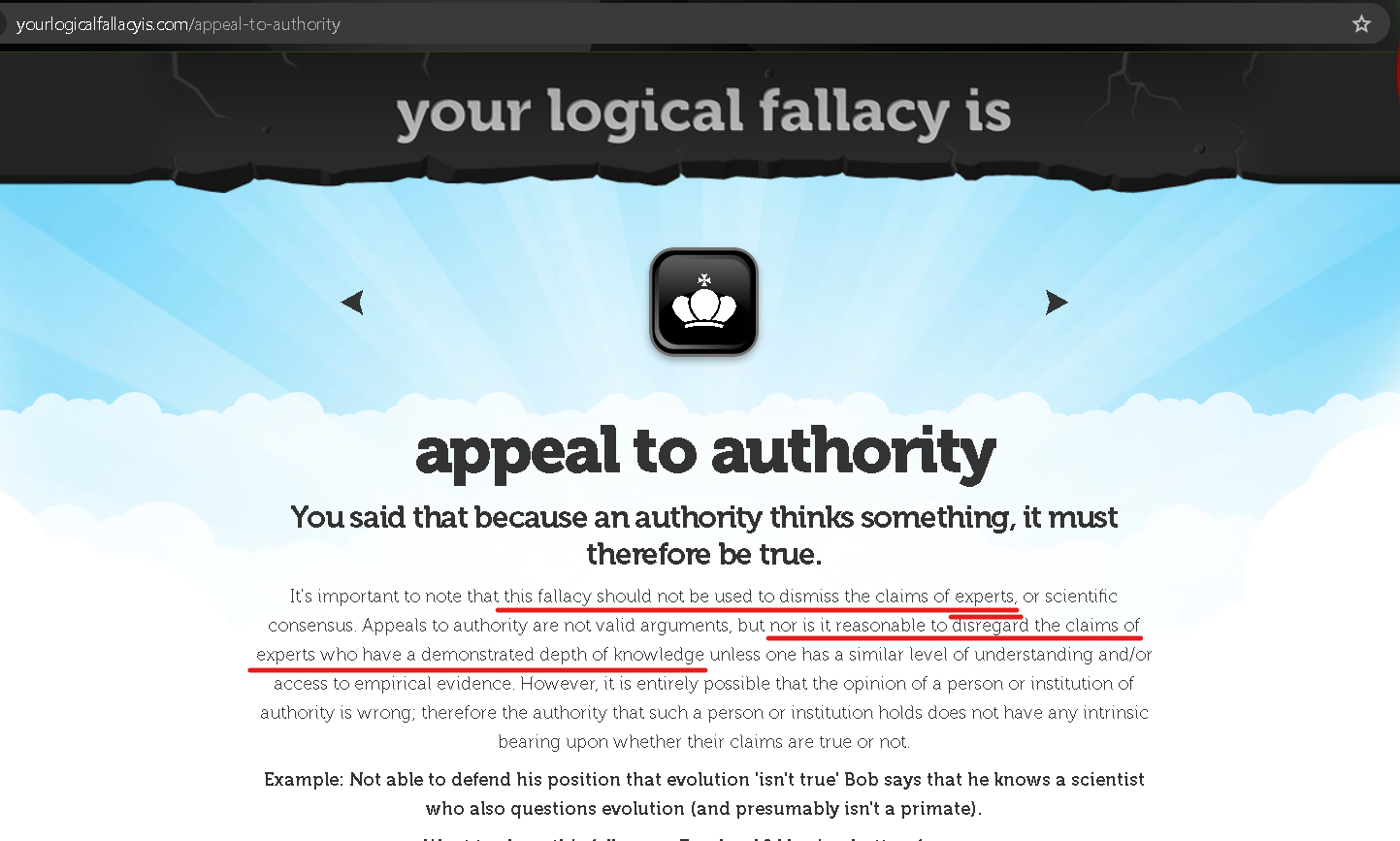
I believe you’re conflating the rules of maths with the notation we use to represent mathematical concepts.
You think a Maths teacher doesn't know the difference?
There is absolutely nothing stopping us from choosing to interpret a+b×c as (a+b)×c
Yes there is - the underlying Maths. 2x3 is short for 2+2+2, which is therefore why you have to expand multiplications before doing additions. If you "chose" to interpret 2+3x4 (which we KNOW is equal to 14, because 3x4=3+3+3+3 by definition) as (2+3)x4, you would get 20, which is clearly wrong, since 20 isn't equal to 14.
We don’t even have to write it like that at all
No that's right, because it IS written differently in different languages, but regardless of how you write it, it doesn't change that 2+3x4=14 - the underlying Maths doesn't change regardless of how you decide to write it. Maths is literally universal.
× before + is a very convenient choice
It's not a choice, it's a consequence of the fact that x is shorthand for +. i.e. 2x3=2+2+2.
it is still just a choice
It is a consequence of the definitions of what each operator does. If x is a contraction of +, then we have to expand x before we do +. If it were the other way around then we'd have to do it the other way around. Anything which is a contraction of something else has to be expanded first.
there’s a mutual agreement that it’s only approximately correct.
No there isn't. I've never seen a single Year 7-8 Maths textbook that is in the slightest bit ambiguous about it. The Distributive Law has to literally always be applied (hence why it's a law). dotnet.social/@SmartmanApps/110819283738912144
The answer still lies in the ambiguity of the way the problem is written though
But it's not ambiguous, as per the reason you already gave.
If the author used fractions instead of that stupid division symbol
If you use fractions then the whole thing is a single term, if you use division it's 2 terms.
9 is definitely not the clear and only answer
1 is definitely the only answer.
those calculators because that is a badly written equation
It's not badly written, and the reason Texas Instruments gets it wrong is right there in their manual (disobeys The Distributive Law).
modern rules of math
The order of operations rules haven't changed in at least 100 years, and more likely at least 400 years. Don't listen to Youtubers who can't cite a single Maths textbook.
“2(3)” is the same as “2 x 3”
No, it's the same as (2x3), as per The Distributive Law and Terms.
There has apparently been historical disagreement over whether 6÷2(3) is equivalent to 6÷2x3
No, there hasn't - that's a false claim by a Youtuber (and others who repeated it) - it is equal to 6÷(2x3) as per The Distributive Law and Terms, and even as per the letter he quoted! Here is where I debunked that claim.
leaving us 3(3)
You just did division before brackets, which violates order of operations rules. 6÷2(3)=6÷(2x3)=6÷6=1
As an engineer with a full PhD. I’d say we engineers aren’t that great with math problems like this
Yay for a voice of reason! I've yet to see anyone who says they have a Ph.D. get this correct (I'm a high school Maths teacher/tutor - I actually teach this topic).
basic calculator to solve multi part problems
This isn't a multi-part problem, and any basic calculator other than Texas Instruments gets it correct.
These things are almost always written as fractions
Fractions are always written as fractions - they are 1 term - 2 separate terms are always separated by an operator, such as a division sign, like in this case.
the Kahn Academy or something similar.
Good advice! In particular look up what they say about The Distributive Law.
A division symbol should never be used after fractions are introduced.
But a fraction is a single term, 2 numbers separated by a division is 2 terms. Terms are separated by operators and joined by grouping symbols.
Indeed Duncan. :-)
"strong juxtaposition" already existed even then in Terms (which Lennes called Terms/Products, but somehow missed the implication of that) and The Distributive Law, so his rule was never adopted because it was never needed - it was just Lennes #LoudlyNotUnderstandingThings (like Terms, which by his own admission was in all the textbooks). 1917 (ii) - Lennes' letter (Terms and operators)
In other words...
...Terms/Products., as we do today in modern high school Maths textbooks (but we just use Terms in this context, not Products).