17
Microsoft DevBlogs now federated
(devblogs.microsoft.com)
Different compilers
Different programmers.
it’s going in parentheses
Unfortunately some places don't care where you've put brackets, they'll just go ahead and change it anyway. Welcome to my quest to educate.
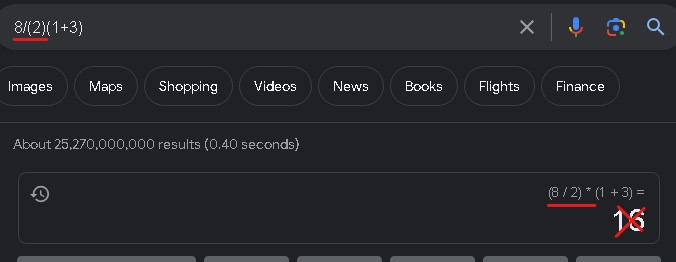
I’ll die on a hill that this is 16
both you and people arguing that it’s 1 would be wrong
No, they're correct Order of operations thread index
This problem is stated ambiguously and implied multiplication
It's not ambiguous, there's no such thing as implicit multiplication
This is all matter of
...following the rules of Maths.
since 🐟 is no longer a number
It's still a pronumeral though, equal to 4, so the answer is still 8÷8=1.
They are order of operations
No, they're not.
Multiplication and division are not on the same level
Yes, they are.
they are distinct operations which form the identity when combined with a multiplication
In other words, they are the inverse operation of each other - welcome to why they have the same precedence.
order of ops is an established convention, not mathematical fact
It's a mathematical fact.
Under pemdas divisor operators must literally be completed after multiplication
Not literally. It's only a mnemonic, not the actual rules.
They are not of equal priority
Yes, they are. Binary operators have equal precedence, and unary operators have equal precedence.
It doesn't make sense in BODMAS either. Expanding Brackets has precedence of... Brackets, not "multiplication" - "Multiplication" refers literally to multiplication signs, of which there are none in this question.
All order of operation rules are made up
None of them are made-up. They are all a natural consequence of the way things have been defined. e.g. 2x3 is shorthand for 2+2+2, so if you don't do multiplication before addition then you get the wrong answer, hence the order of operations rules.
You can if you wrote everything as just addition and subtraction, but then we made some shorthand notations for that, such as 2x3=2+2+2, and so now you have to do multiplication before addition otherwise you get a wrong answer, and if you wrote all multiplications before all additions there'd still be no problem, but as someone else pointed out, there are cases where it's easier to have a different order, and so voila! Order of operations rules.
Actually multiplication and division are shorthand notations for addition and subtraction - e.g. 2x3=2+2+2 - so everything boils down to addition and subtraction.
Well thanks to you too for a proper conversation. :-) There's a lot of people here wanting to pull out their pitchforks over the smallest thing.
#MathsIsNeverAmbiguous
The order of operations are the same everywhere. The fights arise from people who don't remember them.