3
New Windows Development Community for Windows-specific issues
(programming.dev)
Order of magnitude?
It's actually short for "to the order of", as in 2 squared is 2 to the order of 2. i.e. same thing as Exponent or Index.
A typical scientific calculator didn’t have juxtaposition, so you’d have to enter 6÷2(1+2) as 6÷2×(1+2)
That's not true
you’d get 9 as the answer because ÷ and × have equal precedence and just go left to right
Well, more precisely you broke up the single term 2(1+2) into 2 terms - 2 and (1+2) - when you inserted the multiplication symbol, which sends the (1+2) from being in the denominator to being in the numerator. Terms are separated by operators and joined by grouping symbols.
There's no pemdas paradox, just people who have forgotten the order of operations rules
Even two casios won’t give you the same answer:
The one on the right is an old model. As far as I'm aware Casio no longer make any models that still give the wrong answer.

I’ve never seen a calculator that had bracket keys but didn’t implement the conventional order of operations.
I've seen plenty
You are saying that 14 is the correct answer because of the order of operations
No, I am saying that is because that's the number that we started with and we wrote the expression based on the operator definitions.
Let me try this again, but be more explicit about each step...
Teacher is writing a test. Has decided the answer for this question is going to be 14. What can he make the question? Well, we can throw in some addition, so let's change it to 2+3+3+3+3. What else can we do?
Well, that 3+3+3+3 part there, we have a shorthand version of that in multiplication, that being 3x4, so now let's change it to 2+3x4.
So, now we've turned 14 into 2+3x4. None of that had anything to do with order of operations, just the definitions of the operators - + means addition, and x is shorthand for multiple additions.
So, we already know that the answer is 14, because that's what the teacher started with.
Now we need some rules of Maths to make sure that anyone who tries this question gets 14 as the answer.
And as we already saw, we have to do multiplication first or we arrive at the wrong answer - 20. And the reason we can only get the correct answer from doing multiplication first is because multiplication is shorthand for repeated additions, which was the first step the teacher made from having started from 14.
Similarly, we have defined exponents as being shorthand for multiplication, so for the very same reason we will need to solve exponents before we solve multiplication or we won't end up at 14.
And welcome to the order of operations rules! As I said, they are a natural consequence of the way that we have defined the operators. So, with the way we have defined addition, multiplication, and exponents, solving any such expression requires that we do them in the order E M A. In other words, we have to undo all the shorthand in the opposite way to how it was written to begin with, until we end up with just additions, and from there we arrive at the correct answer of 14.
Let's say though, way back in time, that instead they had defined exponents as shorthand for multiplication, and x as shorthand for exponents. Then, with these different definitions the order of operations rules would be M E A (because these definitions have exponents and multiplication the opposite way around to how we actually have defined them).
Do you see it now? If there's something you don't understand, then just ask me.
Ok, but why does 2 * 3 = 2 + 2 + 2 mean that we should prioritize multiplication and division over addition and subtraction?
Because multiplication is shorthand for addition, and if you don't expand it before doing the addition you get wrong answers. Let me show you...
Multiply first (i.e. correct)
2+3x4=2+3+3+3+3=14 - the right answer, by the very definition of 3x4=3+3+3+3
Now let's see what happens if we do the addition first...
2+3x4=5x4=5+5+5+5=20 - which we know is the wrong answer! (because we already know the right answer is 14, because we already know that the actual original fully expanded expression was 2+3+3+3+3, so the rules of Maths have to guide us back to getting the same thing the original author started with, or it all breaks down! The author took 2+3+3+3+3 and wrote it as 2+3x4, so the rules of Maths have to make sure when we see that we get back to 2+3+3+3+3)
So the fact that we know multiplication is shorthand for addition, means we have to multiply before we add. Similarly, exponents are shorthand for multiplication (2³=2x2x2), so we have to do exponents before we do multiplication... which we have to do before we do addition! It all comes from what these very things have been defined as meaning in the first place.
I’ll take a source if you got one
Well, I just showed you by doing the Maths myself, which is one of the great things about Maths - some things you can prove it to yourself! :-) And that's another topic I wrote about here and here.
Ummm, I was agreeing with you??
Anyways, I'm a Maths teacher who has taught this topic many times - what would I know?
multiple always happens first. But apparently it’s what’s left side first
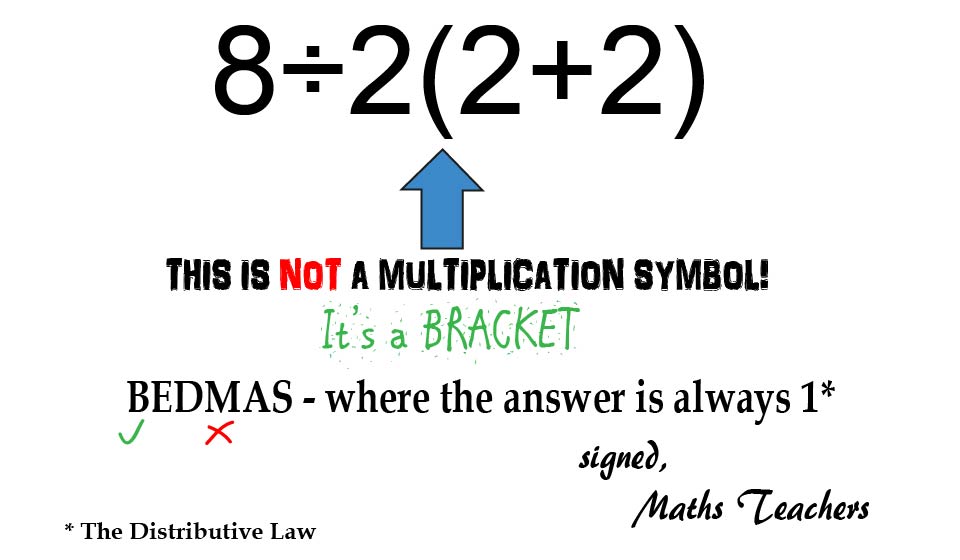
Multiplication and division are equal precedence (and done left to right) if that's what you're talking about, but the issue is that a(b+c) isn't "multiplication" at all, it's a bracketed term with a coefficient which is therefore subject to The Distributive Law, and is solved as part of solving Brackets, which is always first. Multiplication refers literally to multiplication signs, of which there are none in the original question. A Term is a product, which is the result of a multiplication, not something which is to be multiplied.
If a=2 and b=3, then...
axb=2x3 - 2 terms
ab=6 - 1 term
I've taught a class of kids that has various disabilities. Having a disability doesn't make you stupid.
No, they have to be the way they are as a result of the way the operators have been defined. e.g. 2x3 is shorthand for 2+2+2, so if you don't do multiplication before addition then you get the wrong answer, hence the order of operations rules.
Hello everyone. I am your mod, Donald, Founder of Smartman Apps. You can find me on Mastodon at @SmartmanApps@dotnet.social.
You can follow/post to this Community from Mastodon by following @windows_dev@programming.dev
A few rules…

Such as?