[-] SmartmanApps@programming.dev -1 points 7 months ago

“a X b is written ab and means a times b.”

Notice that it doesn't say equals, speaking of Illiterate fraud, as per your other comment 🙄

[-] SmartmanApps@programming.dev -1 points 8 months ago

Multiplying two things makes them one term

You so nearly had it, look "two things"! Yes axb is 2 Terms being Multiplied to make them one 😂

Immediately before the definition you’re now lying about

Nope! Says exactly what I already said, and I have no idea why you think it says otherwise. Now read the next page, which tells you ab is one Term and doesn't say that axb is 1 Term. 🙄 You're proven wrong by the very textbook you're quoting from! 😂

Fuck your non-sequitur

Says person trying to disprove a(b+c)=(ab+ac) by dragging a(bc)²=ab²c² to try and make a false equivalence argument 😂

a(b+c)2 is a*(b+c)2

No it isn't! 😂 The first is one term, the second is two terms

for example - these four math textbooks.

Says Mr. Ostrich, still ignoring the dozens of textbooks I posted saying a(b+c)=(ab+ac)

No textbook will ever say it produces an a2 term

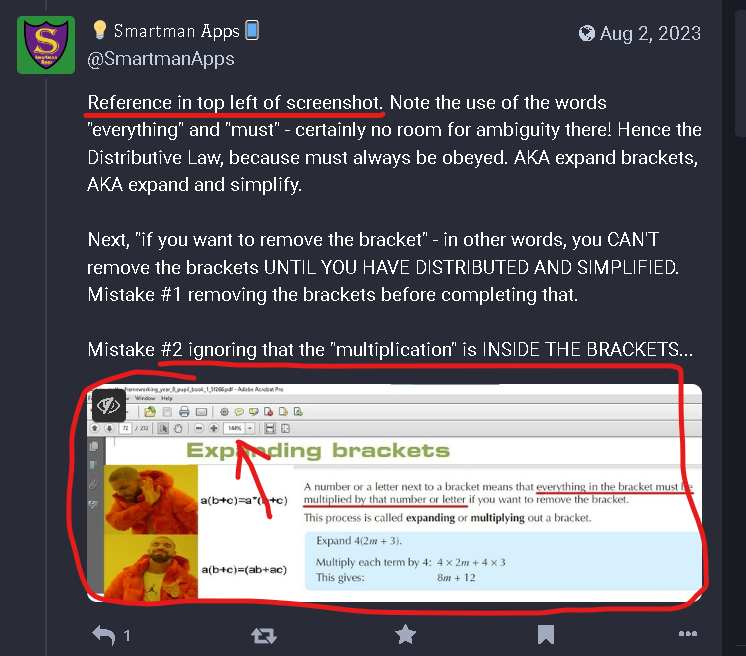
No, it produces an ab term and an ac term, a(b+c)=(ab+ac) 🙄

You made it up. You’re just full of shit

Says Mr. Ostrich, now completely full of shit, still ignoring the dozens of textbooks I posted, including ones written before I was even born

[-] SmartmanApps@programming.dev -1 points 8 months ago

The result of a multiplication operation is called a product

Now you're getting it - axb=ab. axb is Multiplication of 2 Terms, ab is the single Product. It's the reason that 8/2(1+3) and 8/2x(1+3) give different answers 🙄

Show me one textbook where a(b+c)2 gets an a2 term

I already gave you many that tell you a(b+c)=(ab+ac) Mr. Ostrich - which part of a(b+c)=(ab+ac) are you having trouble understanding?

[-] SmartmanApps@programming.dev -1 points 8 months ago

then multiplications

There aren't any, only Addition and Brackets (and Subtraction inside Brackets)

[-] SmartmanApps@programming.dev -1 points 8 months ago

I mean, there are very few ambiguous cases

There are precisely none which are ambiguous

[-] SmartmanApps@programming.dev -1 points 8 months ago* (last edited 8 months ago)

so it would be clearer

That's because it's already clear as is, as per the rules of Maths.

I think someone told me that order of operations is like a natural law

It's a natural consequence of the definitions of the operators. e.g. Multiplication is shorthand for repeated Addition - 2x3=2+2+2 - so if you don't do it before addition you end up with wrong answers. The order of operations rules is in fact just breaking everything down into Addition and Subtraction and then solving from there.

not a convention

There are some conventions, like left to right, but in that case that's only because students tend to make mistakes with signs when they don't go from left to right, so it's there to preserve teachers sanity.

[-] SmartmanApps@programming.dev -1 points 8 months ago

Remember that multiplication goes first

Remember Brackets are solved first - there is no Multiplication

so it’s: 2+5(8-5) = 2+5*3

No, so it’s: 2+5(8-5) = 2+(5x8-5x3), a(b+c)=(ab+ac).

[-] SmartmanApps@programming.dev -1 points 2 years ago

if they filter out your personal

...it'll still be 35 users/month, which is still not dead.

it’s your personal mission to generate traffic

I'm not generating the other 34 people who used it this month, which includes, as I mentioned before, someone who actually provided me with a solution to a problem I had. Welcome to why Communities are useful. Not sure what purpose you think they're for?

It’s ok if you feel that it’s your personal mission

As opposed to your apparent personal mission of trying to declare groups dead which actually aren't?

Bye now Mr. Gaslighter.

[-] SmartmanApps@programming.dev -1 points 2 years ago* (last edited 2 years ago)

Citation needed.

So you think it's ok to teach contradictory stuff to them in Maths? 🤣 Ok sure, fine, go ahead and find me a Maths textbook which has "weak juxtaposition" in it. I'll wait.

Your comments only reference ‘math textbooks’, not anything specific

So you're telling me you can't see the Maths textbook screenshots/photo's?

outside of this link which you reference twice in separate comments but again, it’s not evidence for your side, or against it, or even relevant

Lennes was complaining that literally no textbooks he mentioned were following "weak juxtaposition", and you think that's not relevant to establishing that no textbooks used "weak juxtaposition" 100 years ago?

We’re talking about x/y(b+c) and whether that should be x/(yb+yc) or x/y * 1/(b+c).

It's in literally the first textbook screenshot, which if I'm understanding you right you can't see? (see screenshot of the screenshot above)

you have an uncited refutation of the side you’re arguing against, which funnily enough you did cite.

Ah, no. Lennes was complaining about textbooks who were obeying Terms/The Distributive Law. His own letter shows us that they all (the ones he mentioned) were doing the same thing then that we do now. Plus my first (and later) screenshot(s).

Also it's in Cajori, but I didn't find it until later. I don't remember what page it was, but it's in Cajori and you have the reference for it there already.

you should probably make it easy to find the evidence you speak of

Well I'm not sure how you didn't see all the screenshots. They're hard to miss on my computer!

[-] SmartmanApps@programming.dev -1 points 2 years ago

Hooray! Correct! Anyone who downvoted or disagrees with this needs to read this instead. Includes actual Maths textbooks references.

[-] SmartmanApps@programming.dev -1 points 2 years ago

Without parentheses around (2×3)

But there is parentheses around (2x3). a(b+c)=(ab+ac) - The Distributive Law. You can't remove them unless there is only 1 term left inside. You removed them when you still had 2 terms inside, 2x3.

6/2(1+2)=6/2(3)=6/(2*3)=6/6=1

OR

6/2(1+2)=6/(2+4)=6/6=1

view more: ‹ prev next ›

SmartmanApps

0 post score
0 comment score
joined 2 years ago
MODERATOR OF