1
2 gbps symmetrical fiber optic internet
TLDR - Saturated Fat is good for you. Linoleic acid (seed oils, vegetable oils) oils are bad for you.
https://doi.org/10.1136/bmj.i1246 (full paper)
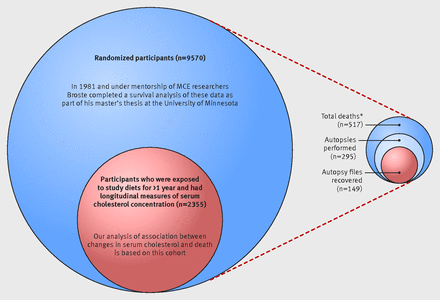
The MCE (1968-73) is a double blind randomized controlled trial designed to test whether replacement of saturated fat with vegetable oil rich in linoleic acid reduces coronary heart disease and death by lowering serum cholesterol. Recovered MCE unpublished documents and raw data were analyzed according to hypotheses prespecified by original investigators. Further, a systematic review and meta-analyses of randomized controlled trials that lowered serum cholesterol by providing vegetable oil rich in linoleic acid in place of saturated fat without confounding by concomitant interventions was conducted.
The intervention group had significant reduction in serum cholesterol compared with controls (mean change from baseline −13.8% v −1.0%; P<0.001). Kaplan Meier graphs showed no mortality benefit for the intervention group in the full randomized cohort or for any prespecified subgroup. There was a 22% higher risk of death for each 30 mg/dL (0.78 mmol/L) reduction in serum cholesterol in covariate adjusted Cox regression models (hazard ratio 1.22, 95% confidence interval 1.14 to 1.32; P<0.001). There was no evidence of benefit in the intervention group for coronary atherosclerosis or myocardial infarcts. Systematic review identified five randomized controlled trials for inclusion (n=10 808). In meta-analyses, these cholesterol lowering interventions showed no evidence of benefit on mortality from coronary heart disease (1.13, 0.83 to 1.54) or all cause mortality (1.07, 0.90 to 1.27).
Available evidence from randomized controlled trials shows that replacement of saturated fat in the diet with linoleic acid effectively lowers serum cholesterol but does not support the hypothesis that this translates to a lower risk of death from coronary heart disease or all causes.
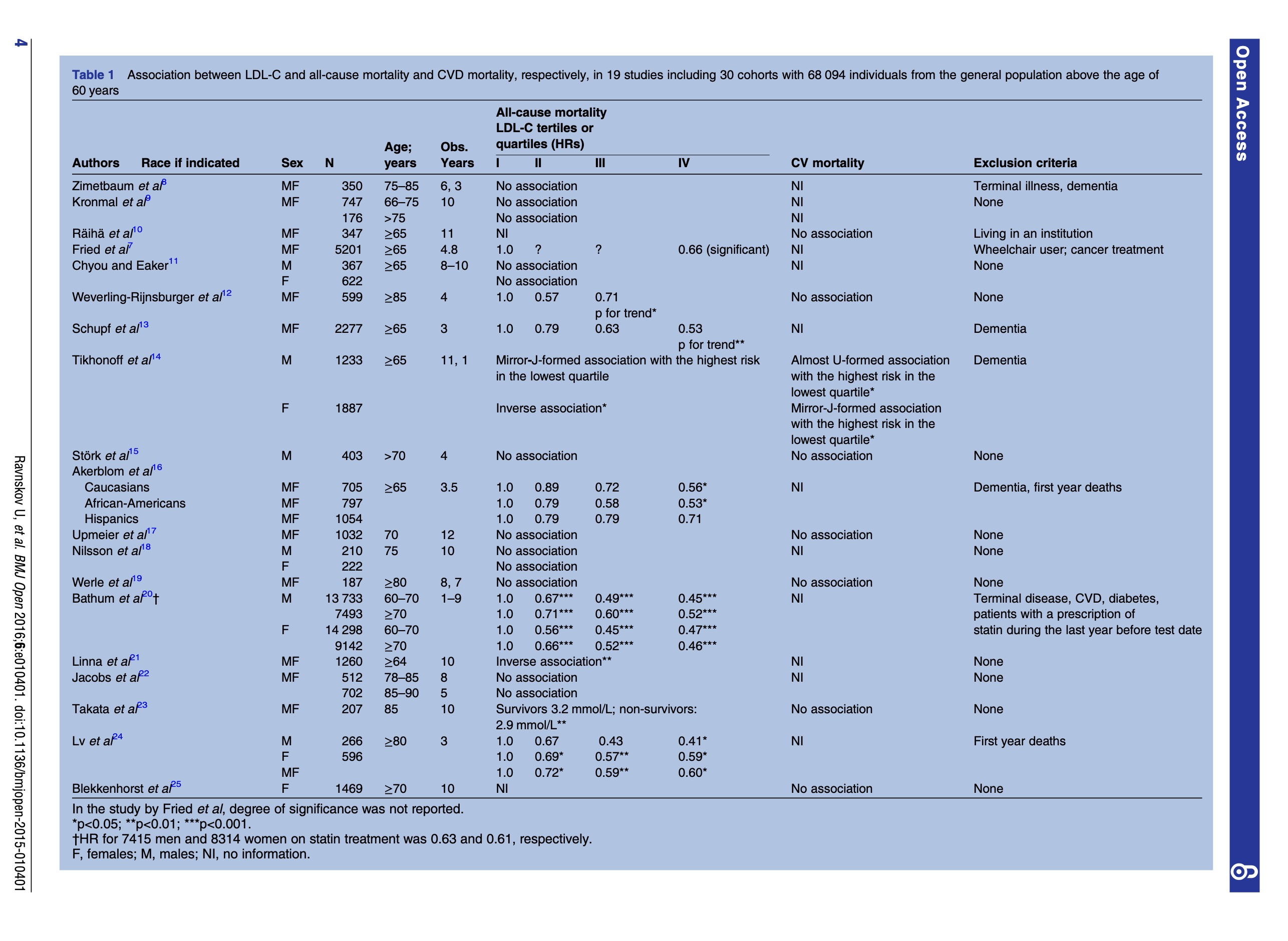
TLDR: The current advice that LDL is "bad cholesterol", appears to be outdated, and the actual situation is more complex. In people over 60 high LDL appeared to be protective for mortality.
Conclusions: High LDL-C is inversely associated with mortality in most people over 60 years. This finding is inconsistent with the cholesterol hypothesis (ie, that cholesterol, particularly LDL-C, is inherently atherogenic). Since elderly people with high LDL-C live as long or longer than those with low LDL-C, our analysis provides reason to question the validity of the cholesterol hypothesis. Moreover, our study provides the rationale for a re-evaluation of guidelines recommending pharmacological reduction of LDL-C in the elderly as a component of cardiovascular disease prevention strategies.
Full Paper at https://pubmed.ncbi.nlm.nih.gov/27292972/
Related to, and following up on the LMHR paper from https://hackertalks.com/post/5835924
2 gbps symmetrical fiber optic internet
The maze doesn't go anywhere and the red line circles back on itself
The benefit of using a package manager like Winget, brew, apt, snap, fdroid is that these attacks are less likely especially with doubly signed reproducible builds like fdroid
The factory factory factory factory factory factory factory factory factory factory must grow
But with one key difference: it's *not* in fact SUID. Instead it just asks the service manager to invoke a command or shell under the target user's UID. It allocates a new PTY for that, and then shovels data back and forth from the originating TTY and this PTY. Or in other words: the target command is invoked in an isolated exec context, freshly forked off PID 1, without inheriting any context from the client (well, admittedly, we *do* propagate $TERM, but that's an explicit exception, i.e. allowlist rather than denylist).
Don't be mortified. That was a power move. Lunch time is for lunch.
It's an interdimensional portal, she's cutting her hair in a different reality, once she's done they'll switch
Sounds like you're defining a failure of the free market
If these devices are so cheap the marginal cost justifies the lower price, why isn't market competition eating into their margin in the more affluent countries?
Sounds like somebody's got their finger on the market balance
Strong press freedom is required to maintain a open and free democracy.
I thought Google wallet generated a unique card id for every transaction.
This is a interesting bug, but I think fairly niche. Not many people use app pinning at all.
I think Lemmy should come up with a meta cross post type. Where the post only exists once, but it's indexed in multiple communities, and moderators of those communities can remove the cross post. Without affecting the original post
Kind of like a symbolic link
If not that then give us the ability to have relative references to posts inside of Lemmy. Instead of referencing a URL to a specific instance, kind of like the ! Or @ for for community names and usernames.
Then across post could at least link to the canonical discussion for talking.
Now... Now... Wait until they have to debug it