this post was submitted on 11 Aug 2026
1172 points (98.8% liked)

Work Reform

17220 readers
1439 users here now

A place to discuss positive changes that can make work more equitable, and to vent about current practices. We are NOT against work; we just want the fruits of our labor to be recognized better.

Our Philosophies:

Our Goals

founded 3 years ago
MODERATORS
top 50 comments
sorted by: hot top controversial new old
[–] Folstar@lemmus.org 24 points 5 days ago* (last edited 5 days ago) (1 children)

Interesting claim. Let's look into it.

Average home price in 1970: $25k I found a few different figures on this one, and averaged them out.

$25k 1970 dollars in 2026 per CPI: $220,251 https://data.bls.gov/cgi-bin/cpicalc.pl?cost1=25000&year1=197001&year2=202604

not necessary, but gives context: Average (not median) home price today: $502k https://fred.stlouisfed.org/series/MSPUS

Median home price today: $410k https://fred.stlouisfed.org/series/MSPUS

"The median money income of all families in 1970 was about $9,870" https://www.census.gov/library/publications/1971/demo/p60-80.html

Median family income in 2024 (most recent year reported): $105,800 [note: does anyone believe this? FRED is claiming median family income went up 45% in the past decade and I find that EXTRAORDINARILY suspect. Few people get COLA over 3% and many getting fuckall.] https://fred.stlouisfed.org/series/MEFAINUSA646N

roughly a 10.7X increase

My best guess is that Mr. Brooks, using slightly different numbers (sources vary, exact years, etc...), to arrive at: 1970 Home Price + Flat Income Gains = $138,000. This is not great methodology, as growth is looked at in percentages for a reason. To illustrate, suppose instead of a house we were looking at candy bars. Let's say in 1970 a candy bar was a dime and today it's $2. Grafting raw wage gains onto candy bars, we're saving over $80k on each candy bar!!! Oh wait, that's silly. Let's stick with percentages.

Using the official wage numbers, we arrive at "the average home today would be $267,500". This is more accurate yet still a massive departure from where we are today.

So... what actually broke?

There are several explanations for this divergence.

The Good: Houses today are bigger and have better construction standards. Please, before you start typing a survivorship bias based claim about your house from 1905 that's still in great shape today, read up on survivorship bias. Yes, there are modern builders who do shoddy work (we've all seen the Youtube videos), but overall a house built to code in 2026 is significantly more advanced. A fair amount of the cost increase can be captured here.

The Bad: Rent seeking. Figurative and literally. Somehow someone was like "hey, I'm going to get rich by making a basic necessity worse" and nobody beat them within an inch of their life to discourage others. Rookie mistake by our society.

The Ugly: Official numbers are suspect at best. This was true before 2025 and whoa boy is it true now. Inflation is chronically under-reported BY DESIGN. That means actual inflation is driving up the cost of houses and cans of bean and things, while reported inflation is being used to determine your pay raise (that is, if you even get one). This divergence that started in the 90s is hitting critical mass here in the roaring 20s and we're probably fucked as I haven't heard anyone in a position of power even recognize this problem, let alone suggest how to fix it.
[–] Funkt4st1c@lemmy.world 5 points 5 days ago (2 children)

Renting out a single family home for longer than 3 months at a time without living in it should be an actual crime, or at least extremely (50-80%) tax heavy (the taxes then going towards house subsidies). Owning an unoccupied home should be taxed even worse. A corporation can count as a single person, so a property management company can own a single house OR as many apartment complexes as they want before tax punishment.

The modern version of Airbnb as a business model (people owning 5+ houses to rent for daily prices often in excess of hotel prices with none of the hotel benefits + "cleaning fees") should have millionaires hanging from trees.

I foolishly believe the above two policies alone would cut home prices by at least half.

load more comments (2 replies)
[–] BarneyPiccolo@lemmy.today 45 points 6 days ago (3 children)

The 1974 Tax Code re-write, that baked Trickle Down Economics into our tax code, created the Oligarch class, giving them the disposable income to manipulate political policy to their further benefit.

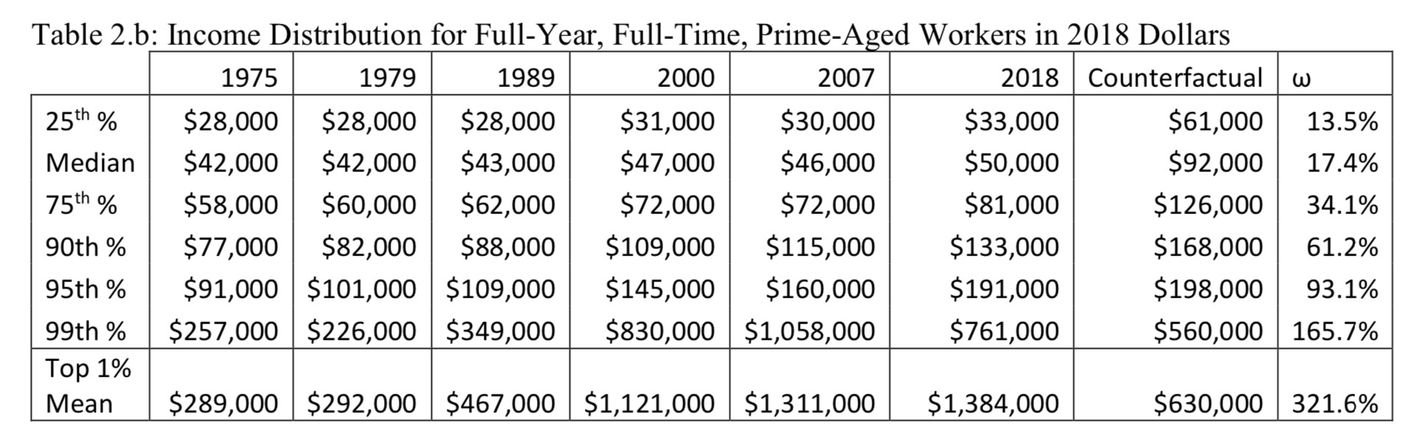
The Rand Corp issued a report on income inequality, and the situation is far worse than most people think.

Chart

The median salary of $43K in 1975 has increased to only $50K today, while they would have been making $92K if the tax code hadn't been steadily re-written to enrich the wealthy at the cost of the middle class and poor.

In that same time period, the mean income for the top 1% went from $289K to $1.384 million, while they would have been making $630K under the old tax codes.

Thats a 17.4% increase in the lower median, and an increase of 321.6% in the 1% median. Clearly there has been an upwards distribution of wealth at the expense of the middle class since the tax codes started to be re-written in 1974 to favor the top economic tier.

Read more about it :

New York Mag: http://nymag.com/intelligencer/amp/2020/09/rand-study-how-high-is-inequality-us.html

Fast Money: https://www.fastcompany.com/90550015/we-were-shocked-rand-study-uncovers-massive-income-shift-to-the-top-1

[–] doingthestuff@lemy.lol 6 points 6 days ago (2 children)

Yes our earning power is trash compared to the 70s, and I think there are more reasons for that than what you stated. But your answer didn't really address why homes specifically have dramatically outpaced the general rate of inflation.

[–] qarbone@lemmy.world 14 points 6 days ago

Probably because land is one of the best non-fungible assets around. You buy land and you have something whose upper limit on price is only limited by what someone else wants to build on it. And premium space around existing economic centers (cities) doesn't just spring up.

load more comments (1 replies)
load more comments (2 replies)
[–] rumba@lemmy.zip 49 points 6 days ago (3 children)

What actually broke?

People figured out they could buy more than one house and rent it to other people, paired with a housing shortage partially due to people/companies owning all the houses, paired with technology to allow you to rent your houses out for a few days here and there to make income.

We allowed house ownership to become entangled with entrepreneurship.

[–] flandish@lemmy.world 26 points 6 days ago (1 children)

that’s not broken though. this is how capitalism works at a temporal scale. we were marketed to and sold lies. on purpose. by monsters who have spent centuries making us think we can achieve a “dream.”

[–] stringere@sh.itjust.works 8 points 6 days ago

Gotta be asleep to dream!

...and it screwed EVERYTHING up;

  1. People can't afford kids because the rents are too high,

  2. Rents too high for cool spaces to hangout in, so everybody's at home and miserable.

  3. Rents too high for a cheap restaurant to open, so everybody's mad and pointing fingers,

  4. Can't find daycare, because it's too expense for the daycare to rent a commercial property,

load more comments (1 replies)
[–] ZombieCyborgFromOuterSpace@piefed.ca 38 points 6 days ago (1 children)

What broke is they allowed housing to be a commodity allowing speculators to bid on.

[–] chiliedogg@lemmy.world 15 points 6 days ago

Yep. With the repeal of Glass-Steagal, the commercial banks used for things like mortgages, checking accounts, and car loans were able to merge with investment banks. The Act was out into place in 1933 because having retail banks mixed with investment banks was why Black Tuesday lead to the Great Depression.

That allowed houses and mortgages to be combined into investment packages for the speculators, and lead to prices skyrocketing.

It's what caused the 2008 crash, and in all the aftermath of that, nothing was actually done to fix the issue. The fix was simple - re-divorce them and reinstate Glass Steagall.

[–] DudleyMason@lemmy.ml 31 points 6 days ago

Nothing broke.

This is capitalism working as intended.

[–] forgetboutpiper@lemmy.zip 20 points 6 days ago
[–] RizzRustbolt@lemmy.world 11 points 5 days ago

Homes as equity.

Once they were considered investments, then they were subject to the "Line Must Go Up" tenet of capitalism.

[–] UltraGiGaGigantic@lemmy.ml 6 points 5 days ago

Capitalism is working as intended.

[–] sobchak@programming.dev 13 points 6 days ago

I think nearly all western nations have similar problems, so it's not solely a US thing? I see people talking about affordability in Toronto, London, and New Zealand at least. I recently saw a video of a Chinese software engineer living in a makeshift shack on the roof of a building and still needing to do food delivery on a hacked ebike to make ends meet, so it may not be only a western thing either.

I would guess it's a multitude of issues causing it. Wealth disparity and the ballooned financial sector is probably the largest contributor. Resources (lumber, fossil fuels, etc) getting more expensive to extract and transport probably plays some role. Stricter building and sanitation codes, zoning, and communities fighting low income housing being built probably does too.

[–] Formfiller@lemmy.world 18 points 6 days ago (1 children)

It’s the end of the monopoly game

[–] WhyIHateTheInternet@lemmy.world 10 points 6 days ago (1 children)

Someone should get mad and flip the board and say fuck this shit

[–] Formfiller@lemmy.world 8 points 6 days ago (1 children)
[–] WhyIHateTheInternet@lemmy.world 8 points 6 days ago (1 children)

He should do it again. Or at least his brother, Mario, since Luigi is a bit tied up at the moment.

[–] Formfiller@lemmy.world 9 points 6 days ago (1 children)

It needs to be be collectively accomplished

[–] WhyIHateTheInternet@lemmy.world 7 points 6 days ago (2 children)

Sounds like a job for smash bros

load more comments (2 replies)
[–] Hueristic_Autistic@lemmy.world 9 points 6 days ago (3 children)
load more comments (3 replies)
[–] technocrit@lemmy.dbzer0.com 6 points 5 days ago* (last edited 5 days ago) (4 children)

Capitalism has always been broken.

But an underlying problem is the pseudo-scientific ideology of "economics". It's what fuels these kind of dumb questions. Nothing broke. The denial of human needs has always been a feature, not a bug.

load more comments (4 replies)
[–] TheDemonBuer@lemmy.world 7 points 6 days ago (3 children)

Nothing's broken, least of all the laws of physics. Detached, single family homes are low density housing. The land that makes up any given metro area is basically a two dimensional plane. That plane is a finite amount of space that can only be filled with so many buildings. Detached homes are almost always limited to just a few stories at the most, and they can't be stacked on top of each other, so vertical expansion is essentially non-existent. The only way to build more detached homes is to spread out horizontally along the two dimensional plane. But the further you go out horizontally from the metro center, the further you are from the jobs and amenities that are associated with an urban core. The detached houses that are nearest to that center are in the highest demand, so their prices go up the most. You can continue to just build out horizontally, but after a while you simply run out of land. Or, the houses get so far from where the jobs and amenities are that it's not viable.

There are areas in the US where you can buy a home for $138,000, but most people probably don't want to live there, which is why the homes only cost $138,000. Areas in greater demand will have higher home prices. In the areas that are in higher demand, again, the only option is horizontal sprawl away from the metro center, if you're building only detached single family homes.

[–] chilicheeselies@lemmy.world 7 points 6 days ago (2 children)

This is also a function of transit efficiency. It's not the distance to a metro center that is the problem, it's the time to get to that metro center. Our commuter rail network is woefully slow. Our highways have design issues that create choke points that cause traffic jams. If living 20 miles from the urban centers was only 20 minutes away, then it wouldn't be an issue. In fact, it might be desirable to go home to a quiet place, but have more action a short commute away.

Not even going to mention the poor design of suburban areas that lack a proper downtown of their own.

load more comments (2 replies)
[–] laurenceOfSuburbia@lemmy.world 5 points 6 days ago (23 children)

They should start building china style huge apartment buildings.
Stupid that we aren't yet doing it

load more comments (23 replies)
load more comments (1 replies)
[–] HulkSmashBurgers@reddthat.com 11 points 6 days ago
[–] childOfMagenta@jlai.lu 9 points 6 days ago
[–] Etterra@discuss.online 8 points 6 days ago

Nothing broke - the capitalist system is working exactly as designed. We're just not the tiny sliver of the populace that benefits from it.

[–] merc@sh.itjust.works 7 points 6 days ago* (last edited 6 days ago) (4 children)

Houses should be investments... in the same sense that a good, durable pair of shoes is an investment.

In a well designed system, the value of property should stay pretty flat over time, and the value of a structure built on that property should slowly go down over time as wear and tear sets in.

It's ridiculous that it makes sense to buy more home than you need, and to hold onto a house longer than you need it because it's one of the best and safest money-earning investments you can make. It's especially annoying as someone in a position to make that investment gets to live inside their investment and enjoy it even as it appreciates in value.

Nothing else works that way. Can you imagine if you bought a classic car and drove it on the road as a daily driver and it went up in value? Or, if you bought a rare Magic the Gathering card, used it in your regular deck, and somehow it only became more valuable?

load more comments (4 replies)
[–] KingGimpicus@sh.itjust.works 8 points 6 days ago (16 children)

If you actually look at the cost of labor and materials to build a house today, its not far off. The difference you see is the cost of allowing enormous corporate development companies to exist and do business in this country. The false scarcity on top is a product of the greed that keeps people out of housing to begin with.

load more comments (16 replies)
load more comments
view more: next ›