[-] Heikki@sopuli.xyz 2 points 3 days ago

Thanks, that matches what we found. The map shows Denmark as "no winter-tyre law", with the note that since 1 July 2025 "obviously unsuitable" tyres for the conditions can be fined (Færdselsstyrelsen, linked in the table).

One small difference from Germany: the Danish authority says M+S tyres count as approved winter tyres and only recommends the snowflake mark for hard winter driving, so it isn't required the way it is in Germany.

[-] Heikki@sopuli.xyz 2 points 4 days ago

Thanks, that matches what we read from Statens vegvesen: studs from 1 November to the first Sunday after Easter Monday 16 October to 30 April in Nordland, Troms and Finnmark, and longer when conditions call for it.

That's why Norway is shown as "wintry conditions at any time" the grip rule is the one that decides. And Oslo's stud fee applies even when you only drive through ofcourse.

[-] Heikki@sopuli.xyz 3 points 4 days ago

The shades are close. Three on purpose: the lighter grey (Poland, Hungary, the Netherlands) means "no winter-tyre law" the darker one (Ukraine, Belarus, Moldova) means "not verified / not covered" we only map what we can read in a countries own law or traffic authority, Russia is just the base map, outside what is covered

[-] Heikki@sopuli.xyz 2 points 4 days ago

Yeah, totally get that, in ever smaller housing and apartments in cities price of storing winter tires might not make sense anymore. Ofcourse it also makes other funny things like people remembering their cars bolt pattern when someone has useless round of wheels at their storage and such.

[-] Heikki@sopuli.xyz 16 points 4 days ago

Pretty much yes! In the Nordics and the Alps most families own two sets, usually each on its own wheels (then you can change them by ourself, slo many times theres somekind of storage or you can use storaging and changing as a service), so the swap takes half an hour at home or a few minutes at a tyre shop. Many don't keep them at home at all: tyre shops run "tyre hotels" that store your off-season set and swap it for you twice a year.

The other route is all-season tyres with the snowflake-on-a-mountain mark (3PMSF): in most countries with a winter rule, Germany included, they count as winter tyres, so one set does the whole year. Where winters are mild that's the usual choice.

[-] Heikki@sopuli.xyz 2 points 4 days ago

Thanks, that was a real bug: LibreWolf's fingerprinting protection blocks reading back canvas pixels, and the map read its data that way. It now decodes the data directly, so it should play for you after a reload.

"Where" = every place in Europe: each spot is coloured by the capital whose car reaches it first, if all 38 cars leave at the same moment. Tap any place on the map (or type a town) to see who gets there first, second and third, with the drive times.

81
submitted 4 days ago by Heikki@sopuli.xyz to c/europe@feddit.org

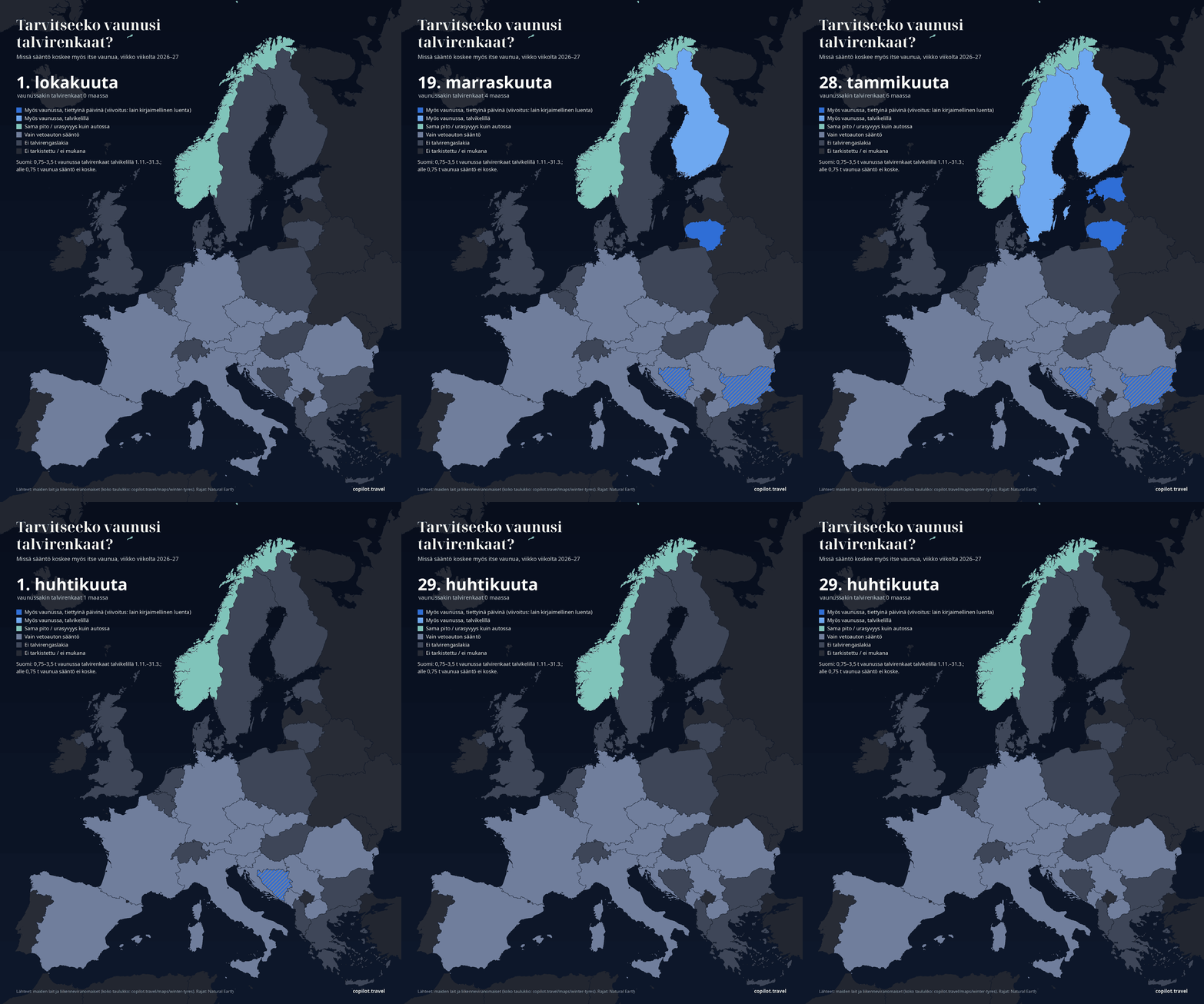
Made in October 2026. Each country's rule was read from its own law or transport authority on 24–25 Oct 2026; every source is linked in the full table: https://copilot.travel/maps/winter-tyres

A few things that surprised me:

  • Estonia requires winter tyres 1 Dec–1 Mar whatever the weather; Finland 1 Nov–31 Mar only when conditions require.

  • Germany only accepts tyres with the snowflake (3PMSF) mark in wintry conditions; old M+S-only tyres no longer count.

  • Caravans need winter tyres too in Finland, Sweden, Estonia and Lithuania; in Germany, Austria and France the rule only covers the towing car.

[-] Heikki@sopuli.xyz 6 points 4 days ago

Data: drive times computed on the OpenStreetMap road network (roads and ferries © OpenStreetMap contributors); coastlines and borders: Natural Earth.

Tools: Python (NumPy, Pillow) for the drawing, ffmpeg for the GIF. Method: for each of 38 capitals, the drive time to every point on the road network, non-stop at typical road speeds with no traffic;

Ferries at their sailing time with no waiting. Each spot is coloured by the capital whose car arrives first. Equal-area projection, so the territory sizes are true km².

Grey: not in the race (Iceland, Malta, Cyprus, Ukraine, Moldova, Belarus, Russia, Turkey). Dark: no car within 18 hours. Some results: Berlin's car reaches only 37 % of Germany first; Liechtenstein's car reaches Zürich in about an hour, before Bern's;

Monaco's car claims about 94 500 km², roughly Portugal; Dublin's car takes the Belfast ferry and wins south-west Scotland.

2
5
submitted 4 days ago by Heikki@sopuli.xyz to c/suomi@sopuli.xyz

Tein kartan talvirengassäännöistä Euroopassa lokakuusta huhtikuuhun. Jokainen sääntö on luettu maan omasta laista tai liikenneviranomaisen sivulta.

  • Suomi: talvirenkaat 1.11.–31.3., jos sää tai keli vaatii (Traficom). Kitkarenkaissa lumihiutalemerkki (3PMSF) 1.12.2024 alkaen.

  • Viro 1.12.–1.3. kelistä riippumatta, Ruotsi 1.12.–31.3. talvikelillä, Saksa aina liukkaalla – ja siellä kelpaa vain lumihiutalemerkitty rengas.

  • Vaunussakin talvirenkaat: Suomi (0,75–3,5 t), Ruotsi, Viro, Liettua.

  • Puolassa enintään 3,5 tonnin auto vaunun kanssa ei 21.9.2026 alkaen enää maksa e-TOLL-maksua.

Asuntovaunut : https://copilot.travel/maps/winter-tyres/vaunun-talvirenkaat.gif

Koko taulukko lähteineen: https://copilot.travel/maps/winter-tyres

Heikki

0 post score
0 comment score
joined 4 days ago